














































This report was produced by The Hechinger Report, a nonprofit, independent news organization focused on inequality and innovation in education.
MINNEAPOLIS — On a frigid February afternoon at a Spanish-immersion child care center, the ritual of dismissal looks deceptively ordinary. Toddlers scramble for puffy coats in colorful cubbies, while parents struggle to fasten mittens and secure hats against the biting Minnesota chill. But in a cramped office down the hall, the atmosphere is electric with tension. Michael, the husband of the center’s director, sits hunched over a computer monitor, his eyes scanning a live feed from the building’s security cameras. He is not looking for intruders in the traditional sense; he is searching for the telltale signs of federal vehicles—the unmarked vans and tactical gear that have come to define the local landscape since January.
Since the launch of "Operation Metro Surge," a federal immigration enforcement initiative, the center has been forced to transform its daily operations into a clandestine logistics mission. To keep their doors open and their staff safe, they have relied on an unlikely band of volunteers: a group of retirees, mostly in their 70s, who have become a lifeline for immigrant employees living in fear of deportation.
The Chronology of a Crisis
The shadow currently hanging over Minneapolis child care providers began to lengthen in November, when whispers of widespread detentions—including those of individuals with legal status—began to circulate through immigrant communities.
The situation deteriorated rapidly on December 26, when Nick Shirley, a right-wing social media influencer, published a viral YouTube video alleging massive fraud within Somali-run daycares in Minneapolis. The video, which made sweeping, largely debunked claims that these facilities were collecting government subsidies while providing no actual care, struck a nerve in the national political discourse. The video was amplified by high-profile figures, including Vice President JD Vance and Attorney General Pam Bondi.
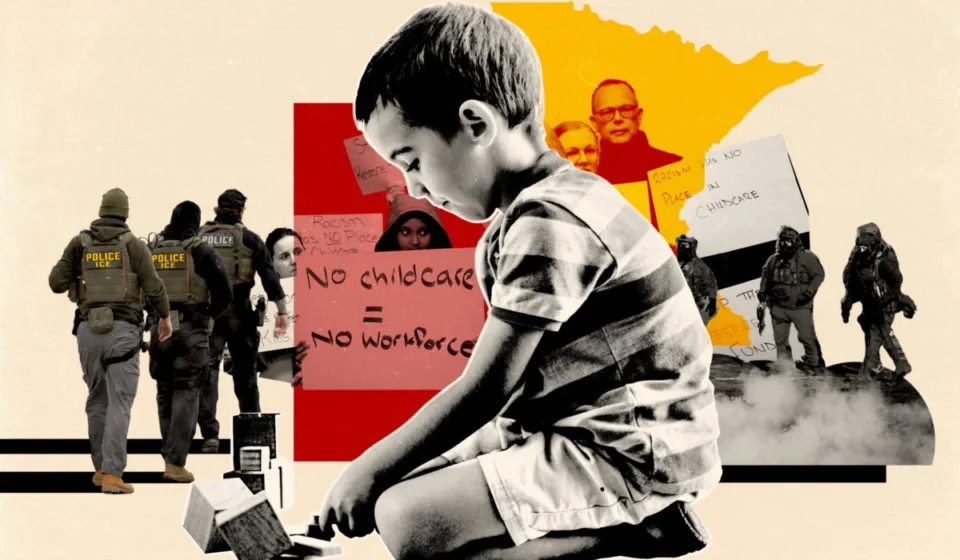
By January 5, the Trump administration leveraged the viral claims to justify a massive escalation of immigration enforcement. They announced the deployment of 2,000 additional ICE and Border Patrol agents to Minnesota under Operation Metro Surge, bringing the total federal presence to approximately 3,000 officers—a force roughly three times the size of the combined police departments of Minneapolis and St. Paul.
The volatility peaked on January 7, when an ICE agent shot and killed a volunteer observer, Renee Macklin Good. The tragedy sent a shockwave of terror through the immigrant community. In the days following, the child care center was forced to shutter its doors for six days as the staff, paralyzed by fear, stayed home. Enrollment plummeted as families withdrew 12 children, forcing the director to implement layoffs just to keep the business solvent.
The "Abuelitas" and the Mechanics of Mutual Aid
In the absence of support from government entities, the center turned to a network of volunteers. These individuals, whom staff affectionately dubbed the abuelitas, stepped into a role that few of them ever expected to play. With some 60 volunteers participating in rotating shifts, they began the daily, time-consuming grind of escorting staff members to and from their homes across the city.
Sarah, a 71-year-old volunteer, encapsulates the quiet resolve of this movement. "I’m just doing what I can do," she says, noting that her demographic profile provides a layer of protection that her immigrant colleagues lack. "I’m white, I’m 71. I think I would not be treated like she might be treated."
The protocol is rigorous. Drivers are coached to keep windows cracked, avoid confrontation, and demand to see a warrant signed by a judge. Sarah routinely disables her smartphone’s location services before driving, a small but necessary precaution in an age of digital surveillance.
The bond between the drivers and the staff has grown despite significant language barriers. For the 30-minute drives, silence often fills the car, yet the protection is absolute. "We’ve kind of adopted her," Sarah says of the teacher she transports. "We really want to protect her."
Supporting Data: The Fragility of the Child Care Sector
The crisis in Minnesota is a microcosm of a larger, national vulnerability. According to data from the American Immigration Council, one in five child care workers in the United States is an immigrant. As these enforcement actions continue, the impact on the child care infrastructure is becoming increasingly clear.

The financial fallout of the political firestorm was immediate. Following the allegations of fraud, the federal government froze child care payments to Minnesota, threatening to destabilize the care for an estimated 23,000 children in the state. While a federal judge ordered these funds unfrozen in February pending a legal challenge, the damage to the reputation and operational stability of these centers remains profound.
The stress is not just financial; it is existential. Directors have reported receiving threatening, anonymous phone calls—some suggesting that staff "are not safe" and should leave the country. Others have faced harassment from social media agitators appearing on-site to record children and staff, leading to a climate where simple tasks, like going to the grocery store or attending a holiday party, are viewed as high-risk activities.
Official Responses and Political Rhetoric
The federal government’s justification for Operation Metro Surge rests on the premise of cracking down on fraud. However, local investigations by reporters have repeatedly found that the centers targeted by influencers were, in fact, operating in compliance with regulations.
Attorney General Pam Bondi and the Trump administration have framed the surge as a necessary measure to protect taxpayer money. Yet, for those on the ground, the rhetoric feels less like a pursuit of fiscal responsibility and more like a targeted campaign against vulnerable populations.
"It’s both really amazing to see the way that people are sticking up for their neighbors and supporting them, and then it also kind of feels bleak realizing that there isn’t going to be some saving entity coming," says Lily Crooks, a St. Paul child care director. Her center took the proactive step of raising $5,000 for Lyft gift cards, allowing parents and staff to avoid public transportation, where ICE agents have been known to conduct stops.
The Long-Term Implications: A Call to Resistir
As spring approaches, Operation Metro Surge is reportedly winding down, though the situation remains precarious. Reports indicate that ICE agents have shifted tactics, becoming more stealthy and moving operations into suburban areas to avoid the high-visibility scrutiny of the urban core.
For the staff at the Minneapolis center, the path forward is one of endurance. By early March, most employees felt comfortable enough to resume driving themselves, though the trauma of the winter remains. P., one of the staff members who relied on the volunteers, continues to find herself in a state of hyper-vigilance.
"It’s not OK that someone feels unsafe in a safe country," she says. Despite the fear, she refuses to walk away. "I need a job. It’s not possible to stop for me. We have to try and just do it. We have to survive. We have to resistir."
Diana, the center’s director, finds strength in that word. In Spanish, resistencia implies more than just holding one’s ground; it is a blend of resistance and endurance—a commitment to keep fighting even when the outcome is uncertain.
As the volunteer networks look toward the future, there is a lingering anxiety about sustainability. Can these networks continue to function if the political environment continues to shift? Are these efforts a permanent fix or a temporary bandage on a systemic wound?
For now, the focus remains on the children. The center continues to operate, the cubbies are filled, and the staff continues to show up. In a landscape defined by fear, the most radical act has become the simplest one: continuing to provide care in a community that is fighting, day by day, to keep its doors open. As the volunteers continue to drive their routes, they carry with them the weight of a generation standing against what they perceive as profound oppression, reminding us that in the absence of institutional support, the survival of the community rests entirely on the shoulders of its neighbors.