

























































This week, the Minneapolis cultural landscape is defined by two monumental 20th-century works, reimagined for the contemporary era. At Orchestra Hall, the Minnesota Orchestra is launching its ambitious “Sound Unbound” series by pairing Igor Stravinsky’s seminal The Firebird with cutting-edge video mapping technology. Simultaneously, across downtown at the Guthrie Theater, director Joseph Haj is breathing urgent, modern life into Samuel Beckett’s Waiting for Godot. Together, these productions offer a profound reflection on how we consume classical art in an age of hyper-saturation and existential uncertainty.
The Minnesota Orchestra: Stravinsky in a Digital Age
Main Facts and the Visionary Canvas
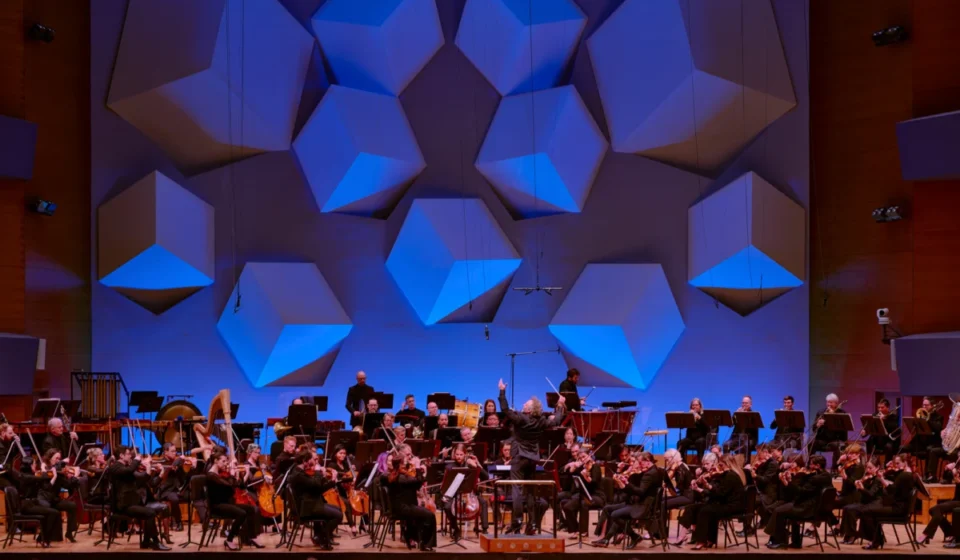
The iconic, modular acoustic cubes that define the architecture of Minnesota’s Orchestra Hall are undergoing a transformation. For the season-opening performance, the orchestra has invited BAFTA-winning designer Tal Rosner to utilize these ceiling and wall-mounted structures as a high-tech canvas. Using the precise technique of video mapping, Rosner is projecting a fluid, visual landscape that synchronizes with the orchestra’s performance of Igor Stravinsky’s 1910 masterpiece, The Firebird.
The performance is the inaugural entry in the orchestra’s “Sound Unbound” series, a multi-year initiative designed to forge deeper connections between orchestral music and the visual arts. By integrating light and motion, the orchestra seeks to bridge the gap between traditional concert-going and the immersive, digital-first experiences favored by modern audiences.
Chronology and Historical Context
The Firebird occupies a unique space in music history. Commissioned for Sergei Diaghilev’s Ballets Russes in Paris, it featured dancers from St. Petersburg’s Imperial Ballet and served as a catalyst for the modernist movement. It was the "big bang" of Stravinsky’s career, laying the groundwork for the more radical, riot-inducing The Rite of Spring three years later.
Rosner’s design respects this history while stripping away literalism. He navigates the folklore of Prince Ivan’s struggle against the sorcerer Koschei and his interaction with the 12 princesses not through representational imagery, but through evocative, rhythmic metaphors. “I don’t show the princesses,” Rosner explains. “The princesses are represented by golden ribbons.” This approach allows the visual design to mirror the complexity of the score, ensuring the audience is not distracted by literal storytelling but is instead enveloped by the emotional arc of the composition.
Implications of Collaborative Design
Rosner, whose background spans from a dream of working in MTV graphics to high-end theater production, emphasizes that working with a full orchestra is a unique challenge. Unlike smaller stage sets, the concert hall provides a massive, “blank slate” canvas.
Crucially, the success of this production relies on a shift in artistic philosophy. Rosner notes that his maturity as a designer has moved away from individual ego—the "look at me" phase—toward a holistic, team-oriented approach. He is working in lockstep with the Minnesota Orchestra’s in-house lighting crew to ensure the visual cues—the "ups and downs" of the performance—are surgically precise. The cubes, which he calls a "serendipitous" constraint, forced a design process that is non-transferable; the specific geometry of Orchestra Hall makes this visual performance an experience that cannot be replicated anywhere else on earth.
The Guthrie Theater: Beckett and the End-Times
The Relevancy of Waiting for Godot
While the orchestra explores the interplay of light and sound, the Guthrie Theater is delving into the depths of human silence. Director Joseph Haj’s staging of Samuel Beckett’s 1953 existential masterpiece, Waiting for Godot, arrives at a moment when the play’s core themes—hopelessness, persistence, and the fear of the unknown—feel more resonant than ever.
Beckett famously wrote the play in the aftermath of the Second World War, drawing from his own experiences in the French Resistance. Today, as contemporary society grapples with what critics like Naomi Klein describe as "end-times fascism," the image of two men waiting for an entity that never arrives carries a chilling, contemporary weight. Haj’s production asks the audience: how do we maintain our humanity when the world around us appears to be collapsing?
Supporting Data and Performance Analysis
The production is anchored by the performances of David Strathairn as Vladimir and Jimmy Kieffer as Estragon. Despite the rigidity of Beckett’s stage directions—which leave almost no room for improvisation regarding pauses and silence—the actors find a magnetic, rhythmic chemistry.
- The Cast:
- David Strathairn: Bringing a veteran’s gravitas, Strathairn excels in the second act, capturing the palpable "ache" of existential plight.
- Jimmy Kieffer: Providing a necessary counterweight, Kieffer leans into the role’s innate, comedic vulnerability.
- William Sturdivant & Jim Lichtscheidl: Sturdivant navigates the duality of Pozzo’s cruelty and pomp, while Lichtscheidl delivers a tour-de-force performance of Lucky’s famously incomprehensible, frantic monologue.
The production is further bolstered by the sound design of Darron L. West, whose work creates an atmosphere of terrifying immediacy. The soundscapes serve to emphasize the isolation of the characters, forcing the audience to sit with the discomfort of the play’s minimalism.
Synthesis: Why These Innovations Matter
The Art of Disquiet
Both the Minnesota Orchestra and the Guthrie Theater are taking risks this season. Whether it is the bold, visual-mapping of The Firebird or the stark, minimalist despair of Waiting for Godot, both institutions are pushing back against the idea that the arts should be purely decorative. Instead, they are positioning art as a mechanism for communal reflection.
The "Sound Unbound" series at the Orchestra acknowledges that music in the 21st century is rarely consumed in a vacuum. By using technology to interpret the music, the orchestra is inviting a new generation of listeners to engage with Stravinsky’s complex rhythms. Conversely, the Guthrie’s production of Godot reminds us that the classics are not static museum pieces; they are living, breathing entities that change meaning depending on the political and social climate of the moment.
Official Performance Information
Minnesota Orchestra: The Firebird & Works by Walker and Prokofiev
- Conductor: Thomas Søndergård
- Soloist: Vadym Kholodenko (Piano)
- Dates: Friday, Sept. 25 (8 p.m.); Saturday, Sept. 26 (7 p.m.)
- Location: Orchestra Hall, 1111 Nicollet Mall, Minneapolis
- Pricing: $64–$159
Guthrie Theater: Waiting for Godot
- Director: Joseph Haj
- Dates: Runs through Oct. 11, with various afternoon and evening showtimes.
- Location: The Guthrie Theater, Minneapolis
- Pricing: $25–$91
Conclusion: A Week of Cultural Resonance
As Minneapolis audiences navigate the late September calendar, they are presented with a unique juxtaposition. They can choose to witness the height of orchestral innovation, where light is used to map the sonic landscape of Stravinsky’s genius, or they can step into the Guthrie to confront the silence of Beckett’s void.
In both instances, the message is clear: the arts in Minneapolis are not merely surviving; they are evolving. By embracing both the high-tech, sensory-heavy future of the concert hall and the stripped-back, philosophical intensity of the theater, the city’s cultural institutions are proving that they remain essential venues for the most pressing conversations of our time. Whether through the visual brilliance of the Firebird or the existential longing of Vladimir and Estragon, the message to the public is the same: show up, pay attention, and prepare to be moved.