


















































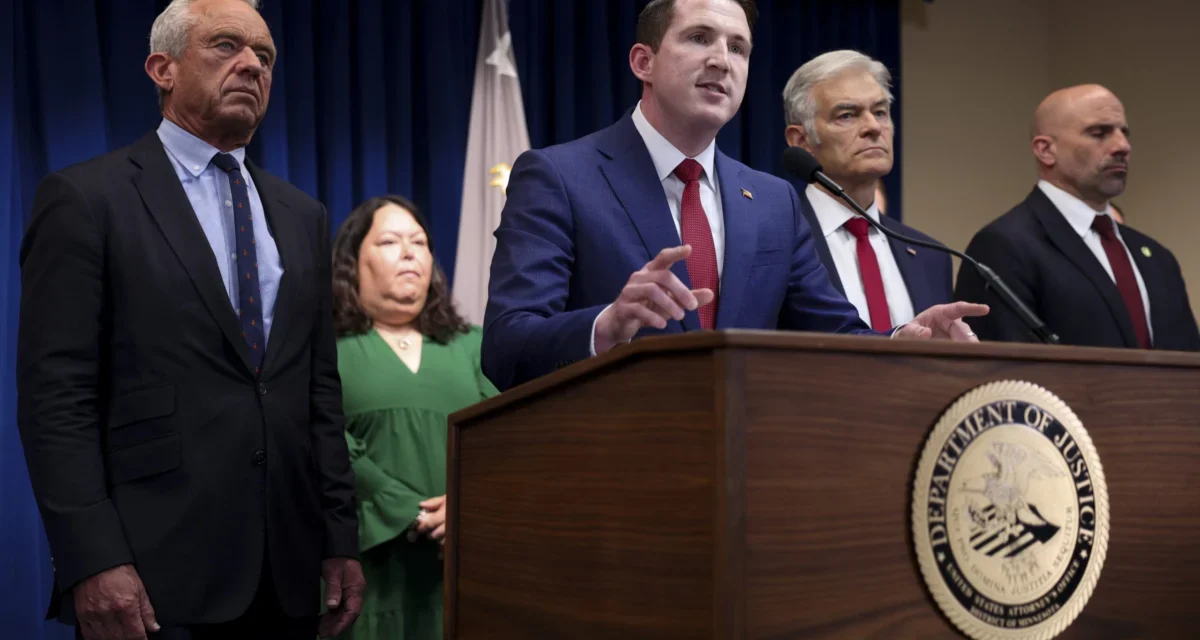





As the 2026 midterm elections approach, the American political landscape is bracing for a familiar, yet fundamentally transformed, clash over healthcare. While rising premiums and access to affordable care have historically dominated the discourse, a strategic pivot has emerged within the Republican platform: a laser-focused, aggressive campaign against alleged fraud in federal health programs.
This shifting narrative, spearheaded by the Trump administration, is being deployed not merely as an administrative cleanup effort, but as a potent political instrument. By framing the reduction of federal health spending as a crusade against "waste, fraud, and abuse," the GOP is attempting to neutralize Democratic attacks regarding cuts to Medicaid and the Affordable Care Act (ACA). However, the strategy has ignited a firestorm of controversy, raising deep questions about the integrity of the evidence being used, the potential for collateral damage among vulnerable populations, and the political motivations behind the crackdown.
The Strategy: Framing the Debate
For years, the Republican party has faced electoral vulnerability for its efforts to shrink the federal footprint in healthcare. Analysts note that emphasizing fraud allows the GOP to seize the moral high ground.
“Going after fraud gives Republicans a healthcare message when they would otherwise just be defending cuts to Medicaid and the Affordable Care Act,” explains Larry Levitt, executive vice president for health policy at KFF. By reframing fiscal austerity as a “safeguard for taxpayer dollars,” Republican candidates are effectively attempting to blunt the traditional Democratic advantage on healthcare policy.
Recent polling data suggests the strategy is gaining traction, particularly among the GOP base. A mid-September KFF poll revealed that 54% of Republican voters consider fraud in government programs an "extremely important" issue for candidates to address. Among rural Republican voters, it ranks as the top healthcare concern, indicating that the administration’s messaging is resonating where it matters most for the upcoming contests.
A Chronology of the Crackdown
The administration’s anti-fraud campaign has been characterized by a rapid succession of investigations, funding freezes, and policy shifts.
- Early 2026: The Government Accountability Office (GAO) issues a report warning that the sheer scale of Medicare payments creates significant fraud risks. Simultaneously, GAO investigators successfully obtain subsidized ACA insurance for fictitious enrollees, providing the administration with a narrative hook.
- Spring 2026: The Department of Health and Human Services (HHS) begins an audit of state Medicaid fraud units. The administration announces the withholding of billions in federal Medicaid payments to states like Minnesota and California, citing "lax oversight."
- June 2026: The Trump administration charges hundreds of individuals, including physicians, in major billing schemes, creating a high-profile series of indictments to bolster their anti-fraud credentials.
- August 2026: CMS Administrator Mehmet Oz announces the cancellation of ACA enrollments for 760,000 people, claiming they were “phantom consumers.”
- October 2026: President Trump calls on Congress to enact mandatory prison terms for healthcare fraud, aiming to remove judicial discretion and probation as options for convicted offenders.
The Data: Substance or Spectacle?
The core of the dispute lies in the interpretation of data. The administration, led by CMS Administrator Mehmet Oz, points to the fact that nearly 35% of individuals on the ACA marketplace have never used their insurance—no prescriptions filled, no doctor visits—as prima facie evidence of systemic fraud.
“That just is not possible,” Oz stated during a recent press event. “So we know there is fraud.”
However, public health experts and Democratic analysts argue this is a fundamental misunderstanding of health insurance behavior. They point out that younger, healthier individuals often purchase coverage as a safety net and may not require immediate care. Furthermore, the absence of a Social Security number—another metric the administration uses to flag fraudulent applications—is often a bureaucratic quirk, such as in the case of newborns who have not yet been assigned a number but are eligible for coverage.
The administration’s data-driven approach suffered a notable setback in New York. CMS initially alleged that 5 million people had received personal care services, which would have represented an impossible three-quarters of the state’s entire Medicaid population. After the claim was publicized, the agency admitted it had misread its own billing codes, later conceding the actual number was closer to 450,000. Despite this, the federal government maintained its posture of scrutiny, eventually suspending funding for the state’s fraud unit.
Official Responses and Political Implications
The political divide is stark. Democrats characterize the crackdown as a cynical, partisan effort to dismantle the social safety net. Rep. Melanie Stansbury (D-N.M.) has been a vocal critic, arguing that the administration’s policies are a pretext for stripping healthcare from vulnerable Americans.
Conversely, conservative policy experts, such as Brian Blase of the Paragon Health Institute, argue that critics are either willfully ignorant or politically motivated. “Those criticizing the action either don’t understand it or see some political advantage in mischaracterizing it,” Blase said, maintaining that the administration has implemented rigorous safeguards to protect legitimate coverage.
The inconsistency of the administration’s actions has further fueled the debate. Critics point out that while the White House talks of a “zero tolerance” policy, it simultaneously recertified hundreds of insurance brokers previously suspended for fraud and laid off 200 CMS staff members responsible for regional marketplace oversight. Furthermore, President Trump’s history of pardoning healthcare executives convicted of multi-million-dollar fraud schemes—including a nursing home operator and several Medicaid billing conspirators—has drawn sharp rebukes from organizations like the National Health Care Anti-Fraud Association.
The Collateral Damage
The real-world implications of these policies are beginning to ripple through the electoral map. Because ACA enrollees are highly concentrated in states like Florida and Texas—both of which have delivered for Republicans in the past—the threat of widespread, erroneous disenrollment could create a significant political backlash.
If legitimate consumers are swept up in the administration’s "phantom account" purge, the optics for the GOP could turn negative just as voters head to the polls. Advocacy groups like Families USA warn that the crusade against fraud is being used to mask the impact of broader legislative cuts. Legislation enacted last year is projected to reduce federal Medicaid spending by hundreds of billions over the next decade, and the expiration of enhanced ACA subsidies at the end of 2025 has already seen millions drop off the rolls.
According to a Congressional Budget Office (CBO) analysis, the cumulative effect of these GOP-led changes could result in 16 million additional uninsured Americans by 2034. For Democrats, this provides a clear counter-narrative: while Republicans talk about "stopping fraud," they are simultaneously overseeing a decline in national health coverage.
Conclusion: A High-Stakes Gamble
The fight over healthcare fraud is more than a technical dispute over billing accuracy; it is a battle for the soul of the 2026 midterm message. By elevating technical audits to the level of a national crusade, the Trump administration has successfully moved the goalposts of the healthcare debate.
Whether this strategy will be viewed by voters as a necessary act of fiscal responsibility or a dangerous attempt to weaken public health remains to be seen. As the election nears, the administration’s "fraud-first" agenda continues to collide with the reality of millions of Americans who rely on these programs for their physical and financial well-being. The result will likely hinge on whether the electorate trusts the administration’s statistics on fraud more than they fear the loss of their own access to care. In this high-stakes political theater, the margin for error is razor-thin, and the consequences for the American healthcare system are profound.