











































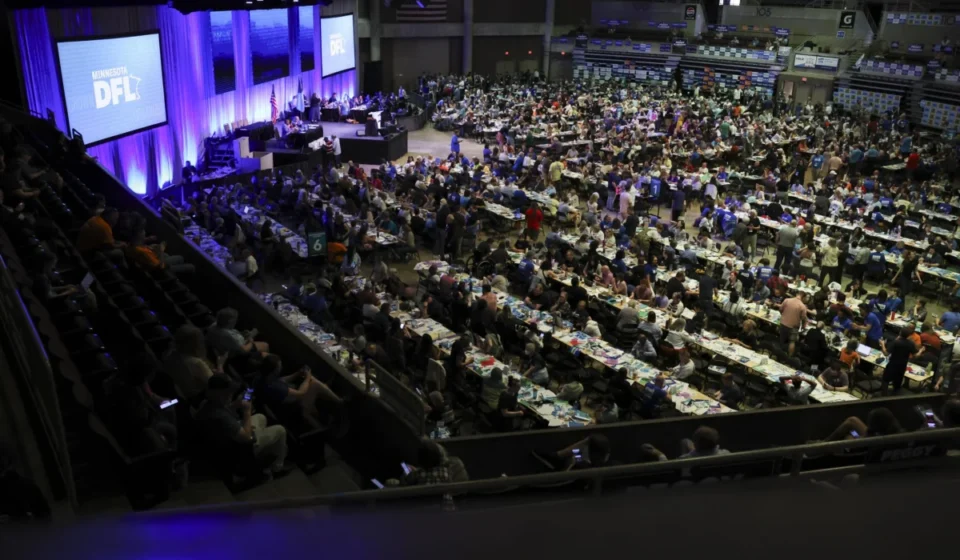

ROCHESTER, MN – May 30, 2026 – The Minnesota Democratic-Farmer-Labor (DFL) Party’s State Convention, held this past weekend at the Mayo Convention Center in Rochester, culminated in decisive endorsements for seasoned politicians Senator Amy Klobuchar for Governor and Lieutenant Governor Peggy Flanagan for U.S. Senate. However, the convention was far from a mere coronation, marked instead by an unexpected, spirited challenge from a progressive newcomer and a palpable undercurrent of internal party dynamics, from rural economic anxieties to the evolving demands of its urban base.
While the Republican Party held its own gubernatorial endorsement in Duluth, the DFL convention in Rochester was initially anticipated to be a largely predictable affair, particularly after Congresswoman Angie Craig announced she would not seek the party’s endorsement for the open U.S. Senate seat. Yet, the Friday evening proceedings were dramatically enlivened by Kobey Layne, a 26-year-old DFL delegate whose passionate, policy-driven address captivated many, injecting a much-needed jolt of energy into a convention often bogged down by procedural minutiae and the mundane. Layne’s audacious bid for the gubernatorial endorsement against a formidable incumbent like Klobuchar became the weekend’s most riveting episode, sparking conversations about the party’s future direction and the balance between electability and ideological fervor.
The Unforgettable Friday: Layne’s Challenge to Klobuchar
The DFL State Convention officially kicked off on Friday, May 29, 2026, with delegates from across Minnesota converging on the Mayo Convention Center. The atmosphere, initially a blend of anticipation and routine political gathering, took an unexpected turn as the evening progressed.
The Emergence of a Progressive Voice
Kobey Layne, a relatively unknown figure in statewide politics, garnered enough delegate support to earn a coveted 15-minute speaking slot, a significant achievement requiring 10% support from the over 1,200 voting delegates, plus at least 12 votes from each of Minnesota’s eight Congressional delegations. Layne’s campaign, described as a "quixotic quest" by some, quickly distinguished itself with its raw energy and commitment to specific policy objectives.
Layne, a University of Minnesota public policy master’s graduate, brought a unique background to the podium. Her political journey had seen her transition from a legislative assistant for moderate Republican Jim Abeler of Anoka to a progressive DFL advocate. This shift, she explained in an interview, coincided with a personal transition to identifying as female after previously identifying as a gay man, marking a profound evolution in her political and personal identity. Currently an assistant manager at the cosmetics company Aveda, Layne represents a new generation of activists seeking to reshape the political landscape.
As Klobuchar’s nomination for the gubernatorial endorsement was presented late Friday night, reviving a convention audience weary from procedural motions and a perceived lack of adequate food options, chants of "Let her speak!" erupted, signaling the delegates’ eagerness to hear Layne.

A Convention’s Unexpected Drama: The Strobe Light Debacle
Before Layne and Klobuchar could deliver their addresses, an unforeseen delay gripped the proceedings. Klobuchar’s campaign, in what seemed an innocuous attempt to energize her supporters, had distributed strobe lights to delegates. This seemingly minor decision quickly escalated into a chaotic procedural dispute. A visibly weary State Senator Scott Dibble of Minneapolis issued a stern warning: "The strobe lights need to be turned off. No strobe lights."
However, his plea was largely ignored, leading to frustrated delegates taking to the microphone to blast Dibble’s "milquetoast" stance and demand the immediate confiscation of the glowing wands. This unusual interlude underscored the unpredictable nature of live political conventions and highlighted a serious, albeit niche, concern: a tiny portion of the population diagnosed with photosensitive epilepsy could be susceptible to seizures due to intense flashing lights, a point later acknowledged by concerned delegates. The incident, while momentarily distracting, also served to heighten the drama before the candidates finally spoke.
Layne’s Vision vs. Klobuchar’s Experience
When Layne finally took the podium, she was a bundle of "jittery energy and concrete goals." Her high-velocity remarks blended economic and cultural issues, advocating for a bonding bill to integrate Minnesota’s clean energy goals and proposing a bold "capping rent increases across the state to 3%." She declared, with fingers pointing to her eyes and ears, "Politics is about policy, not personalities, not platitudes." This line resonated deeply, drawing "raucous applause" from a segment of the delegates who yearned for a focus beyond traditional political rhetoric. She also argued for a more substantive diversity, equity, and inclusion (DEI) statement for the DFL, asserting, "Just because we are not the Republican Party does not mean that our anti-racism work is done." Layne’s progressive platform and earnest delivery clearly moved many, as noted by delegate Laura Turman, who said, "Wonderful, it moved me, I felt it."
Following Layne, Senator Amy Klobuchar, who has represented Minnesota in the U.S. Senate for two decades, offered a stark contrast. Her speech emphasized her proven track record and electability, a cornerstone of her appeal to the broader electorate. Her declaration, "When you look at my track record, when I lead the ticket, we win," elicited a "much louder ovation," a testament to her established political capital and broad support within the party. Klobuchar played up her extensive appeal across the state, confidently asserting, "I think there are some counties where I have met nearly literally every person."
The divergence between the two candidates was further highlighted when Layne drew boos for announcing her intention to continue campaigning to the August primary even without the party’s endorsement. Klobuchar, on the other hand, committed to abiding by the endorsement, a traditional gesture of party unity.
The Digital Vote and Its Aftermath
As the convention moved into the endorsement vote, the transition to digital voting proved challenging for some delegates. Many delegates, metaphorically described as "your parents trying to use a QR code," descended upon a folding table promising IT support. Frequent reminders to hit the "submit" button after casting a vote underscored the technological hurdles.

The results, announced after 1 a.m., confirmed Klobuchar’s dominant position. She "sailed to the endorsement" with 68% of the vote, while Layne secured a respectable 28%. The remaining 4% voted "no endorsement."
Despite the numerical outcome, Layne’s impact was undeniable. Many delegates expressed admiration for her performance. Andrew Ulasich, a delegate from South Minneapolis, commented, "I really appreciated how specific she was at the things that she wanted to do." However, for many, Klobuchar’s "electability" and "competence" ultimately swayed their votes. Several delegates cited concerns about the leadership of outgoing Governor Tim Walz, who has "presided over fraud committed by social service providers," suggesting a desire for a "tighter ship" under Klobuchar.
When asked by media if she might incorporate some of Layne’s policy prescriptions into her platform, Klobuchar, still at the drawing board with her detailed policy rollout, responded, "I have so many ideas," mentioning housing, childcare, and healthcare as key areas. She added, "So, stay tuned. We’re going to release a lot more ideas." This suggests an openness to progressive ideas while maintaining her characteristic pragmatism.
The Saturday Coronation: Flanagan’s Path to the Senate
Saturday, May 30, 2026, presented a different tone. With the gubernatorial endorsement settled, the focus shifted to the U.S. Senate race, which saw Lieutenant Governor Peggy Flanagan endorsed as the party’s candidate.
Angie Craig’s Strategic Withdrawal
The path to endorsement for Flanagan was significantly cleared by Congresswoman Angie Craig’s decision to "no longer seek the endorsement" for the open U.S. Senate seat, vacated by the retiring Senator Tina Smith. Craig’s move, while simplifying the endorsement process, has complicated matters for the DFL in other ways. Don Slaten, a long-time DFL attendee from Hastings who has known Craig for 15 years, expressed consternation, stating, "I wanted her to stay in the House, because that will be a hard seat to keep."
Craig’s decision, while sacrificing the endorsement, is part of a "risky new strategy" aimed at stopping Flanagan’s momentum, indicating that Craig intends to challenge Flanagan in the August primary. This nuance is crucial; while Flanagan received the party’s official backing, the primary contest remains a significant battle. The DFL has already endorsed Matt Little, a former state senator, to replace Craig in the U.S. House, further illustrating the strategic ripple effects of Craig’s gambit.

Flanagan’s Historic Endorsement
Peggy Flanagan’s endorsement was, as anticipated, a "coronation party." If successful in the general election, she would make history as the first Native American woman elected to the U.S. Senate, a moment of profound significance for both Minnesota and national politics.
Addressing the question of why primary voters should care about a party endorsement, Flanagan emphasized the grassroots nature of the process: "The delegates who are here today, they represent the nearly 40,000 Minnesotans who went to the caucus on Feb. 3," during the height of "Operation Metro Surge." She eloquently described these delegates as "the heart of our party," underscoring the democratic legitimacy of the convention’s decisions.
The Enduring "F" in DFL: Rural Minnesota’s Critical Voice
Throughout the convention, a recurring refrain served as a constant reminder of the DFL’s roots and the critical importance of its rural base: "Remember, the F in DFL stands for farmer." While sometimes perceived as "reflexive pandering," this sentiment reflected genuine and pressing concerns from rural Minnesota, even as the state’s population continues to shift towards its metro areas.
Farmers on the Brink
Mary Sullivan of the DFL’s rural caucus, who, with her husband, has presided over a livestock farm near Redwood Falls since 1980, painted a stark picture of economic hardship. She detailed how "tariffs and the war in Iran" have led to "skyrocketing costs for fertilizer and fuel for tractors," among other price hikes. Sullivan likened the current economic situation to the infamous "farm crisis of the mid-1980s," a period of severe financial distress for American agriculture. This firsthand account highlighted the tangible impact of global events on local communities and the urgent need for political solutions.
Opportunity in Crisis?
The economic woes facing rural Minnesota present both a challenge and a potential "opportunity for Democrats," as one might awkwardly paraphrase Rahm Emanuel. Don Slaten noted that in areas like Hastings, many voters are "conservative Catholics driven by their views on guns, gay people and abortion." However, he mused, "If what Trump has done to farmers doesn’t get them voting DFL, I don’t know what can." This observation suggests a potential pathway for the DFL to bridge ideological divides by focusing on economic issues that transcend traditional cultural wedge issues, particularly in areas feeling the pinch of national and international policies. The ability of the DFL to genuinely address these rural concerns will be pivotal in maintaining and expanding its statewide appeal.
Implications for the DFL and Minnesota’s Political Future
The 2026 DFL State Convention offered a microcosm of the party’s ongoing evolution and internal tensions.

For Amy Klobuchar: The endorsement solidifies her position as the DFL’s leading gubernatorial candidate, leveraging her established brand of electability and competence. Her victory against an energetic progressive challenge demonstrates the party’s pragmatic bent, prioritizing a proven winner for the general election. However, Layne’s strong showing and the positive delegate feedback on her specific policy proposals indicate a growing appetite within the DFL for more ambitious, progressive policy platforms. Klobuchar’s commitment to release more detailed policy ideas suggests she may incorporate some of these progressive themes to energize her base while maintaining her broad appeal. The emphasis on her ability to "run a tighter ship" than the outgoing Governor Walz also hints at a campaign strategy focused on effective governance and accountability.
For Kobey Layne: Despite not securing the endorsement, Layne emerged as a significant new voice within the DFL. Her performance captivated many, demonstrating that there is a passionate and growing segment of the party eager for bold, specific policy solutions and a deeper commitment to anti-racism and social justice. Her decision to continue campaigning to the primary, despite the boos, signals a long-term commitment to advocating for her vision. Layne’s journey, from a legislative assistant for a Republican to a progressive DFL candidate and her personal transition, offers a compelling narrative that could resonate with younger and more diverse voters, positioning her as a potential future leader in Minnesota’s progressive movement.
For Peggy Flanagan: The endorsement positions Flanagan as the official DFL standard-bearer for the U.S. Senate, a significant step towards a potentially historic election as the first Native American woman in the chamber. Her emphasis on the delegates as "the heart of our party" reinforces the grassroots foundation of her campaign. However, the shadow of Angie Craig’s primary challenge looms large. While Craig is not seeking the endorsement, her continued presence in the primary race means Flanagan cannot afford to rest on her laurels and must actively campaign to consolidate support and unite the party before the general election. The DFL’s endorsement of Matt Little for Craig’s House seat also highlights the intricate strategic calculations involved in this high-stakes political chess game.
For the DFL Party: The convention underscored the ongoing tension between the party’s desire for pragmatic electability and its progressive aspirations. It highlighted the challenge of balancing the demands of an increasingly urban and diverse base with the economic anxieties of its traditional rural constituents. The "F in DFL" mantra, coupled with the stark realities faced by farmers, demonstrates the critical need for the party to develop comprehensive policies that address rural concerns and prevent further erosion of support in these areas. The DFL must navigate these internal dynamics effectively to present a united front in the upcoming general election, facing a GOP that secured its own gubernatorial endorsement in Duluth, setting the stage for a compelling statewide contest.
The DFL Convention of 2026, though largely predictable in its ultimate endorsements, was nonetheless an eventful and revealing gathering, offering glimpses into the party’s evolving identity, the emergence of new voices, and the enduring challenges and opportunities that lie ahead for Minnesota’s dominant political force.