








































Beyond the Textbook: How a New "Climate Literacy Seal" is Transforming High School Education

In the shadow of Denver’s sprawling international airport, Anthony Muñoz spent his high school years looking upward. While many of his peers were concerned with standard curriculum, Muñoz found himself preoccupied by the faint, chemical scent of jet fuel and its potential impact on the local ecosystem. Today, that curiosity has evolved from a personal concern into a burgeoning national movement: the "Seal of Climate Literacy."
As climate change accelerates, altering everything from local weather patterns to the global economy, a growing number of U.S. states are rethinking how they prepare the next generation. By offering a formal endorsement on high school diplomas—akin to the Seal of Biliteracy—policymakers and educators hope to move climate education out of the abstract realm of textbooks and into the tangible, high-stakes arena of community action.
The Genesis of a Movement: From Colorado to the Nation
The initiative, pioneered by the Denver-based nonprofit Lyra Colorado, was born from a realization that rural students and educators felt disconnected from the high-level, often apocalyptic rhetoric surrounding climate change. They wanted a way to engage with the reality of their environment through a localized, practical lens.
"Rural students and educators told us they wanted to explore climate change as a reality in their daily lives, not just through a dense unit in a textbook," says Mary Seawell, CEO of Lyra Colorado.
The Colorado state legislature approved the seal in 2024, providing a blueprint that is now being exported across the country. To earn the endorsement, students must complete two advanced courses—one focused on earth systems and another in a discipline of their choosing, such as the humanities or fine arts—and execute a capstone project that addresses a climate-related issue in their local community. Since its inception, 26 of Colorado’s 179 school districts have adopted the program, with roughly 1,200 students receiving the distinction.
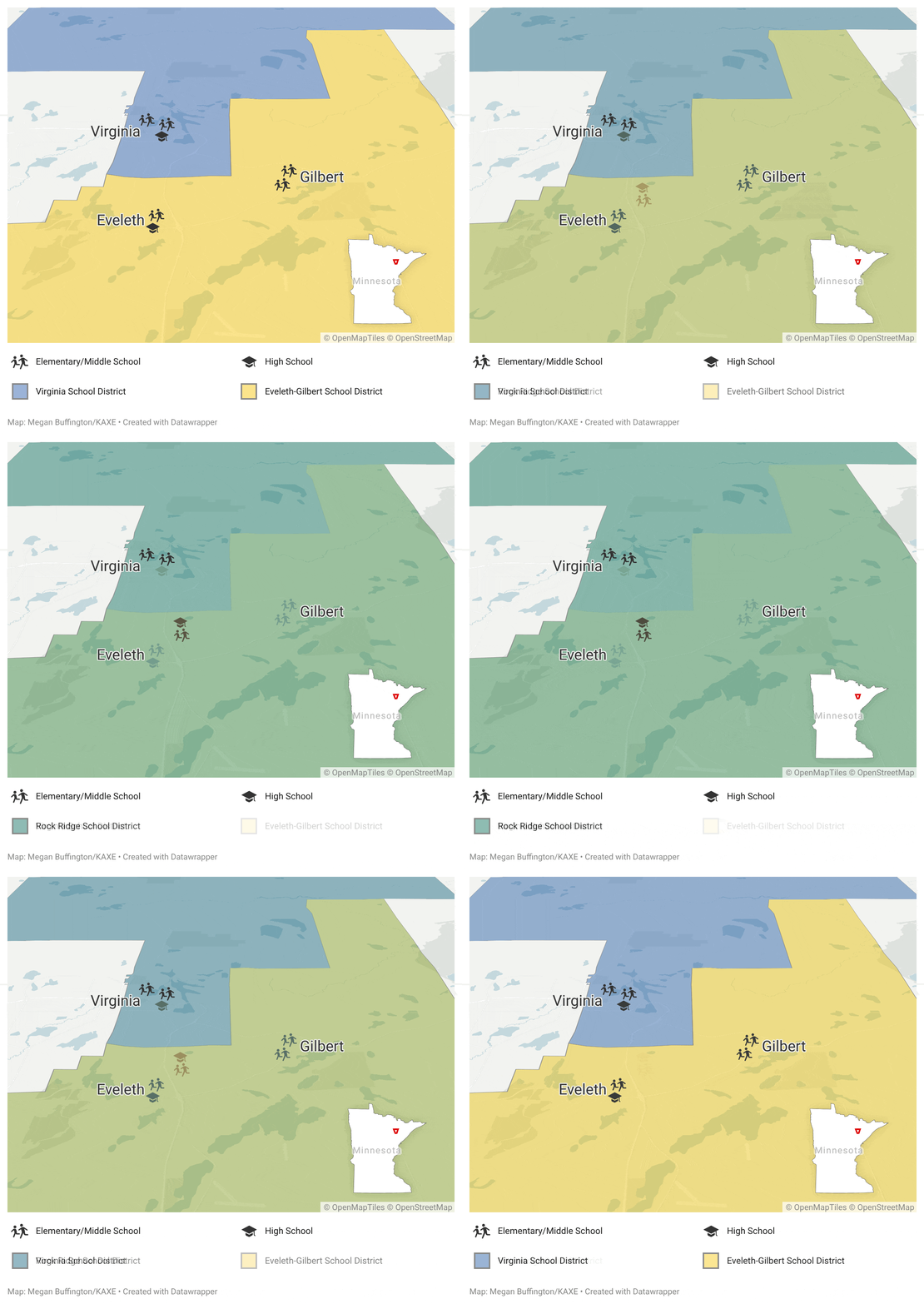
The momentum is undeniable. Maine has adopted its own version of the seal, and California recently signed into law a bill establishing a similar certification for its graduates. Meanwhile, youth-led coalitions are aggressively lobbying for the policy in states like Hawaii and Minnesota.
Bridging the Gap: The Mechanics of Climate Literacy
The seal is not merely a badge; it is a pedagogical shift. By requiring a community-based capstone, the program forces students to apply scientific principles to real-world problems.
For Anthony Muñoz, this meant partnering with the National Center for Atmospheric Research (NCAR) to build an "ozone garden" at his charter school, Vista Academy. By planting species sensitive to ground-level ozone, Muñoz and his peers could physically measure air quality through the condition of the leaves. This project allowed him to study monarch butterfly migration patterns and soil health, turning his campus into a living laboratory.
"One garden is a very good data source," Muñoz reflects. "Colorado is so beautiful, and I would hate to see it wilt away."
This approach addresses a critical flaw in traditional K-12 education: the lack of agency. Laura Schifter, a senior fellow with the Aspen Institute’s This is Planet Ed, notes that climate change is rarely covered in depth. "The seal offers students a chance to learn about a topic that is often ignored, and it provides a sense of agency," she says. "Where we can make the most difference is often in our local community."
The "Green" Workforce Pipeline
Proponents of the seal argue that it serves a secondary, vital function: economic preparation. As the global economy pivots toward sustainability, the demand for "green-collar" jobs is skyrocketing.
Lyra Colorado is currently working with higher education institutions, such as Colorado Mountain College, to align the high school seal with certifications in skilled trades. These include training for heat pump installation, solar grid maintenance, and sustainable agricultural management. The goal is to create a seamless transition from high school, where students gain foundational knowledge, to post-secondary programs or direct entry into the workforce.
In Maine, the program is already showing unexpected popularity. During a spring pilot across nine schools, state official Teddy Lyman anticipated a dozen applicants. Instead, 57 seniors applied. Melissa Luetje, a science teacher at Freeport High School, emphasizes that the program is tailored to local realities. Her students are not just studying global warming; they are developing ways to compost invasive crab species and managing sustainable fisheries in the Gulf of Maine, a region currently warming faster than almost any other body of water on Earth.
Official Responses and Political Hurdles
Despite the enthusiasm from educators and students, the seal has faced significant resistance. The primary challenges are financial; with school districts already struggling under tight budgets, the additional administrative burden of verifying projects and coordinating with nonprofits is a point of friction.
Moreover, the initiative has become a flashpoint in the broader American culture wars. Critics argue that the seal encourages activism rather than academic rigor. Lance Izumi, a senior director at the Pacific Research Institute, contends that the focus should remain on foundational science rather than community projects. "Diverting focus away from foundational science learning could worsen California’s already abysmal performance levels," Izumi wrote, citing low proficiency scores in standardized science testing.
Furthermore, the initiative faces an uncertain federal landscape. The Trump administration has historically been skeptical of climate initiatives, and recent efforts to curtail the funding of climate research—including proposed cuts to the National Center for Atmospheric Research—have created a climate of uncertainty for educational nonprofits. Mary Seawell admits that the political environment has created a "chilling effect" among potential philanthropic donors, who are increasingly wary of being targeted for supporting climate-related causes.
The Future: Empowerment Over Anxiety
For students like Rylan Neumann, a graduate of the Boulder Valley School District who now studies environmental economics at UC Berkeley, the seal was a catalyst for civic engagement. Upon entering college, Neumann immediately traveled to the state capitol to lobby for California’s climate seal bill. "Getting more students involved in climate action and how they’ll be impacted in the future is essential," she says. "Students are the future. We’re the ones growing up in this world."
The long-term success of the seal may depend on its ability to transcend politics by framing itself as a tool for empowerment. In Maine, officials have found that the seal serves as a buffer against "climate anxiety" by shifting the focus from global, systemic doom to local, manageable action.
"No more global doom and gloom," says Teddy Lyman. "Students can feel empowered to make a difference in their community. They’re not trying to solve something for the U.N. They’re advocating at their town committee instead."
As for Anthony Muñoz, now a sophomore studying mechanical engineering at the Colorado School of Mines, his commitment remains unshaken. He continues to volunteer at his high school, helping younger students maintain the garden he built. He is currently writing code to streamline data collection for the ozone garden, ensuring the project remains viable even if federal support for climate science continues to waver.
For Muñoz and his peers, the Seal of Climate Literacy is more than just a credential on a transcript. It is a declaration that they are not content to wait for political consensus. "Are you going to think beyond yourself and help not only those in need but the environment?" Muñoz asks. "Or will you sit back and wait for someone else to change the world for you?"
As more states consider adopting the model, the answer seems clear: a new generation of students is choosing to pick up the shovel, the sensor, and the advocacy work themselves, regardless of the political winds blowing in Washington.