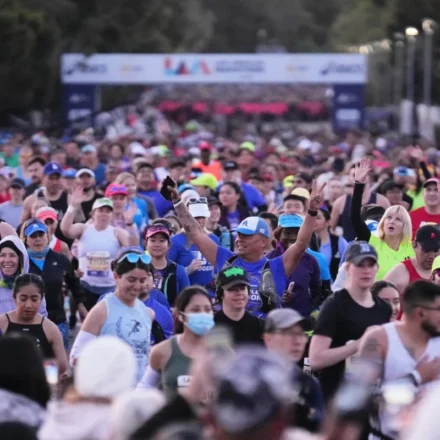




























































DES MOINES, Iowa — For Paul Grinvalds, the marathon is not just a test of endurance; it is a lifelong pursuit. Having completed 114 marathons across all 50 states, the 68-year-old West Des Moines resident is an authority on the physical and psychological toll of the 26.2-mile distance. Yet, even with decades of experience, Grinvalds admits he is no match for the changing climate. Like many seasoned runners, he finds his performance—and his safety—compromised when temperatures climb above 60 degrees Fahrenheit (15.5 degrees Celsius).
"One thing about marathoners is that we are, by nature, kind of stubborn," Grinvalds says, noting that he finds even temperatures in the 50s to be uncomfortably warm for peak performance. "If we have a goal and it’s hot, we are often going to try to push through it anyway. That’s a mistake. You are almost guaranteed a painful, dangerous experience."
Grinvalds’ sentiment captures a growing anxiety within the global running community. As climate change, driven by the combustion of fossil fuels, continues to drive global temperatures to record-breaking highs, the marathon—a sport historically defined by cool-weather competition—is being forced to evolve. From shifting race calendars to modifying course regulations, organizers are scrambling to ensure that the sport remains viable in a warming world.
The New Reality: A Chronology of Climate-Driven Disruptions
The transformation of the race calendar is no longer a theoretical exercise in long-term planning; it is an immediate operational necessity. The recent history of major marathons is marked by a series of weather-related cancellations and emergency pivots that have forced a re-evaluation of event scheduling.
The Twin Cities Marathon serves as a stark case study. For over four decades, the race was a fixture on the first Sunday in October. However, the 2023 edition was abruptly canceled due to record-shattering heat and humidity, followed by a 2025 race that saw starting temperatures hover near 70 degrees Fahrenheit. Recognizing that the old tradition was no longer compatible with modern weather patterns, organizers announced a permanent shift to later in October, starting in 2027.

"The cancellation was absolutely devastating for the runners, the city, and our organization," said Ed Whetham, the Twin Cities Marathon race director. After an exhaustive analysis of shifting weather patterns, the board concluded that while a later date might introduce the risk of cold or even snow, it was a necessary trade-off. "We’ll take a 39-degree (4-degree Celsius) start over a 70-degree start every time," Whetham noted.
The Twin Cities is not an outlier. In South Dakota, organizers of the Sioux Falls Marathon moved their annual event from August to September following the cancellation of the 2024 race due to oppressive heat. Similarly, marquee events such as the Air Force Marathon in Ohio, the Little Rock Marathon in Arkansas, and the Long Beach Marathon in California have all moved their start times to the early dawn hours, seeking to beat the heat before the sun hits its zenith.
The Physiology of Heat: Why Running is Harder in a Warming World
To understand why these changes are necessary, one must look at human physiology. Running is an intensely exothermic activity; only about 25% of the energy produced by a runner’s muscles is used for forward propulsion. The remaining 75% is converted into heat.
"As you get to warmer temperatures, you end up having a bigger competition between blood supplying your muscles to keep running and blood flow to your skin for thermal regulation," explains Dr. Chris Minson, a professor of human physiology at the University of Oregon.
In cool conditions, the body efficiently directs blood to the working muscles and the skin, where sweat can evaporate and cool the blood. However, when the ambient temperature rises, the body struggles to maintain this delicate balance. If the humidity is also high, the challenge becomes a crisis: sweat cannot evaporate, and the body’s core temperature rises, leading to heat exhaustion or, in severe cases, life-threatening heatstroke.

This physiological ceiling is exactly what prompted Los Angeles Marathon organizers to offer an "early finish" option this past March. Recognizing that the weather was unseasonably warm, officials allowed runners to stop at the 18-mile mark and still receive a finisher’s medal. While the move drew some criticism from traditionalists on social media, the data supported the decision: only 14 of the 27,000 participants required hospital treatment, and all were released by the end of the day.
"We welcome the feedback, but when we grade ourselves, it comes down to how safe our runners were on the day of the event," said Meg Treat, a spokesperson for the marathon. "We are very happy with the outcome."
Data and Trends: The Climate Forecast for Athletics
The necessity for these changes is backed by sobering meteorological data. The contiguous United States recently experienced its warmest July on record, and 2024 was globally the hottest year ever documented. The World Meteorological Organization forecasts that the Earth’s average global temperature is likely to rise by more than 1.5 degrees Celsius (2.7 degrees Fahrenheit) above pre-industrial levels between 2025 and 2030.
Climate Central, a non-profit research group, analyzed 221 races and found that the warming trend is actively degrading the conditions that have historically made marathons possible. According to their research, by 2045, "optimal" conditions for recreational runners—typically in the low 40s Fahrenheit—will become increasingly rare at 46 of the 51 major U.S. marathons analyzed.
"The ability to go outside, to exercise, to take advantage of your human body—that is something being challenged by climate change," says Andy Pershing, who led the Climate Central research.

This challenge extends far beyond the starting line of a 26.2-mile race. Jessica Murfree, who leads a laboratory at the University of North Carolina-Chapel Hill studying the intersection of climate change and sports, argues that the implications reach into every facet of physical activity.
"If we can’t walk, if we can’t exercise or go for runs because it’s too hot, we have to ask: can we still stay physically active while remaining cool?" Murfree says. She worries that the inability to safely exercise outdoors will push people toward sedentary lifestyles or force them to seek out indoor facilities, a luxury not available to all segments of the population.
The Cultural Shift: Adaptation and Responsibility
While the climate is changing, the culture of the endurance athlete is also beginning to shift. Some runners are intentionally "heat-training," spending time in saunas or exercising in the midday heat to help their bodies acclimate. John Seals, a West Des Moines local, views the recent heat waves as a functional part of his training for the 135-mile ultramarathon in Death Valley.
"We had a heat wave this week, and for me, that’s a great thing," Seals says, noting that intentional exposure can help build heat tolerance.
However, experts warn that there is a limit to how much the human body can adapt. Douglas Casa, a professor of kinesiology and CEO of the Korey Stringer Institute, which focuses on preventing sudden death in sport, emphasizes that the burden of safety cannot rest solely on the athlete’s ability to "toughen up."

"If someone is smart enough to say, ‘It’s a little hotter today, I’m going to run a 7-minute mile instead of a 6:30,’ they won’t get any hotter than normal," Casa explains. "But runners are often incredibly locked into their goals and their splits. The institutional changes—like moving race dates and providing shorter course options—are the most prudent path forward."
As the world continues to warm, the marathon serves as a high-visibility bellwether for how society will adapt to a new climate reality. Whether through earlier start times, cooling stations, or the willingness to redefine what "finishing" means, the sport is demonstrating that survival in the face of climate change requires flexibility, data-driven decision-making, and, above all, the humility to put health before the clock.
For veterans like Grinvalds, the goal remains the same, even if the method of achieving it has to change. The stubbornness of the marathoner is a powerful trait, but in an era of record-breaking heat, it is a trait that must be tempered by the reality of the thermometer. The finish line is still there, but the road to get there is becoming hotter, longer, and more unpredictable than ever before.