































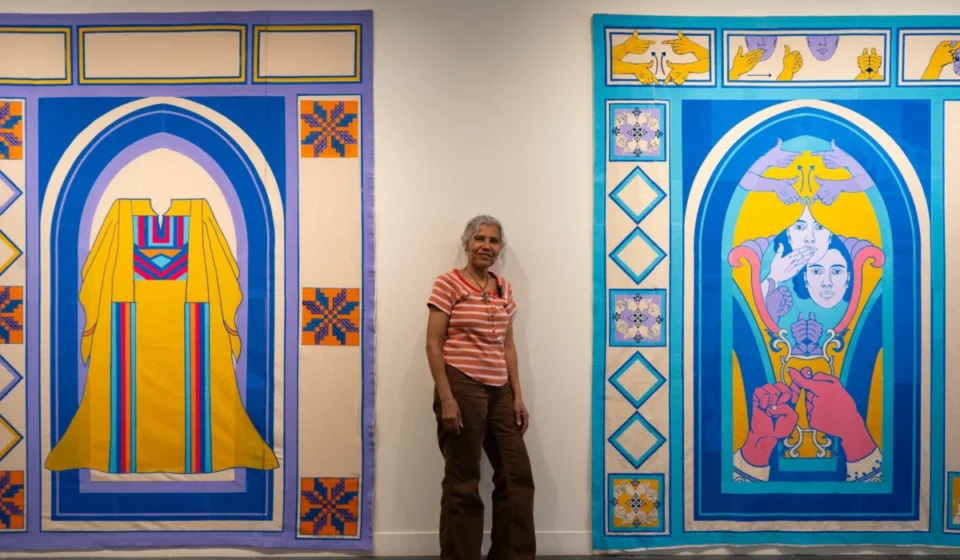

In the heart of Minneapolis, the Rosalux Gallery has become a site of profound intersectionality, where the delicate art of screen printing meets the weight of history and the power of individual identity. The current exhibition, Living Threads, serves as an immersive installation by St. Paul-based artist Hend Al-Mansour. Through this body of work, Al-Mansour explores the nuanced experience of being an Arab woman in the diaspora, moving beyond monolithic stereotypes to present a portrait of power, vulnerability, and domestic grace.
At its core, Living Threads is a testament to the resilience of the human spirit. By focusing her lens on one individual—Yara Omer, a Palestinian American poet and Deaf educator based in Minnesota—Al-Mansour creates a bridge between the personal and the political, utilizing Islamic architectural motifs, American Sign Language (ASL), and the intricate iconography of traditional Palestinian dress to tell a story that is at once singular and universal.
The Evolution of an Artistic Vision: A Chronology
The path to Living Threads is part of a larger, evolving creative trajectory for Al-Mansour, a physician-turned-artist whose work consistently challenges societal expectations.
Al-Mansour’s career began in Saudi Arabia, where she practiced medicine. Her migration to Minnesota in 1997 for a fellowship at the Mayo Clinic marked a life-altering transition. Finding the rigid, state-mandated social structures of her homeland—where religious police monitored public attire and movement—to be an untenable "prison," she eventually abandoned medicine to pursue art, earning an MFA from the Minneapolis College of Art and Design.

This background in clinical science and her later immersion in the arts inform her rigorous, methodical approach to composition. Her recent work, Living Threads, is an outgrowth of her 2025 exhibition at the Minneapolis Institute of Art (Mia), titled Mihrabs: Portraits of Arab American Women. In that earlier iteration, Al-Mansour created walk-in architectural structures housing portraits of four women from her community. These structures were deeply rooted in cultural history, designed to evoke the sacred spaces of the Islamic world.
Her artistic journey has not been without controversy. Before Mihrabs debuted, Al-Mansour had prepared a different exhibition for Mia; however, the museum postponed the show due to its depiction of the Prophet, a decision that forced the artist to pivot. Rather than stifling her voice, this setback served to clarify her focus. She moved toward a project celebrating the agency of Arab women, a theme that has culminated in the intimate, singular focus of the current show at Rosalux.
The Process: Meticulous Craftsmanship as Resistance
The technical demands of Living Threads are as significant as the imagery itself. Al-Mansour’s process is defined by an exacting, labor-intensive approach to screen printing. Because her mesh stencils are limited to four-by-four-foot dimensions, she must segment her image negatives into six separate pieces.
Each panel of the installation is the result of a painstaking layering process. She inks one color at a time onto a large studio table, manually washing and resetting the stencils for every subsequent layer. This physical, repetitive labor—often conducted in collaboration with peers like writer William Noor—acts as a meditative practice, mirroring the patient, steady work of building community and preserving identity.

The result is an aesthetic of intentional invitation. The pastel palette and illustrative quality of the prints may seem soft, but they provide a stark contrast to the gravity of the subject matter. These are not merely portraits; they are archives of lived experience. By integrating ASL into the visual narrative, Al-Mansour honors Omer’s work as an educator and poet, effectively creating a visual language that transcends barriers of sound and silence.
Bridging Cultures: The Palestinian Narrative
Al-Mansour’s commitment to documenting the Palestinian experience is deeply rooted in her own childhood. Growing up in Saudi Arabia, she was surrounded by Palestinian families who had been displaced during the 1948 Nakba. She recalls the visceral image of neighbors who carried the physical keys to homes they were forced to abandon, holding onto the hope of return for decades.
"It is not my direct experience, but it was very close to home," Al-Mansour reflects. Her goal with Living Threads is to humanize a people often obscured by headlines of conflict. "I want to present Palestinian people as normal people," she explains. "To show their love of beauty, what they do, what they love, what are their hopes."
In the gallery, this manifests as a layered tapestry of symbols. The traditional Palestinian thobe, with its intricate embroidery that communicates regional history and ancestry, is presented alongside imagery of Omer’s professional life. By highlighting the mundane, beautiful reality of a Palestinian American educator’s life, Al-Mansour creates a powerful counter-narrative to dehumanization.

Official Responses and Curatorial Context
The exhibition has been received as a landmark moment in local contemporary art, particularly for its ability to balance high-concept installation with emotional intimacy. Rosalux Gallery, a collective-run space in Minneapolis, has long been a venue for work that challenges the status quo, and Living Threads fits squarely within this mission.
The interplay between the artist’s process and the final product has drawn praise from critics for its transparency. Al-Mansour’s habit of conducting deep-dive interviews with her subjects—meeting in their homes or at coffee shops to discuss their fears, goals, and daily lives—ensures that the final work is a collaborative representation rather than a voyeuristic one.
The artist’s own words—"I hope one day they find peace and justice. I’m not sure they’ll have the land, but at least justice"—underscore the weight of the exhibition. Her work is a call for a recognition of rights and humanity that exists beyond the geopolitical stalemate.
Implications for the Future
The implications of Living Threads extend far beyond the walls of the Rosalux Gallery. By documenting the intersection of Palestinian identity, Deaf culture, and the American immigrant experience, Al-Mansour is expanding the canon of what "American art" looks like. She is challenging the viewer to see the "small communities" that form the backbone of our society—communities that, as the sign in Omer’s home reminds us, make life better.

Furthermore, her inclusion in the forthcoming anthology Nick of Time: Women Write about Art and Aging (University of Minnesota Press, Oct. 2026) suggests that her influence will continue to grow as she bridges the gap between generations of artists.
For those who wish to experience the installation, Living Threads is on view at the Rosalux Gallery through August 30. The gallery is open Saturdays and Sundays from 12:00 p.m. to 4:00 p.m., or by appointment. A special artist talk is scheduled for Saturday, August 15, from 2:00 p.m. to 3:00 p.m., offering a rare chance to hear Al-Mansour discuss the intersection of her medical background, her artistic practice, and the enduring power of the stories she chooses to tell.
In an era defined by division, Al-Mansour’s work serves as a necessary, quiet, and persistent reminder that identity is not a static thing—it is a living, breathing thread that binds us together, if only we are willing to look, listen, and learn.