




















































Executive Summary: The Connelly Calculus
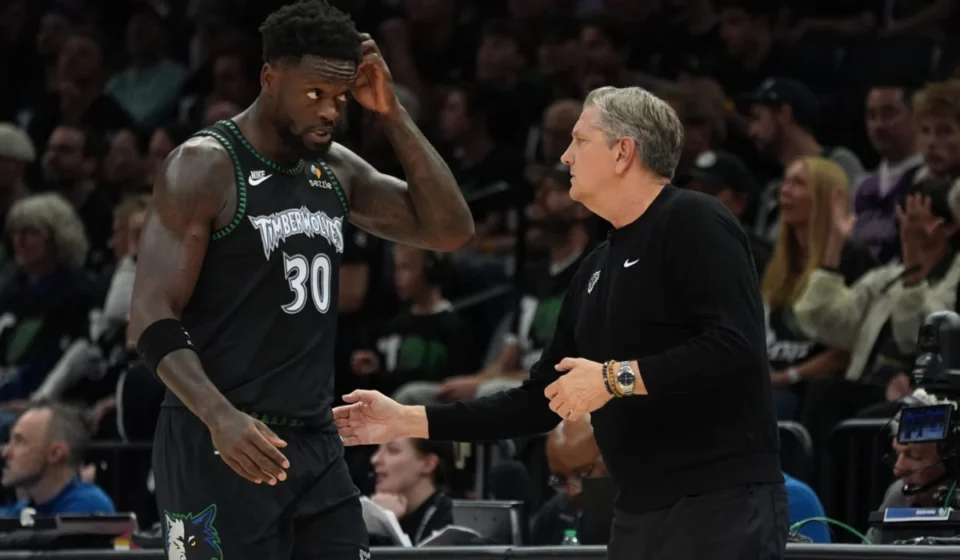
Tim Connelly, the President of Basketball Operations for the Minnesota Timberwolves, has spent the better part of his four-year tenure acting as a high-stakes emergency responder. His primary role, it seems, has shifted from architect to janitor, repeatedly cleaning up roster gambits that failed to materialize into the championship window he was hired to open. The latest chapter in this turbulent saga is the abrupt salary-dumping of Julius Randle—a move executed on the eve of the NBA Draft that signals a dramatic, if painful, pivot toward fiscal discipline and a shift in team identity.
While Connelly has successfully offloaded bench depth like Bryn Forbes, Shake Milton, and Troy Brown Jr. in the past, the current cycle involves "erasure" on a much larger scale. By jettisoning both Rob Dillingham and Julius Randle, the front office is essentially admitting that their previous strategic investments were fundamentally flawed. This is no longer about marginal improvements; it is about a radical restructuring of the Timberwolves’ financial and competitive future.
Chronology of a Failed Vision
The trajectory of the Timberwolves over the last two years has been defined by a series of rapid-fire decisions that, in retrospect, suggest a lack of long-term cohesion.
- The KAT Trade: The decision to trade Karl-Anthony Towns for Julius Randle, Donte DiVincenzo, and a draft pick that became Joan Beringer was designed to balance the books while keeping the team competitive. However, the optics have been disastrously exacerbated by Towns’ immediate success with the New York Knicks, where he played a pivotal role in their recent championship run.
- The Dillingham Departure: Less than two years after investing significant draft capital to secure Rob Dillingham—a move intended to solve the team’s need for a secondary creator—Connelly folded. Moving on from a lottery pick so early is a rare and damaging admission of miscalculation.
- The Randle Resignation: Last offseason, the organization opted to resign Julius Randle, a decision that carried a hidden opportunity cost: the departure of Nickeil Alexander-Walker. NAW subsequently blossomed into an NBA Most Improved Player candidate, providing similar production for a fraction of the cost.
- The Draft Eve Salary Dump: On the Tuesday morning of the NBA Draft, the Wolves finalized the trade of Randle to the Brooklyn Nets. The move was a financial necessity to escape the suffocating weight of his $33 million salary and the looming $36 million player option for 2027-28.
Supporting Data: The Anatomy of the Trade
The mechanics of the Randle deal underscore just how desperate the Timberwolves were to clear cap space. Because the Brooklyn Nets were one of the few franchises with the requisite room to absorb Randle’s contract, the leverage was entirely in their favor.
The trade saw the Wolves swap their 28th overall draft pick for the Nets’ 33rd, effectively paying for the privilege of unloading salary. Furthermore, to satisfy the complex multi-team requirements involving the Chicago Bulls, Minnesota received Mo Gueye—a depth piece with a mere 165 minutes of NBA experience who is expected to be waived immediately.
The financial "silver lining" is the primary justification for this surrender. By offloading Randle, the Timberwolves successfully dipped under the league’s "first apron," a critical threshold in the modern NBA’s collective bargaining agreement. This move grants the organization access to the "non-taxpayer midlevel exception," which analysts like Dane Moore have described as a "$15 million gift card" for team building. Additionally, the move nets the team a $33.3 million trade exception, providing massive flexibility for the next 12 months.
Official Responses and Internal Friction
While the Timberwolves’ leadership maintains a facade of unity, the cracks in the partnership between Tim Connelly and Head Coach Chris Finch have become visible to close observers. The team’s handling of specific players has served as a barometer for this friction.
Rob Dillingham was widely viewed as a "Connelly guy," a front-office prospect who never quite found his footing in Finch’s disciplined system. Conversely, Julius Randle was a "Finch guy," a player the coach explicitly praised as "maybe our most important player" during his tenure. The fact that the organization discarded a player of such high status to a head coach reveals that the front office has reclaimed the reins of personnel control, prioritizing fiscal health over the coach’s stated preferences.
Implications: The New Identity
The departure of Randle and Dillingham is fundamentally an act of "addition by subtraction." The Timberwolves were suffering from a lack of identity, characterized by poor spacing and a decline in defensive intensity during the 2025-26 season.
The Rise of the Youth Core
The most tangible benefit of this reset is the ability to lock in a younger, more cohesive core. The Timberwolves have secured Ayo Dosunmu on a 5-year, $112 million contract—a move that would have been impossible under the previous salary structure. Dosunmu represents the "accelerated pace" the team lacked, fitting perfectly alongside the established core of Anthony Edwards, Jaden McDaniels, and Naz Reid.
Naz Reid, in particular, is the biggest winner of this transition. After years of playing in the shadow of high-usage frontcourt players like Towns and Randle, Reid is now positioned to take over a starting role. His ability to space the floor while providing defensive versatility alongside Rudy Gobert is the stylistic blueprint for the team’s new era.
The "Championship Template"
The Timberwolves are moving toward a model currently championed by the league’s elite: wing-heavy, defensive-minded, and selfless. By clearing Randle’s usage-heavy and inefficient offensive style, the team creates space for Jaden McDaniels to evolve into a primary playmaker and secondary scorer.
The roster for 2026-27 now looks significantly more balanced:
- The Pillars: Edwards, McDaniels, Reid, Dosunmu, Beringer, and TJ Shannon.
- Financial Flexibility: The team is no longer staring into the abyss of the second apron. With the trade exception and the non-taxpayer midlevel exception, Connelly has the tools to make surgical upgrades rather than panicked pivots.
Conclusion: A Lesson in Accountability
The narrative surrounding the Minnesota Timberwolves has been one of high-cost mistakes. Drafting Dillingham and resigning Randle were errors that cost the team draft equity, salary-cap stability, and, ultimately, time. The lingering sting of the 2031 first-round pick owed to the San Antonio Spurs for the Dillingham trade will serve as a permanent reminder of this era of mismanagement.
However, if we move past the cynicism, the current iteration of the roster is arguably more dangerous than the one that preceded it. The team has traded away aging, ill-fitting pieces for long-term stability and a clearly defined philosophy. By centering the offense around Anthony Edwards and empowering players like Naz Reid and Jaden McDaniels, the Timberwolves are finally aligning their roster with the modern reality of NBA success.
The apology to the fans, if one is required, lies in the admission that the previous two years were a detour. The road back to championship contention is rarely linear, but by shedding the weight of the Randle contract, the Timberwolves have at least ensured they are finally traveling in the right direction. The future of the organization now rests on the development of the youth core and the front office’s ability to use its newfound financial ammunition to build a sustainable, competitive culture. The "Connelly era" may have begun with chaotic gambles, but it is currently defined by a cold, necessary return to fiscal and tactical sanity.