
































Weaving Resistance: Hend Al-Mansour’s "Living Threads" Redefines the Portrait of the Arab Woman

At the heart of Minneapolis’s Rosalux Gallery, a transformation is taking place. Through the meticulous, layered process of screen printing, St. Paul-based artist Hend Al-Mansour is re-contextualizing the lived experience of Arab women in the diaspora. Her latest exhibition, Living Threads, is more than a display of portraits; it is an immersive, architectural dialogue that bridges the gap between historical heritage and the urgent, everyday realities of the Palestinian American community.
By focusing on the life of Yara Omer—a Minnesota-based Palestinian American poet and Deaf educator—Al-Mansour continues a career-long commitment to visibility. Her work acts as a visual manifesto, asserting that the power inherent in the Arab woman’s experience is not a monolith, but a tapestry of individual strengths, professional ambitions, and quiet, persistent hope.
The Genesis of an Artistic Vision: From Medicine to Mosaics
To understand the weight of Al-Mansour’s work, one must look at her own trajectory. Born in Saudi Arabia, Al-Mansour did not begin her professional life in the art studio. She was a physician, a career path that took her from the Middle East to the United States in 1997 for a fellowship at the Mayo Clinic.
Yet, the sterile, rigid environments she navigated in her youth—where social interactions were strictly monitored and women’s public autonomy was severely curtailed—began to feel like a cage. "For me, it was like a prison," she reflects on the strict gender segregation and the religious policing of her upbringing. "I just couldn’t tolerate it anymore. So that’s why I just left."

Upon moving to Minnesota, the transition from medicine to art was a radical act of self-liberation. After earning her Master of Fine Arts from the Minneapolis College of Art and Design, Al-Mansour began using her clinical precision to document the human condition. Her work evolved from personal exploration to a broader mission: documenting the narratives of women who have shaped her world, moving from a life of imposed silence to a practice of visual storytelling.
Chronology: A Trajectory of Growth and Advocacy
Al-Mansour’s path to Living Threads has been marked by both professional acclaim and necessary pivots.
- 1997: Al-Mansour immigrates to Minnesota via the Mayo Clinic, eventually pivoting to a career in fine arts.
- 2024: Al-Mansour gains significant attention at the Soo Visual Arts Center (SooVAC) for her unflinching, distinct voice.
- 2025: A breakthrough moment occurs at the Minneapolis Institute of Art (Mia) with the exhibition Mihrabs: Portraits of Arab American Women. Here, she debuted an installation featuring four women from her community encased in architectural structures inspired by their cultural origins.
- 2026 (August): Living Threads opens at Rosalux Gallery, shifting the scope from a group exhibition to an intensive, deep-dive portrait of one individual, Yara Omer.
- October 2026: Al-Mansour is slated to contribute to the University of Minnesota Press anthology Nick of Time: Women Write about Art and Aging, further cementing her role as an intellectual voice in the Minnesota art scene.
The Architecture of Identity: Analyzing "Living Threads"
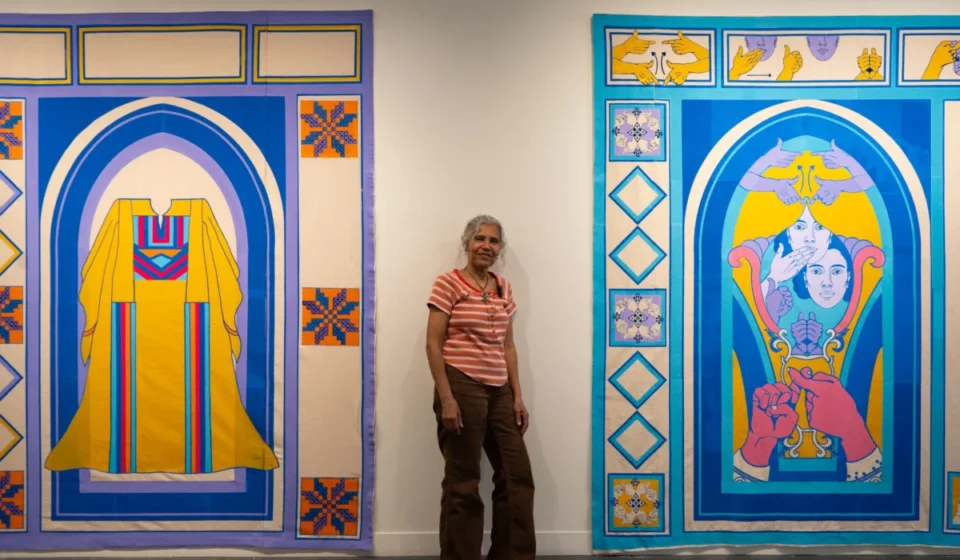
In Living Threads, Al-Mansour employs a sophisticated visual language. She does not merely paint a subject; she constructs an environment around them. Drawing on Islamic architectural motifs—specifically the geometry of the Dome of the Rock—the installation invites the viewer to step into a space that feels both sacred and domestic.
The work is a synthesis of three distinct threads: the ancestral, the professional, and the linguistic.

- Ancestral: The presence of the thobe, the traditional Palestinian tunic. Through intricate embroidery patterns, Al-Mansour highlights the historical storytelling inherent in Palestinian textiles.
- Professional: She documents Yara Omer’s work as an educator in the public school system, specifically focusing on her advocacy for Deaf and hard-of-hearing students.
- Linguistic: Al-Mansour incorporates American Sign Language (ASL) into the visual composition. By translating phrases like "Life is better with friends"—a mantra found in Omer’s home—into signed gestures, the artist bridges the gap between the spoken word and the silent, expressive power of ASL.
"I really like that sentence because it described her very nicely," Al-Mansour notes. "She has her small community, and she cares for them a lot, and they are a source of support to her."
An Exacting Process: The Technical Craft of Resistance
The visual impact of Living Threads is the result of a grueling, manual labor process. Because her mesh stencils are limited to four-by-four-foot dimensions, Al-Mansour engages in a complex technical dance. She cuts her image negatives into six distinct sections, preparing a dedicated screen for every layer.
The process is slow and rhythmic: inking one color, washing the stencil, and repeating the process for the next layer. This is not a solo endeavor; Al-Mansour has mentored others in the craft, including writer William Noor. This collaborative approach mirrors the themes of her exhibition—the idea that community support is the bedrock of individual survival and expression.
The resulting images are deceptive. The use of soft, inviting pastel colors gives the work an approachable, illustrative quality. However, these aesthetic choices serve as a strategic entry point for viewers, drawing them into a discussion about the current, often painful, historical moment facing the Palestinian people.

Official Responses and the Price of Artistic Autonomy
Al-Mansour’s journey has not been without institutional friction. Prior to her successful Mihrabs exhibition at Mia, she faced a significant setback when the museum postponed an earlier show due to its depiction of the Prophet. While the museum cited concerns regarding the subject matter, the experience forced Al-Mansour to reassess her approach to institutional art.
She chose to pivot rather than retreat. Instead of silencing her voice, she channeled her creative energy into the celebration of Arab women’s agency. By moving her work to independent spaces like Rosalux Gallery, Al-Mansour has found a platform where her voice is not only heard but celebrated. This evolution highlights a broader trend in the art world: artists of color increasingly moving toward community-focused, independent galleries to maintain control over their narratives.
Implications: The Quest for Justice and Visibility
What is the implication of Living Threads in the contemporary landscape? For Al-Mansour, the exhibition is a reclamation of the "normalcy" of Palestinian lives. In an era where mainstream media often reduces the Palestinian experience to statistics or tragedy, Al-Mansour insists on showing the full spectrum of humanity: the love of beauty, the professional dedication, the hope for the future, and the joy of friendship.
Her work is a poignant reminder of the displacement that defined the 1948 Nakba. Even though she did not live through the event, her proximity to those who did—neighbors who carried the literal keys to homes they could no longer enter—has left an indelible mark on her psyche.

"I want to present Palestinian people as normal people," she explains. "To show their love of beauty, what they do, what they love, what are their hopes."
As Living Threads concludes its run at Rosalux Gallery on August 30, the legacy of the exhibit remains clear. It is an invitation to witness the strength of the "living thread"—the connection between the past and the present, the individual and the collective, the silent gesture and the loud cry for justice.
"I hope one day they find peace and justice," Al-Mansour says of the Palestinian people. "I’m not sure they’ll have the land, but at least justice."
Exhibition Details:
Living Threads is on display at the Rosalux Gallery in Minneapolis through August 30, 2026.
- Gallery Hours: Saturday and Sunday, 12:00 p.m. – 4:00 p.m., or by appointment.
- Artist Talk: Saturday, August 15, 2:00 p.m. – 3:00 p.m. (Free and open to the public).
- Further Reading: For those interested in the intersections of art, aging, and women’s voices, look for the upcoming anthology Nick of Time: Women Write about Art and Aging, arriving in bookstores on October 20, 2026, via the University of Minnesota Press.