





















































Roots, Resistance, and Resilience: The Long-Awaited Solo Exhibition of Seitu K. Jones

At the Minnesota Museum of American Art (the M), a quiet, profound transformation is taking root. In the gallery, the humble collard green—a staple of Southern culinary tradition and a potent symbol of the African Diaspora—appears with surprising frequency. It is rendered in charcoal, captured in delicate painting, and even enshrined within a hand-carved Minnesota basswood box. These works anchor “The Smell of Earth: Seitu K. Jones Working in the Elements,” a sweeping solo exhibition that marks a long-overdue milestone for one of the Twin Cities’ most influential multidisciplinary artists.
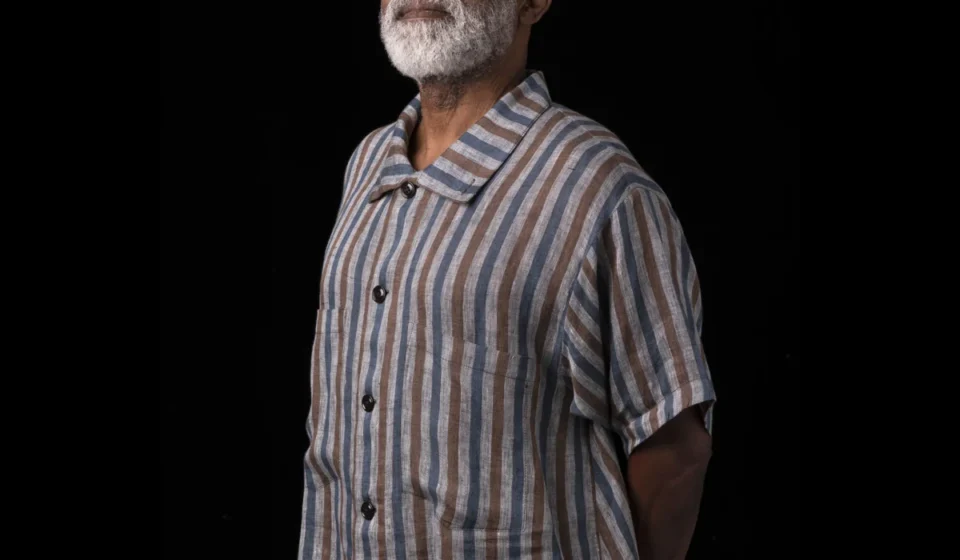
Running from October 22 through July 25, 2027, the exhibition is more than a retrospective; it is a meditation on the connection between soil, culture, and the survival of Black history. Through a diverse range of media—including portraiture, sculpture, and intricate drawings—the show unveils the technical virtuosity of Seitu K. Jones, an artist whose public interventions have long defined the cultural landscape of Minnesota, even as his private studio work has remained largely behind the scenes.
The Archival Imperative: Excavating a Legacy
The exhibition, which held its opening reception on October 29, is the result of a collaborative labor of love between Jones and his team of archivists, Ego Ahaiwe Sowinski and Alexandra Nicome. For years, the pair has been meticulously cataloging Jones’ life’s work, much of which was housed in rolled-up tubes and storage containers.
“We were interested in showing these works where Seitu had an opportunity to slow down and really work at a more intimate scale,” Nicome explained. As they sifted through the archives, they discovered a recurring motif: the collard green. To Jones, this plant is not merely food; it is a biological and cultural thread connecting the American South to the African continent. “I keep coming back to collard greens as a way of accessing Southern cuisine,” Jones reflected. “And then exploring these African American culinary traditions—this line that connects us all to Africa.”
The exhibition serves a secondary, critical purpose: the preservation of Black artistic memory. Jones, a man who has witnessed the erasure of his mentors’ and peers’ legacies, views his archive, The Black Gate, as a defensive tool against historical oblivion. “I’ve lost so many friends, collaborators, mentors—people who I looked up to—who passed on and whose work has literally ended up in a dumpster, or whose legacies are not remembered,” he noted. “Unfortunately, what happens more and more to African American, Indigenous, and other artists of color is that after a generation, their memories are gone.” By bringing these works into the museum space, Jones is actively fighting that disappearance.
A Chronology of Soil and Soul
To understand the depth of Jones’ work, one must look at his lineage. As a fourth-generation Minnesotan, his relationship with the land is inherited. His great-grandfather, a man who self-emancipated from slavery, served in the Union Army during the Civil War before settling in Red Wing, Minnesota, to labor as a hotel porter—a job that eventually allowed him to purchase a farm.

This agricultural legacy continued with Jones’ grandmother, who moved to the Old Rondo neighborhood of St. Paul over a century ago. Despite her father’s forced labor under the institution of slavery, she chose to cultivate the land in her own backyard. Jones recalls the plum trees of his youth and the sensory experience of his grandmother’s kitchen on Fuller Avenue, where the clatter of pots and the “fussing” of his aunties created a soundtrack of domesticity and resilience.
Jones’ professional trajectory is a direct extension of these roots. He holds an undergraduate degree in landscape design from the University of Minnesota’s School of Agriculture and a graduate degree in environmental history. This academic foundation informs his work as a co-founder of Frogtown Farms, a food justice organization that uses community farming as a tool for social equity. His art is never disconnected from the earth; it is an act of cultivation.
Supporting Data: From Public Meal to Private Canvas
While Jones is celebrated for his large-scale public art—such as the 2019 "Shadows of the Crossroads" relief sculptures in the Minneapolis Sculpture Garden, created with longtime collaborator Ta-coumba T. Aiken—"The Smell of Earth" provides a rare look at his technical range.
The exhibition also highlights his role in the 2020 artistic response to the murder of George Floyd. His ocean-blue portraits of Floyd, which appeared throughout the streets of the Twin Cities, solidified his reputation as an artist who meets the demands of history. Yet, this exhibition reveals the quiet, internal life of the artist as well. The M’s curatorial team even performed restoration work on pieces like “Sabian” (1997), a poignant painting of his cousin’s son ice fishing, which had been damaged over the years.
In one section, Jones engages in a visual dialogue with his personal heroes and family. He includes an unfinished painting by his own father, a work that serves as a testament to the sacrifice of previous generations. The painting displays a clear, gifted hand, but its incompleteness speaks to the reality of labor and the limited time available to those working to survive within a system not designed for their prosperity.
Implications: The Black Experience as Landscape
Perhaps the most visceral aspect of the exhibition is Jones’ use of the self-portrait to map the Black experience over the last four centuries. In these works, Jones does not merely paint his own likeness; he occupies the spaces of historical trauma and transcendence.

In the atrium, large-scale charcoal drawings depict figures floating in states of enlightenment—a nod to his public art practice and a desire to elevate the spirit. Conversely, pieces like “Street Scene (Self portrait)” offer a stark, haunting contrast. In this drawing, Jones lies in the street with his eyes closed, accompanied by a pair of abandoned boots. It is a direct, painful engagement with the realities of police brutality and street violence that disproportionately plague Black men in America.
Other works juxtapose the beauty of the natural world with the legacy of lynching, using the image of dangling feet to remind viewers that the landscape in which we live is haunted by its own history.
Conclusion: A Vision for the Future
The delayed recognition of Jones’ work—this being his first solo museum exhibition—is a reflection of the institutional gaps that have long characterized the American art world. However, “The Smell of Earth” is a powerful assertion of his prominence.
By grounding his practice in the tangible reality of the land and the archival necessity of preserving Black narratives, Seitu K. Jones has created a body of work that is as educational as it is emotional. The exhibition does not shy away from the pain of the past, nor does it ignore the beauty of the present. Instead, it invites the visitor to slow down, to engage with the intimacy of a germinating seed, and to recognize that the history of the soil is, in fact, the history of us all.
As visitors walk through the M, they are invited to view a career that has been deeply, consistently, and unyieldingly rooted in the elements. It is a show that demands to be felt, contemplated, and remembered—ensuring that, unlike the artists of the past whom Jones fears we have forgotten, his contribution to the American canon remains indelible.
Exhibition Details:
- Event: "The Smell of Earth: Seitu K. Jones Working in the Elements"
- Location: Minnesota Museum of American Art, 350 Robert St N, St. Paul, MN
- Dates: October 22, 2026 – July 25, 2027
- Admission: Free
- More Information: mmaa.org