





















































The Mobile Battleground: How Low-Cost Texting Economics and Data Brokerage Fuel the Surge in Political Fundraising

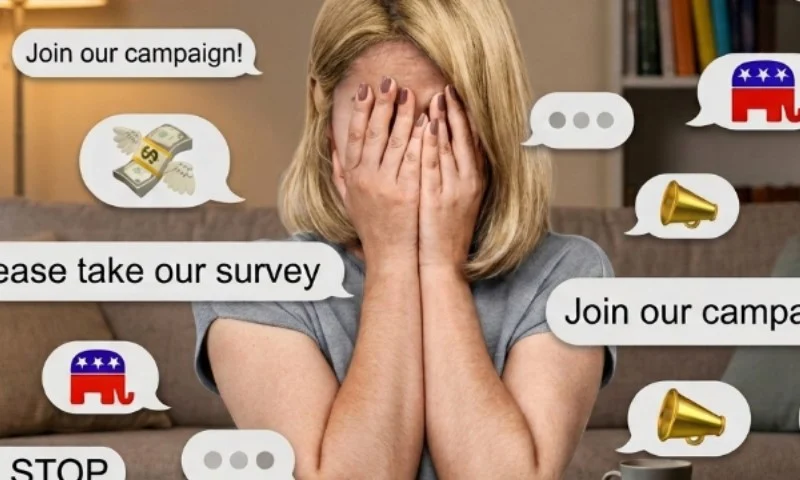
The modern mobile phone has transformed from a personal communication device into the primary battleground for political fundraising. During any given election season, Americans find their messaging apps flooded with urgent pleas, personalized demands, and dire warnings from candidates, political action committees (PACs), and party organs.
What was once an occasional novelty has matured into an aggressive, highly optimized industry. By July 2024, the volume of political text messages sent to Americans had already surpassed the total recorded for the entirety of 2023. This rapid escalation highlights a fundamental shift in how political campaigns interact with the electorate. Driving this relentless wave of communication is a simple, underlying reality: mobile messaging is incredibly cheap, highly direct, and remarkably profitable—even when the vast majority of recipients choose to ignore it.
Main Facts: The Mechanics of Modern Campaign Texting
To understand why political text messages have become nearly impossible to avoid, one must look at the structural advantages they offer over traditional campaign media like television, radio, or direct mail.
High Delivery, Low Resistance
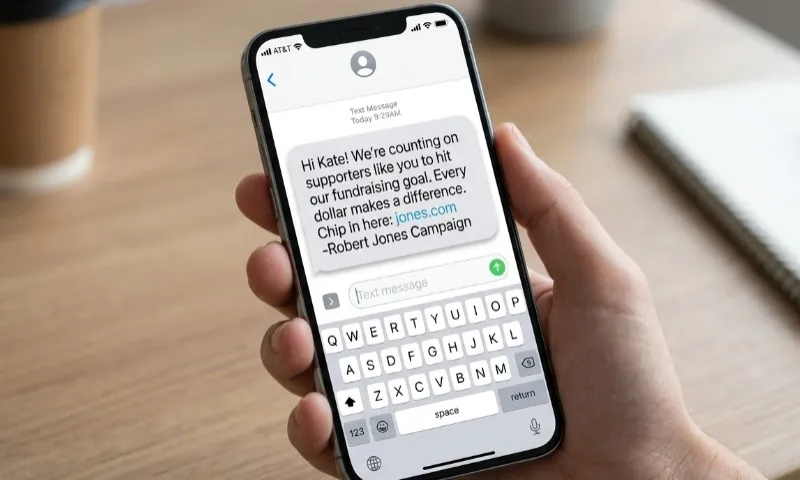
Unlike emails, which frequently languish unread in spam folders, or phone calls, which are routinely screened or ignored, text messages are almost impossible to miss. They appear directly on a user’s lock screen or notification bar within seconds of transmission. This immediate physical proximity gives campaigns a direct window of opportunity to capture voter attention. Furthermore, mobile messaging compresses the distance between a donation pitch and the financial transaction. By embedding direct, personalized donation links within the text, campaigns allow supporters to open an appeal, choose an amount, and complete a contribution on the same device in under a minute.
Personalization and the Illusion of Intimacy
Campaigns rarely send generic broadcast texts. Instead, they leverage sophisticated software to personalize messages, making them feel like direct, one-on-one communications. These messages frequently incorporate:
- The recipient’s first name.
- References to their specific voting district or hometown.
- Mentions of localized polling data or specific issues relevant to their demographic.
- The names of prominent national figures or local candidates.
While repeated exposure can eventually diminish this effect, the initial illusion of personal contact remains a powerful driver of engagement, making a mass-produced message feel like a direct appeal from a candidate.
The Engineering of Urgency
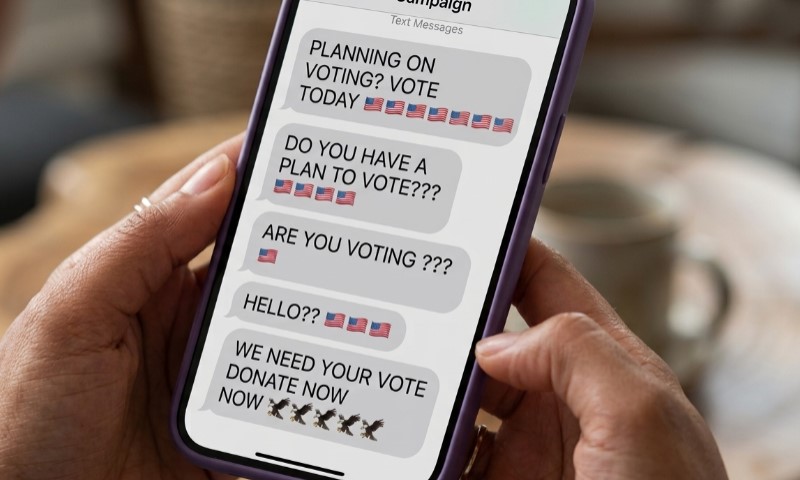
A hallmark of political texting is the constant cultivation of urgency. Messages routinely warn of impending end-of-month deadlines, matching-gift windows that are "about to close," razor-thin polling margins, or sudden, catastrophic fund shortages. This language is carefully designed to induce immediate action. By framing the contribution as a time-sensitive necessity, campaigns seek to bypass the recipient’s hesitation, securing a donation before the user swipes away to another notification.
Chronology: From Novelty to Saturation (2010–2024)
The trajectory of political text messaging reveals how a niche technological experiment became the dominant infrastructure of modern political fundraising.
[2010-2012] Early adoption: Campaigns use basic SMS lists; texts are rare and novel.
     │
     ▼
[2016-2018] Introduction of Peer-to-Peer (P2P) texting to bypass automated dialing regulations.
     │
     ▼
[2020-2022] Massive scaling: Billions of texts sent; voter databases integrated with commercial brokers.
     │
     ▼
[2024] Saturation point: By July 2024, text volume surpasses the entirety of 2023.- The Early Years (2010–2015): Fifteen years ago, receiving a text message from a political campaign was a rare occurrence. Early mobile campaigns relied on simple opt-in SMS keywords, which limited outreach to highly dedicated supporters. The novelty of the medium meant that those who did receive texts were highly likely to open and engage with them.
- The P2P Revolution (2016–2020): The introduction of peer-to-peer (P2P) texting platforms bypassed federal restrictions on automated dialing to cell phones. By employing campaign staff or volunteers to manually press "send" for each message via specialized software, campaigns could legally reach millions of unregistered numbers. This period saw voter databases merge systematically with commercial data broker databases.
- The 2024 Escalation: By 2024, the volume of political texts reached unprecedented heights. Industry tracking data showed that by July of that year, the sheer quantity of political SMS messages had already eclipsed the total volume sent during all twelve months of 2023. This exponential increase reflects an industry-wide realization that mass texting is the most cost-efficient way to sustain modern campaign operations.
Supporting Data: The Financial Math of Spam-Scale Messaging
The explosion of political text messaging is ultimately driven by favorable unit economics. In political marketing, a low conversion rate does not equate to failure; rather, it is a normal part of a highly profitable business model.
High ROI Despite Minimal Conversion
Because the cost of sending an individual text message is extremely low—often fractions of a cent—political messaging programs can operate at immense scale. A campaign does not need a large percentage of recipients to respond. If a campaign broadcasts 500,000 text messages at a cost of $0.01 per message, the total outreach cost is $5,000. If only 0.1% of those recipients (500 people) click through and donate an average of $20 each, the campaign generates $10,000 in contributions, doubling its initial investment.
Case Study: The Statewide P2P Campaign
Real-world data highlights how lucrative these dynamics can be. According to a donor conversion case study reported by Political Comms, a statewide gubernatorial campaign executed a personalized peer-to-peer texting strategy during a six-week fundraising push.
| Metric | Campaign Statistics |
|---|---|
| Total Program Cost | $73,500 |
| Total Funds Raised | $427,000 |
| Conversion Rate | 8.3% |
| Average Donation | $47.00 |
| Net Profit | $353,500 |
This case study demonstrates that when personalization and targeting are executed effectively, conversion rates can climb well above baseline assumptions, yielding massive returns on investment.
Partisan Disparities in Message Volume
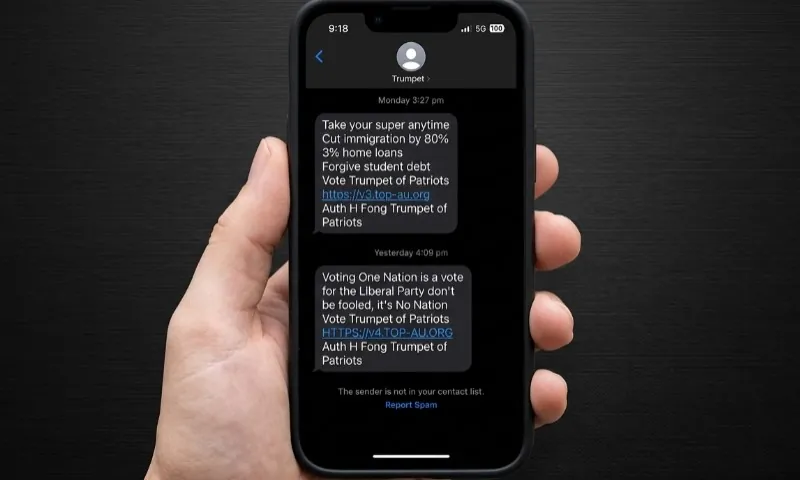
The volume of political messages is not distributed evenly across the political spectrum. Messaging-volume tracking throughout 2024 revealed that Republican campaigns utilized political texting at least twice as frequently as their Democratic counterparts.
While this aggressive volume maximizes immediate fundraising opportunities, it also risks accelerating voter burnout. It illustrates a strategic trade-off: sending more messages consistently generates more revenue in the short term, but it also increases the speed at which the target audience tunes out the messaging.
Official Responses, Regulatory Loopholes, and the PAC Ecosystem
As the volume of texts has surged, so too has public frustration. However, regulating political text messages remains highly difficult due to legal protections and the decentralized nature of political organizations.
The Regulatory Landscape and Free Speech Exemptions
Under the Telephone Consumer Protection Act (TCPA) and Federal Communications Commission (FCC) guidelines, commercial telemarketers face strict rules regarding automated dialing and consent. However, political speech receives broad protections under the First Amendment.
To navigate regulatory limits, campaigns heavily rely on peer-to-peer (P2P) texting platforms. Because a human agent technically initiates each message, these platforms are generally not classified as "autodialers," allowing campaigns to send messages to voters who never explicitly opted in to receive them.
Data Acquisition: How Campaigns Get Your Number
Many voters wonder how campaigns obtained their personal cell phone numbers in the first place. Campaigns compile lists from several sources:
- Voter Registration Records: Publicly available state voter files contain names, addresses, party affiliations, and often phone numbers or email addresses.
- Commercial Data Brokers: Campaigns purchase consumer profiles that link voting records with commercial behavior, household income, and mobile phone numbers.
- Shared Party Databases: National and state party organizations maintain unified databases (such as the Democrats’ NGP VAN or the Republicans’ Data Trust) that pool voter contact information across election cycles.
- Co-Registration and Petition Forms: Signing an online petition, entering a contest, or RSVPing to an event often serves as consent to share contact information across a broad network of allied campaigns.
The Rise of Independent PACs and Overhead Costs
Political texts do not always originate from the candidates themselves. A substantial portion of mobile messaging is conducted by independent Political Action Committees (PACs), super PACs, and dark money groups.
Many of these organizations operate with minimal direct oversight from the candidates they claim to support. In some cases, "scam PACs" exploit the names of popular political figures to raise money, only to spend the vast majority of their revenue on administrative overhead, consulting fees, salaries, and further fundraising efforts, rather than directly supporting political campaigns.
Implications: Voter Fatigue, Security Risks, and Future Trends
The rapid expansion of political texting has introduced significant challenges for the electorate, ranging from psychological exhaustion to serious cybersecurity risks.
The Onset of Message Fatigue
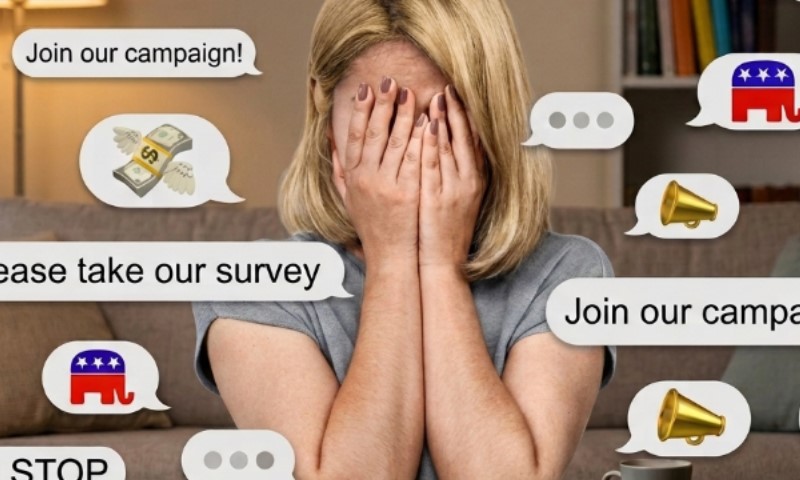
The sheer volume of political communication has led to widespread message fatigue. When voters are bombarded daily with high-stakes warnings and urgent appeals, the effectiveness of individual messages begins to decay.
Familiarity breeds dismissal; recipients quickly learn to recognize patterns—such as capitalized emergency alerts and donation links—and delete the messages without opening them. Over time, this saturation can alienate moderate voters and degrade the overall quality of civic discourse, training the public to view all political communication as spam.
The Threat of Political Impersonation and Scams
The low cost and ease of mass texting have also made it an attractive tool for bad actors. Scammers frequently impersonate legitimate campaigns, using copied logos, familiar candidate slogans, and urgent messaging to direct recipients to fraudulent donation portals.
[Scam Text Sent] ──► [Urgent Call to Action] ──► [Spoofed Donation Page] ──► [Theft of Funds & Data]These deceptive tactics are designed to steal money and harvest sensitive financial information and personal data. Because political text messages are unregulated by carrier-level spam filters in the same way commercial messages are, distinguishing a legitimate campaign plea from a malicious phishing attempt is increasingly difficult for the average user.
Strategic Safeguards for Voters
To protect themselves from potential fraud while navigating the election season, cybersecurity experts recommend several key practices:
- Avoid Direct Link Clicks: Rather than clicking on a link embedded in an unsolicited text message, voters should navigate directly to a candidate’s official, verified website to make contributions.
- Use "Stop" Commands: Replying "STOP" to a political text is often effective for legitimate campaigns, as reputable organizations utilize platforms that automatically process opt-out requests to maintain compliance with carrier guidelines.
- Report Spam: Users can forward suspicious or unsolicited political texts to 7726 (SPAM) to help mobile carriers identify and block malicious senders.
Ultimately, political texting persists because it works. As long as the financial returns of sending millions of low-cost messages exceed the negligible cost of delivery, mobile screens will remain a primary battleground for political influence and campaign cash.