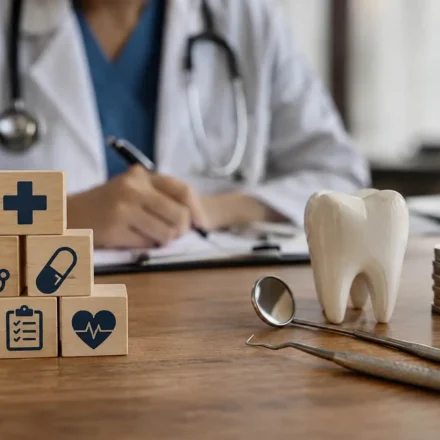



























































Deep Divide: Why American Healthcare Treats Dental and Medical Care as Two Different Worlds

Main Facts: The Structural Divide in American Healthcare
In contemporary American medicine, a patient presenting to an emergency room or primary physician with a severe bacterial infection in a finger or joint will generally receive care covered by standard health insurance, subject to copayments or deductibles. However, if that same patient develops an identical bacterial infection inches away—inside a tooth root or jawbone—the financial and administrative rules change entirely.
For the vast majority of Americans, medical insurance and dental insurance operate as fundamentally separate systems. While major medical plans are designed to protect policyholders against catastrophic expenses by capping out-of-pocket spending, dental insurance functions primarily as a prepaid discount scheme structured around capped annual benefits. Standard major medical insurance frequently excludes routine fillings, root canals, extractions, crowns, and periodontic therapies, leaving patients to navigate a separate market of dental benefits, pay entirely out-of-pocket, or defer necessary care.
+-----------------------------------------------------------------------------------+
|                        THE AMERICAN HEALTHCARE COVERAGE DIVIDE                    |
+-----------------------------------------------------------------------------------+
|  MEDICAL INSURANCE                                 DENTAL INSURANCE               |
|  • Covers overall body/organ illness              • Covers teeth, gums, oral cavity|
|  • Capped Out-of-Pocket Maximum (ACA mandate)     • Capped Annual Benefit Maximum  |
|  • Designed for catastrophic expense protection   • Designed as capped discount plan|
|  • Included in standard single-payer/employer baseline • Supplemental policy/add-on|
+-----------------------------------------------------------------------------------+
The consequences of this separation are both clinical and financial:
- Financial Burden: Millions of insured adults face full out-of-pocket liabilities running into thousands of dollars for standard restorative procedures.
- Avoided Care: Millions of Americans forgo needed oral healthcare annually due to cost, leading to compounded disease progression.
- Emergency Department Strain: Patients seeking relief for severe tooth pain frequently turn to hospital emergency rooms, where care is limited to temporary palliative treatment (such as pain medication and antibiotics) rather than definitive dental repairs.
- Systemic Health Impacts: Untreated oral infections exacerbate chronic conditions, including diabetes and cardiovascular disease.
Chronology: The Historical Evolution of the Dental-Medical Split
The institutional separation between medical and dental practice in the United States is not an accident of modern finance; it is the product of a nearly two-century-old educational and regulatory split.
  1840                 1935–1940s               1965                 2010
   |-----------------------|----------------------|--------------------|
Baltimore College     Post-WWII Employer     Medicare & Medicaid    Affordable Care Act
of Dental Surgery     Health Plans Exclude   Codify Separation in   Mandates Pediatric
Establishes Separate  Routine Dental Benefits Public Policy         Dental Only
Professional Path
1840: The Educational Separation
In the early 19th century, dentistry was largely practiced as an unregulated trade alongside minor surgery and craftwork. In the late 1830s, physicians Chapin A. Harris and Horace H. Hayden sought to integrate formal dental training into the medical curriculum at the University of Maryland.

The medical faculty rejected the proposal, viewing dental work as mechanical rather than academic or medical. In response, Harris and Hayden founded the Baltimore College of Dental Surgery in 1840—the world’s first autonomous dental school. This established a precedent: dentistry developed its own academic degrees (DDS and DMD), separate state licensing boards, and independent professional associations, chief among them the American Dental Association (ADA), founded in 1850.
1930s–1950s: The Rise of Commercial Health Insurance
When commercial health insurance and employer-sponsored fringe benefits expanded during WWII and the post-war economic boom, coverage models were constructed around hospitalizations, surgical interventions, and physician visits. Blue Cross and Blue Shield plans codified the coverage of general systemic illness. Because dentists operated independently in private fee-for-service practices outside hospital networks, commercial health insurers omitted dental services from core health contracts.
1954–1970s: Development of Standalone Dental Plans
The first dedicated dental service plans emerged in the mid-1950s, pioneered by dental societies in Washington, Oregon, and California (which later evolved into the Delta Dental plans). These programs were built around preventive checkups and low-cost routine care rather than comprehensive indemnity insurance. Consequently, they adopted maximum annual benefit caps to limit insurer liability—a framework that persists today.
1965: Codification in Medicare and Medicaid
When Congress enacted Title XVIII (Medicare) and Title XIX (Medicaid) of the Social Security Act in 1965, lawmakers adopted the existing private insurance structure. Original Medicare explicitly excluded routine dental examinations, cleanings, fillings, crowns, and dentures under Section 1862(a)(12). Medicaid mandated pediatric benefits but left adult dental coverage optional for states, cementing the division in federal healthcare policy.
2010: The Affordable Care Act (ACA)
When the ACA instituted statutory mandates requiring qualified health plans to cover ten categories of "Essential Health Benefits" (EHBs), pediatric oral care was included. However, adult dental care was excluded from the statutory mandate, preserving the historical bifurcation for the adult workforce and senior populations.

Supporting Data: Financial Mechanics, Benefit Limits, and Systemic Costs
1. Contrasting Insurance Architecture: Medical vs. Dental
The structural mismatch between medical and dental coverage lies in how risk and financial limits are allocated between the insurer and the patient.
| Feature | Standard Major Medical Insurance | Typical Commercial Dental Benefit Plan |
|---|---|---|
| Primary Financial Function | Catastrophic financial protection | Cost-sharing for low-cost preventive care |
| Annual Benefit Limit | Prohibited for essential health benefits (ACA mandate) | Hard cap (typically $1,000 to $2,000 per year) |
| Patient Out-of-Pocket Cap | Mandated annual out-of-pocket maximum | None; patient pays 100% after benefit limit is met |
| Coverage Structure | Coinsurance drops after deductible/OOP maximum met | Tiered coinsurance (100% Preventive / 80% Basic / 50% Major) |
| Waiting Periods | Prohibited for covered essential benefits | Common (6–12 months for major procedures) |
2. Tiered Benefit Structures and Cost-Sharing
Standard dental policies categorize procedures into distinct tiers, leaving complex restorative treatments heavily exposed to patient out-of-pocket spending:
+-----------------------------------------------------------------------------------+
|                        TYPICAL DENTAL BENEFIT COVERAGE TIERS                      |
+-----------------------------------------------------------------------------------+
| TIER 1: PREVENTIVE CARE (100% Insurer Covered)                                    |
| • Exams, cleanings, basic bitewing X-rays                                         |
+-----------------------------------------------------------------------------------+
| TIER 2: BASIC PROCEDURES (80% Insurer Covered / 20% Patient Coinsurance)          |
| • Amalgam/composite fillings, non-complex extractions                             |
+-----------------------------------------------------------------------------------+
| TIER 3: MAJOR PROCEDURES (50% Insurer Covered / 50% Patient Coinsurance)          |
| • Crowns, bridges, root canals, deep periodontics, complete/partial dentures      |
+-----------------------------------------------------------------------------------+
| EXCLUSIONS / SPECIALTY (0% Covered or Subject to Separate Caps)                   |
| • Dental implants, adult orthodontics, cosmetic whitening, elective veneers       |
+-----------------------------------------------------------------------------------+
3. The Impact of Static Annual Benefit Caps
Unlike medical coverage, which adjusts over time to account for healthcare inflation, dental maximum benefits have remained largely static for decades. In the 1970s, a standard annual dental cap was approximately $1,000. Adjusted for consumer price inflation, that cap would exceed $6,000 today. However, many current commercial policies maintain maximums between $1,000 and $1,500 per year.
Scenario: Comprehensive Treatment Plan (Single Plan Year)
---------------------------------------------------------
Diagnostic & Root Canal:           $1,400
Core Buildup & Crown:              $1,500
Periodontal Scaling (2 quadrants):   $500
Total Direct Medical/Dental Cost:  $3,400

Insurer Contribution (under $1,500 Cap): $1,500
Patient Out-of-Pocket Share:            $1,900 (55.8% of total cost)
4. Direct Cost Drivers in Dental Practice
High out-of-pocket costs for dental procedures are directly linked to the operational overhead of modern dental practices:
- Capital Expenses: Advanced imaging technology (such as CBCT 3D scans), digital impression scanners, sterilization units, and specialized operatory chairs.
- Practice Overhead: Facility leases, specialized staff salaries (dental hygienists and assistants), and commercial liability insurance.
- Laboratory and Material Fees: Custom restorations (such as zirconia or porcelain crowns) milled by external specialized laboratories.
- Geographic Variances: In high-cost urban regions like Manhattan, San Francisco, or Chicago, operating overhead drives procedure costs significantly higher than national medians.
5. International Comparisons: The Global Context
The separation of adult dental care from public healthcare infrastructure is not unique to the United States. Many nations with universal healthcare systems maintain distinct financial arrangements for adult oral health.

+-----------------------------------------------------------------------------------+
|                     INTERNATIONAL ADULT DENTAL COVERAGE MODELS                    |
+-----------------------------------------------------------------------------------+
| COUNTRY        | MEDICAL COVERAGE MODEL    | ADULT DENTAL COVERAGE POLICY         |
+----------------|---------------------------|--------------------------------------+
| United States  | Mixed Private / Public    | Primarily separate commercial plans; |
|                |                           | excluded from Original Medicare      |
+----------------|---------------------------|--------------------------------------+
| Norway         | Universal Public (Tax-funded)| Fully covered for under-18s; adults |
|                |                           | pay out-of-pocket with rare medical  |
|                |                           | condition exceptions                 |
+----------------|---------------------------|--------------------------------------+
| United Kingdom | Universal Public (NHS)    | Fixed Band copayments for NHS dental |
|                |                           | care; access capped by dentist quotas|
+----------------|---------------------------|--------------------------------------+
| Canada         | Universal Public (Single-payer)| Historically separate private/employer|
|                |                           | care; expanding public Canadian Dental|
|                |                           | Care Plan (CDCP) for lower incomes   |
+----------------+---------------------------+--------------------------------------+
Official Responses and Regulatory Frameworks
Centers for Medicare & Medicaid Services (CMS)
CMS enforces statutory restrictions on dental coverage while clarifying narrow administrative exceptions. Under current regulations, Original Medicare (Parts A and B) can only cover dental procedures when they are integral to the clinical success of a primary covered medical procedure.
   PERMITTED MEDICARE EXCEPTIONS             EXCLUDED FROM ORIGINAL MEDICARE
+-------------------------------------+   +-------------------------------------+
| • Dental extraction prior to oral/  |   | • Routine cleanings & prophylaxis   |
|   head and neck radiation therapy   |   | • Standard fillings & extractions   |
| • Oral exams prior to cardiac valve |   | • Dentures & partial appliances     |
|   replacement or organ transplants  |   | • Dental implants                   |
| • Reconstruction following jaw injury|   | • Treatment for routine caries      |
+-------------------------------------+   +-------------------------------------+
While Medicare Advantage (Part C) plans frequently offer supplemental dental benefits to attract enrollees, CMS guidelines permit individual insurers to set their own network restrictions, clinical pre-authorization requirements, and annual dollar allowances.
The Affordable Care Act (ACA) and HealthCare.gov
The U.S. Department of Health and Human Services (HHS), through HealthCare.gov guidelines, stipulates that while health marketplace plans must ensure pediatric dental coverage is available, insurers are under no statutory obligation to integrate adult dental benefits into general silver, gold, or platinum medical plans. Consequently, adult dental care remains an optional stand-alone purchase.
The CDC and Public Health Guidance
The Centers for Disease Control and Prevention (CDC) explicitly recognizes oral health as an essential component of total systemic health. CDC surveillance data shows that over 40% of U.S. adults experience oral pain annually, and periodontitis affects nearly half of adults aged 30 and older. Public health officials emphasize that omitting dental care from primary healthcare models creates systemic inefficiencies across the broader medical network.
Systemic Implications and Consumer Outlook
1. The Oral-Systemic Health Connection
Pathogens originating in the oral cavity have well-documented systemic effects throughout the human body:

+-----------------------------------------------------------------------------------+
|                        ORAL-SYSTEMIC PATHOPHYSIOLOGY LINKS                        |
+-----------------------------------------------------------------------------------+
| DIABETES MELLITUS     | Severe periodontal disease triggers systemic inflammation,|
|                       | increasing insulin resistance and worsening glycemic control.|
+-----------------------+-----------------------------------------------------------+
| CARDIOVASCULAR HEALTH | Oral bacteria (e.g., P. gingivalis) can enter the        |
|                       | bloodstream (bacteremia), contributing to arterial plaque|
|                       | inflammation and endocarditis risks.                      |
+-----------------------+-----------------------------------------------------------+
| PREGNANCY COMPLICATIONS| Active periodontal infections are associated with elevated|
|                       | rates of preterm birth and low birth weight.              |
+-----------------------+-----------------------------------------------------------+
| ADVERSE ADMISSIONS    | Untreated abscesses can spread to deep neck spaces (Ludwig|
|                       | angina), requiring ICU admission and emergency airways.   |
+-----------------------------------------------------------------------------------+
2. Emergency Department Burden and Economic Inefficiency
When financial barriers prevent patients from seeking early outpatient dental care, severe tooth decay often progresses until acute pain forces an emergency room visit. Hospital emergency departments, however, generally lack dental operatory equipment or licensed dentists on staff.
Patient with Advanced Dental Abscess
               │
               ▼
   Lacks Dental Insurance / Funds
               │
               ▼
   Visits Hospital Emergency Dept.
               │
               ▼
   Receives Antibiotics & Analgesics (Palliative Care)
               │
               ▼
   Underlying Pathology Unresolved ($1,000+ Hospital Bill)
               │
               ▼
   Infection Recurs (Repeat ER Visits or Intensive Surgical Care)
Studies show that non-traumatic dental condition (NTDC) visits to emergency departments cost the U.S. healthcare system billions of dollars annually, offering low-value, temporary relief while shifting financial burdens onto hospitals and public programs.
3. Practical Guidance for Healthcare Consumers
Navigating the separate medical and dental insurance sectors requires proactive financial and clinical strategies:
- Pre-Treatment Cost Estimates: Before undertaking major restorative work (such as crowns, root canals, or implants), patients should request a formal pre-treatment estimate from their dentist. The practice submits proposed diagnostic codes to the insurer, detailing covered expenses and patient copayment liabilities before care begins.
- Checking Medical Plan Overlaps: For complex surgical procedures involving the jaw, bone grafting, or biopsy of oral lesions, patients should consult their major medical plan, as certain surgical procedures may fall under medical benefits rather than dental benefits.
- Alternative Care Pathways:
- Dental School Clinics: Accredited dental universities offer supervised, lower-cost care provided by pre-doctoral students or residents.
- Federally Qualified Health Centers (FQHCs): Community health centers often provide dental services on a sliding-fee scale based on household income.
- Benefits Strategy: When evaluating employer compensation packages, workers should review dental policy maximums, rollover rules, and waiting periods rather than relying solely on monthly premium costs.
4. Legislative Policy and Reform Outlook
Efforts to integrate adult dental care into broad healthcare frameworks face ongoing political and fiscal debate:
- Medicare Part D Parallel: Advocates support adding a comprehensive dental benefit to Medicare Part B or creating a standalone "Part E" program.
- Fiscal Counterarguments: Opponents highlight significant upfront federal costs, potential increases in taxpayer burdens, and administrative resistance from dental practices reluctant to adopt lower public reimbursement fee schedules.
- State Medicaid Expansion: Several states have moved to expand adult dental benefits within their Medicaid programs, citing lower emergency room utilization and improved workforce participation among low-income adults.
Until structural policy reforms reconcile the century-old split between the medical and dental fields, patients will continue to navigate two distinct systems—where the level of financial coverage depends entirely on whether an illness originates in the body or in the mouth.