





















































Adobe Revolutionizes Creative Workflow: Introducing AI-Assisted Editing and Enhanced Precision in Photoshop

Adobe has officially unveiled a significant expansion of its flagship software, Photoshop, introducing a suite of artificial intelligence (AI) tools designed to bridge the gap between novice users and seasoned professionals. By balancing accessibility with granular control, Adobe is positioning its creative ecosystem to remain the industry standard in an era increasingly dominated by generative AI.
The update, announced this past Thursday, marks a departure from the traditional, complex interface that has defined Photoshop for decades, opting instead for a dual-mode system that prioritizes speed, intuition, and high-fidelity output.
Main Facts: The Dual-Mode Paradigm Shift
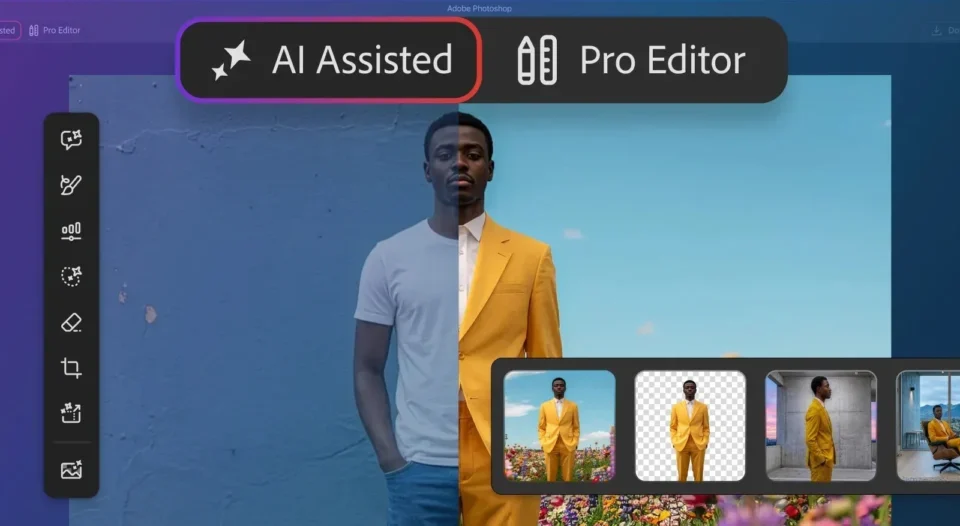
The cornerstone of this update is the introduction of the AI Assisted Editor, currently available in beta. This feature transforms Photoshop’s traditional, tool-heavy workspace into a simplified, prompt-based interface. Designed with an aesthetic reminiscent of the Adobe Firefly web editor, the AI Assisted Editor features a dedicated side panel that houses core generative AI functionalities, including Generative Fill, background removal, and a conversational text-prompt interface.
For existing power users, Adobe has rebranded the standard, high-complexity interface as Pro Editor mode. This ensures that while the software welcomes newcomers, the deep, pixel-level manipulation tools that professionals rely on remain untouched and fully accessible.
Key features introduced in this rollout include:
- Prompt to Edit: A generative capability allowing users to apply global or localized changes to an entire image through text commands, such as "add stormy clouds and rain."
- Instruct Edit with Masks: Powered by the new Firefly Image 5 model, this allows users to specify precise regions for AI intervention, ensuring that unmasked areas remain pristine.
- Visual Markup: An intuitive drawing tool that allows users to circle or highlight specific areas of an image, providing the AI with a visual reference for recoloring or modifications.
- Professional Lighting Controls: The new Light Adjustment Layer offers non-destructive manipulation of exposure, shadows, and contrast.
- Stock Integration: A dockable panel providing direct access to Adobe’s library of over 900 million assets.
Chronology: The Path to AI Integration
The evolution of Adobe’s strategy can be traced back to the early 2020s, as the company recognized the looming disruption of generative AI models.
- Early 2023: Adobe introduced "Firefly," its proprietary generative AI model trained on ethically sourced stock imagery. This marked the company’s first major pivot toward embedding AI directly into its Creative Cloud suite.
- Late 2023: The integration of Generative Fill into Photoshop became a watershed moment, allowing users to extend images and remove objects with unprecedented ease.
- Mid-2024: Adobe focused on performance upgrades, specifically refining the speed of Firefly-powered rendering within local environments.
- August 2026 (Current Update): The release of the AI Assisted Editor signifies the transition from "AI as a plugin" to "AI as the primary interface." By bifurcating the user experience into an Assisted mode and a Pro mode, Adobe is acknowledging that the future of creativity lies in the hybrid cooperation between human intent and machine execution.
Supporting Data: The Efficiency Gap
Industry analysis suggests that the barrier to entry for professional image editing software has historically been high, with many users requiring months of training to master basic workflows. Adobe’s internal testing indicates that the AI Assisted Editor reduces the time required for common tasks—such as background removal, lighting adjustments, and asset composition—by approximately 60% compared to traditional manual methods.
Furthermore, the integration of Adobe Stock into the workspace is expected to minimize "context switching." Designers currently spend an average of 15–20% of their working hours navigating between browser-based asset stores and their editing software. By embedding a library of 900 million assets directly into the Photoshop dock, Adobe aims to keep the creative "flow state" uninterrupted.
The use of the Firefly Image 5 model also represents a leap in precision. Unlike earlier iterations, which often struggled with complex shadows or perspective, the new masked-instruction features allow for a 40% higher accuracy rate in maintaining the structural integrity of the original image while modifying specific elements.
Official Responses and Strategic Vision
Adobe’s leadership has framed this update as an attempt to democratize high-end creative work. During the announcement, an Adobe spokesperson emphasized that the goal is not to replace the human artist, but to "automate the friction."
"Our users have told us that while they love the power of Photoshop, they sometimes find the sheer density of the toolbars intimidating when they just need a quick iteration," the spokesperson noted. "By introducing the AI Assisted Editor, we are providing a sandbox for experimentation. Whether you are a professional needing to quickly mock up a concept or a hobbyist trying to achieve a specific look, the tool now adapts to your expertise level rather than forcing you to adapt to it."
Adobe also addressed concerns regarding the "black box" nature of AI. By providing non-destructive layers for lighting and masking, the company is ensuring that users retain total control over the output. This is a direct response to feedback from creative agencies that feared AI tools would produce "one-and-done" images that could not be modified or refined to fit specific brand guidelines.
Implications: The Future of Professional Creative Work
The implications of this update are profound for both the creative industry and the future of software design.
1. The Death of "Gatekeeping"
For decades, proficiency in Photoshop was a professional credential. As interfaces become more natural-language-based, the value of "technical skill" is shifting toward "creative direction." The ability to craft the perfect prompt or visually mark an image for the AI to interpret will soon be as important as understanding curves or layers.
2. A New Era for Mockups
The AI Assisted Editor is set to become the standard for rapid prototyping. Creative directors and agencies can now use the tool to generate high-fidelity concepts in seconds, moving past the "sketch" phase significantly faster. This allows for more iterations before a final, detailed edit is performed in the Pro Editor mode.
3. Ethical and Copyright Stability
By continuing to lean on its proprietary Firefly model, Adobe remains the only major player in the AI space that offers legal indemnity to its enterprise customers. While competitors rely on scraped data, Adobe’s reliance on its massive stock library provides a level of security that is increasingly critical for advertising and marketing firms.
4. The Challenge of "Over-Automation"
There is a potential risk that these tools may lead to a homogenization of visual style. If users rely heavily on AI to handle lighting and composition, there is a danger that images may begin to look identical. Adobe’s emphasis on "control" and "masking" is a deliberate safeguard against this, pushing users to remain the primary decision-makers in the creative process.
5. Future-Proofing the Workforce
As the software evolves, the workforce must adapt. The distinction between a "Pro Editor" and a "Prompt Engineer" is beginning to blur. Photoshop is no longer just a collection of tools; it is becoming a creative partner. The professionals who thrive in the next decade will be those who can leverage these AI assistants to execute their vision with greater speed, while using their human intuition to guide the AI toward unique and emotive outcomes.
Conclusion
Adobe’s latest Photoshop update is a masterclass in balance. By respecting the legacy of the Pro Editor while aggressively pursuing the simplicity of AI-assisted workflows, Adobe has effectively hedged its bets against the shifting landscape of digital design. As the beta for the AI Assisted Editor rolls out, the creative community will be watching closely to see if these tools truly simplify the workflow or if they merely add a new layer of complexity to an already crowded digital canvas. One thing is certain: the era of the "blank page" is over, replaced by an era of "intelligent collaboration."