


















































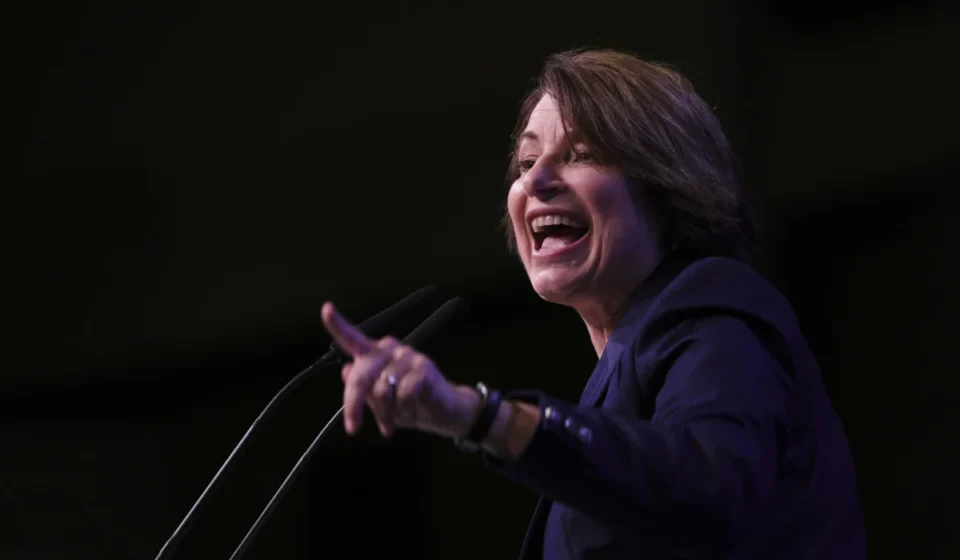

WASHINGTON D.C. & ST. PAUL, MN – In a political maneuver that has sent ripples through both Capitol Hill and the heart of Minnesota, U.S. Senator Amy Klobuchar, a formidable figure in national Democratic politics, has announced her decision to step away from her esteemed position in the Senate to run for governor of her home state. The unexpected pivot, spurred by Governor Tim Walz’s eleventh-hour decision not to seek a third term, positions Klobuchar as the heavily favored candidate to become Minnesota’s first female governor, promising a swift and decisive transformation of state government.
Klobuchar, 66, a veteran legislator known for her pragmatic approach and tireless work ethic, articulated her rationale with characteristic directness. "I truly do love my job in the Senate, but I love my state more than any job and I believe that we can get to a better place," she declared, signaling her profound commitment to Minnesota. Her frustration with the current state of affairs was palpable: "I don’t like the status quo." This sentiment underscores a campaign built on a promise of rigorous reform and a crackdown on alleged fraud, encapsulated in an ambitious 40-point plan. Her stated impatience for change, "Patience is a virtue, but it’s one I don’t have," sets a tone for an administration poised for immediate action.
The Unexpected Call: A Senator’s Sacrifice for State
The catalyst for Klobuchar’s dramatic career shift was the unforeseen announcement by Governor Tim Walz in early January, who, after prolonged speculation, reversed course and decided against pursuing a third term. Walz’s decision, conveyed to Klobuchar with just a single day’s notice, left a significant void at the top of the DFL (Democratic-Farmer-Labor) ticket.
"I’d been saying, ‘Maybe you could wait two weeks,’" Klobuchar recalled, recounting her initial reaction to Walz’s abrupt news. Despite the short timeline, she herself waited a measured two weeks before officially filing as a gubernatorial candidate, allowing for careful consideration and consultations. The senator confirmed that her decision was not made lightly, facing considerable pressure from her Washington colleagues. "There were a lot of people in the Senate that made the case for me to stay there," she admitted, acknowledging the weight of her seniority and influence within the Democratic caucus.
However, Klobuchar emphasized a deeper understanding among her peers regarding the unique circumstances in Minnesota. "But I think people understood the unique moment we were in as a state and why I made that decision," she stated, hinting at a broader recognition of the challenges facing Minnesota and the critical need for strong leadership. Her move represents a significant personal and political sacrifice, as she relinquishes a position of considerable national power for the more localized, albeit impactful, role of state chief executive.
From Capitol Hill to St. Paul: Weighing the Senate’s Lure
Klobuchar’s departure from the U.S. Senate is not merely a change of address but a forfeiture of substantial political capital. A long-standing member of Democratic leadership, she had meticulously climbed the ranks through years of dedicated service and legislative acumen. Her ascent culminated in securing the No. 3 spot in Senate Democratic leadership as chair of the Steering and Policy Committee, a position that afforded her considerable influence over legislative priorities and strategic direction.
Senator John Hoeven, a Republican from North Dakota who has frequently collaborated with Klobuchar on critical regional issues, suggested that her decision might have been influenced by a realistic assessment of her future trajectory in Washington. "She had to weigh, ‘Do I stay and see how that plays out or do I go back to Minnesota?’" Hoeven observed, highlighting the strategic considerations inherent in such a career pivot. The upper echelons of Senate leadership are notoriously difficult to penetrate, often requiring decades of service and specific political alignments.
Tim Lindberg, a political science professor at the University of Minnesota Morris, offered a compelling academic perspective on Klobuchar’s motivation, pointing to the inherent frustrations of working within an increasingly gridlocked U.S. Senate. Lindberg noted that regardless of which party holds the majority, the Senate’s filibuster rule—which demands at least 60 votes to advance most legislation—frequently acts as a formidable impediment to progress. This procedural hurdle has stymied countless initiatives, leading to a sense of stagnation for many legislators.
"Being governor allows her to be in a power position where she can do things and make big changes," Lindberg explained, articulating the allure of executive power. The governorship offers a more direct pathway to implementing policy and enacting reforms, free from the often-paralyzing partisan divisions and procedural bottlenecks characteristic of Washington. The professor further highlighted the strategic advantage Klobuchar gained by entering an open race relatively early, effectively "eclipsing all other possible (Democratic) contenders" and consolidating DFL support.
A State in Crisis: The Impetus for Action
Beyond political calculations, Klobuchar’s decision appears deeply rooted in a genuine concern for her state’s recent travails. She explicitly cited the "horror" of a series of tragic events that have gripped Minnesota as a significant influence on her decision to run for governor. These included the shocking murders of former Minnesota House Speaker Melissa Hortman and her husband, the devastating mass shooting at Annunciation Catholic School, and the controversial deaths of Renee Good and Alex Pretti at the hands of federal agents during "Operation Metro Surge."
These incidents, ranging from domestic violence to public safety crises and federal overreach, paint a grim picture of a state grappling with profound challenges. Klobuchar framed these events as obstacles to Minnesota’s collective aspirations. "I’ve always believed that we could get to higher ground and it’s been one thing after another that’s made that hard in Minnesota," she lamented, underscoring a belief that the state needs a strong, unifying leader to navigate these turbulent times and restore a sense of security and purpose.
Building a Campaign: Strategy, Strength, and Bipartisan Credentials
Klobuchar has wasted no time in assembling her gubernatorial team, choosing former Fergus Falls Mayor Ben Schierer as her lieutenant governor candidate. Schierer’s background as a mayor from a Greater Minnesota city could offer valuable geographical and demographic balance to the ticket.
Having served Minnesota in the U.S. Senate since 2007, Klobuchar is a well-established political figure, a "known commodity" with a distinctive profile. She has cultivated a reputation as a moderate Democrat, capable of working across the aisle while also fearlessly challenging powerful interests. Her legislative targets have included the pharmaceutical industry, pushing for lower drug prices, and tech giants, advocating for greater accountability and competition. Her workaholic tendencies are legendary on Capitol Hill, a trait she candidly admits can sometimes exhaust her staff. Yet, it is this same relentless drive, coupled with an innate ability to forge common ground with Republicans, that has defined her legislative successes.
"I’ve always focused on getting things done," Klobuchar affirmed, reiterating her core political philosophy. She sees the current moment as a critical juncture for Minnesota: "There’s this moment in time that is not going to be like any other where we’ve been facing hard things and I want to make sure that we stay together as a state, despite the political divides and changing the status quo and not just accepting things and restoring people’s trust in our government again."
Senator Tammy Baldwin, a Democrat from Wisconsin, who frequently collaborated with Klobuchar on regional issues, attested to her colleague’s effectiveness. "When she’s trying to persuade a colleague on an issue, she’s really prepared," Baldwin noted. "She also has the instinct to know where an agreement can be forged." This capacity for preparation and compromise has been a hallmark of Klobuchar’s Senate tenure.
Her dedication extends beyond Washington, reaching every corner of Minnesota. Baldwin highlighted Klobuchar’s unparalleled commitment to constituent engagement: "She visits every single county in Minnesota every year. That means to me she knows every corner of the state and she has her finger on the pulse." This grassroots connection is expected to be a significant asset in her gubernatorial campaign.
Even her bipartisan partners acknowledge her indefatigable nature. Senator Hoeven, recalling their joint efforts on a massive Red River flood protection plan, quipped that Klobuchar "probably gets no more than six hours of sleep."
Professor Lindberg characterized Klobuchar’s bipartisanship as "politically palatable." He elaborated that she does not merely adopt Republican initiatives but strategically identifies areas of shared interest, enabling collaborative legislative outcomes. A prime example of this pragmatic approach is her partnership with Senator Ted Cruz, a staunch Republican from Texas. Their collaboration led to the "Take it Down Act," a landmark piece of legislation that criminalizes the non-consensual sharing of AI-generated intimate images and mandates social media platforms to remove such content within 48 hours. Klobuchar views this as a model for broader digital safety: "It’s a model (to take down) other inappropriate things on platforms." She even leveraged her position as chairman of the Joint Congressional Committee on Inauguration Ceremonies, fostering a direct line to then-First Lady Melania Trump, to successfully lobby President Donald Trump for his support of the "Take it Down Act."
The ‘Strongest DFL Statewide Candidate’
Klobuchar’s political pedigree is undeniable. A graduate of Yale and the University of Chicago Law School, she has authored several policy books, mounted a presidential bid, and served as Hennepin County Attorney. Her name has resonated within Minnesota for decades, initially benefiting from the prominence of her father, Jim Klobuchar, a revered sports and politics reporter for the Star Tribune. Today, she stands as the most recognized Klobuchar in the state, a political titan whose presence at the top of the DFL ticket is expected to buoy the fortunes of other party candidates down-ballot.
Jacob Rubashkin of Inside Elections, a non-partisan political analysis publication, underscored Klobuchar’s formidable political standing. Her strength, he noted, lies in her "universal name ID and a track record of being the strongest DFL statewide candidates over the past decade." Rubashkin further detailed her campaign advantages: "She has a nationwide fundraising base from her time in the Senate and presidential run, and an existing statewide infrastructure that she can redirect to her gubernatorial contest." This established network and financial backing provide her with an unparalleled head start.
Indeed, Klobuchar’s fundraising efforts have been robust, having already amassed more than $7 million in campaign cash, far outstripping her potential rivals. This financial dominance is a clear indicator of her widespread support and the confidence placed in her candidacy.
Looking ahead to the August primary, Klobuchar is widely expected to secure the DFL nomination against progressive challenger Kobey Layne. Her victory would set the stage for a general election showdown against one of three Republicans vying for their party’s nomination: House Speaker Lisa Demuth, former healthcare executive Kendall Qualls, or the controversial My Pillow CEO Mike Lindell.
While her eventual Republican opponent remains to be determined, Klobuchar’s campaign messaging is already taking shape. She has focused on critiquing former President Trump on various issues, including the widely reported "reflecting pool fiasco," and aligning with the Democratic Party’s national mantra of "affordability," a resonant theme amidst rising prices for essential goods like oil and food. Interestingly, her direct appeals for campaign donations frequently highlight Mike Lindell, whose personal allegiance to Trump and false claims about the 2020 election have made him a polarizing figure, leading to numerous lawsuits and multi-million dollar judgments. Lindell’s higher name recognition among the GOP contenders makes him a convenient fundraising foil.
Regardless of who emerges from the Republican primary, they face an uphill battle. Minnesota Republicans have not won a statewide election in two decades, a testament to the DFL’s enduring strength in the state and the formidable challenge of unseating a candidate of Klobuchar’s caliber.
Clout That Would Be Hard to Replace: The Implications for Minnesota
Klobuchar’s potential victory in November carries significant implications, particularly regarding Minnesota’s representation and influence in Washington. If she vacates her Senate seat, any appointed successor would find it exceedingly difficult to replicate her level of seniority, legislative skill, and the resulting clout she wielded on behalf of the state.
Her long tenure and strategic positioning in the Senate have enabled Klobuchar to direct billions of federal dollars towards critical Minnesota projects. Senator Baldwin highlighted their joint effort in securing over $1 billion to replace the aging 60-year-old Blatnik Bridge, a vital artery carrying Interstate 535 and U.S. Highway 53 between Duluth, Minnesota, and Superior, Wisconsin. Though the project received initial approval under former President Joe Biden’s massive infrastructure bill, concerns about its fate arose with the prospect of a second Trump administration. Klobuchar and Baldwin successfully lobbied Transportation Secretary Sean Duffy, a northern Wisconsin native, leveraging personal relationships to safeguard the funding.
Similarly, Klobuchar’s partnership with Senator Hoeven was instrumental in securing federal funding for the U.S. Army Corps of Engineers’ Red River flood prevention project. This $3.2 billion public-private partnership, a testament to intricate legislative maneuvering, involved years of collaborative effort, transforming what was once a "friendly rivalry" of sandbagging efforts between the states into a permanent solution. Hoeven lauded the complex "lot of legislation" required to bring the project to fruition.
Hoeven, who served as North Dakota’s Republican governor before his Senate career, offered a telling perspective on the different roles. "Governor was the better job," he stated unequivocally. "I am deeply honored to be in the Senate, but as governor you can set your agenda and work with people to achieve it and Amy would really like that." His words resonate with the understanding that for a driven, results-oriented politician like Klobuchar, the executive power of a governorship offers a more direct and satisfying path to achieving substantive change than the often-frustrating machinations of the U.S. Senate.
Amy Klobuchar’s pivot to the Minnesota gubernatorial race represents a momentous shift, not just for her personal career, but for the political landscape of Minnesota and the broader Democratic Party. Her deep roots in the state, combined with her national political experience and reputation for getting things done, position her as a formidable candidate ready to tackle Minnesota’s challenges head-on. The stakes are high, with the state poised for a potentially transformative era under the leadership of its first female governor, but also facing the loss of a powerful voice in the halls of Congress.