














































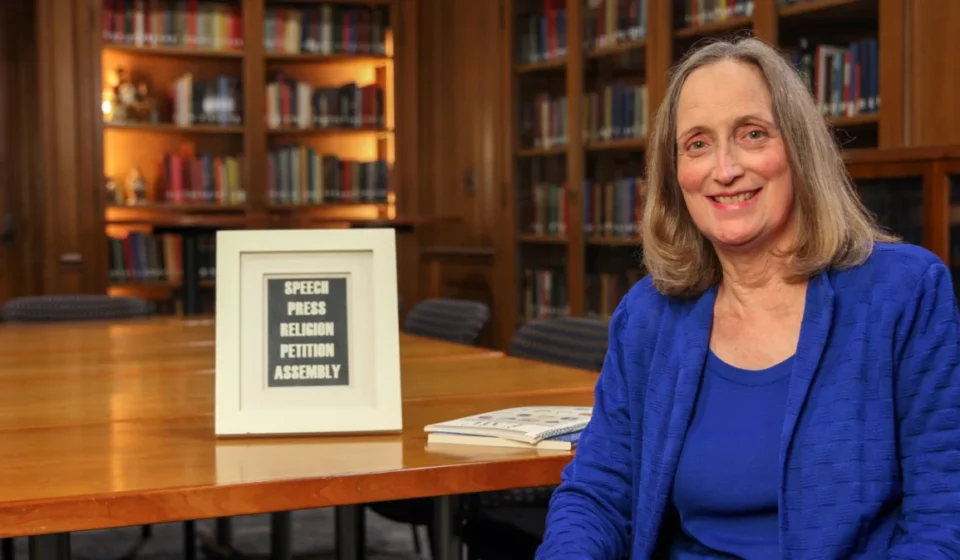
A Pillar of Press Freedom: Jane E. Kirtley Reflects on a Career Defined by the First Amendment

As the academic year draws to a close, the University of Minnesota’s Hubbard School of Journalism and Mass Communication is preparing to bid farewell to a titan of media law. Jane E. Kirtley, the Silha Professor of Media Ethics and Law, will officially retire on May 25, marking the end of a career that has served as a bedrock for press freedom advocacy in the United States and abroad.
For over four decades, Kirtley has been the definitive authority on First Amendment jurisprudence and freedom of information issues. Whether advising legacy media giants or mentoring the next generation of investigative reporters, her influence has been both broad and profound. As she steps away from the classroom, she leaves behind a landscape of journalism that is, by her own admission, facing its most perilous existential threats in the modern era.
A Legacy Built on Legal Advocacy
Kirtley’s departure is not merely the retirement of a professor; it is the closing of a storied chapter in the history of media law. Before joining the University of Minnesota in 1999, Kirtley honed her expertise on the front lines of the legal battle for public access.
She spent 14 years as the executive director of the Reporters Committee for Freedom of the Press in Arlington, Virginia. In that capacity, she became the go-to expert for journalists navigating the complex web of libel, privacy, and government transparency. Prior to her work with the Committee, she practiced law at a firm in New York and Washington, D.C., for five years, gaining the tactical experience that would later define her academic approach.
Her transition to academia allowed her to institutionalize her advocacy. As the Silha Professor, she expanded the reach of the Silha Center for the Study of Media Ethics and Law, ensuring that the next generation of journalists understood that the law is not just a barrier to be avoided, but a tool for accountability.
The Decision to Step Down: A Personal Reflection
The question of "why now" is one that Kirtley has wrestled with for years. She initially considered retirement in late 2019, following the retirement of her husband, Stephen Cribari, a law professor at Notre Dame. However, the COVID-19 pandemic—with its sudden shift to virtual learning and the suspension of global travel—gave her pause.
"You just can’t take for granted you can keep doing the things you care about doing, and travel is very important to me," Kirtley explained. She recalled her five-month Fulbright tenure in Riga, Latvia, as a highlight of her professional life, noting that she wants to prioritize her health while she still has the vitality to explore the world.
She considered stepping down again over a year ago but delayed the decision, correctly anticipating that the onset of a second Trump administration would trigger unprecedented legal challenges for the American press. Having now reached the age of 72, she feels the time has come to pass the baton, drawing inspiration from her predecessor, Don Gillmor. Gillmor, the founding director of the Silha Center, retired in 2009 but faced declining health shortly thereafter, passing away in 2013. For Kirtley, the lesson is clear: life is finite, and the work of defending the First Amendment is perpetual.
The Weaponization of the Law
In an exclusive interview, Kirtley offered a sobering assessment of the current state of journalism. She argues that the most significant threat today is not merely political rhetoric, but the active "weaponization" of the legal system to stifle independent reporting.
"I’ve been doing media law since the 1980s," she noted. "The biggest concern I have right now is the weaponizing of the law to go after the independent media. President Trump has been leading the charge on this."
Kirtley pointed to the erosion of long-standing legal protections, specifically the New York Times v. Sullivan libel standard. Established in 1964, the Sullivan ruling requires public officials to prove "actual malice" in libel cases—a high bar that protects journalists from being sued into silence. While threats to Sullivan have existed for decades, Kirtley warns that the current composition of the Supreme Court has created a genuine risk that this foundational precedent could be overturned.
"We know the current court has been willing in other contexts to reverse or overrule existing precedent of long standing," she said. "Whether they would do so to Times v. Sullivan is anyone’s guess. But that threat represents the greatest risk to the stability of a principle that has served us so well."
Corporate Interests vs. Public Service
Beyond the courtroom, Kirtley identifies an "operational crisis" within the media industry itself. She observes that the ownership structure of modern media outlets has shifted away from the public interest model that dominated the mid-20th century.
"So many of the owners of media outlets today do not see them as vehicles for serving the public interest," Kirtley observed. "They see them as means for wielding power or maximizing profit or both."
She draws a sharp contrast between the press barons of the past—who, despite their profit motives, maintained a commitment to the role of the press in a democracy—and the current influx of venture capitalists and "Silicon Valley bros." This shift, she suggests, has contributed to a weakened media ecosystem that is increasingly unable to effectively hold power to account.
The Credibility Gap and the Information Silo
Kirtley traces the current "fake news" crisis back to a systematic, decades-long campaign to undermine the credibility of mainstream journalism. She argues that the post-Watergate era of journalistic prestige has been dismantled by both political extremes, leaving the public susceptible to misinformation.
"It becomes very easy for someone like President Trump to use terminology as he did in his first administration, calling the press the enemy of the American people," she said. "If you’re an institution that has been labeled as a liar, how credible is it for you to be calling out lies by another institution?"
This credibility gap is exacerbated by the digital age, where users can isolate themselves in information silos that reinforce existing biases. Even when journalists provide rigorous, evidence-based documentation of government wrongdoing, that information is often dismissed as biased by those who have been conditioned to distrust the institution of the press.
The Artificial Intelligence Dilemma
Perhaps the most contentious issue Kirtley addresses is the role of artificial intelligence in newsrooms. Her stance is unequivocal: she views AI as "the devil’s tool."
"Using it mindlessly is a disaster in the making," Kirtley asserted. "It’s a tool. It doesn’t think. It’s not a human being. We shouldn’t expect it to act ethically because it’s not in a position to operate in that way."
She expressed concern that AI is being used as a cost-cutting measure to replace human copy editors—the critical "safety net" that ensures accuracy and accountability. While acknowledging that some organizations, such as The New York Times, have implemented strict prohibitions on AI-generated text for freelancers, she fears that "AI-native" generations entering the workforce may not possess the critical thinking skills to resist the allure of automated content.
Regulatory Overreach: The Case of the FCC
Finally, Kirtley turned her attention to the Federal Communications Commission (FCC) under the leadership of Chairman Brendan Carr. She characterized the current regulatory climate as the most "blatantly political" in modern history.
"His relentless assault on broadcast media who are not toeing the line for President Trump… I’ve not seen anything like it in my career," she said.
Kirtley argued that the FCC’s recent scrutiny of late-night talk shows and their networks represents a dangerous departure from the agency’s mandate. While the FCC has the authority to regulate content based on standards like indecency, it is constitutionally barred from engaging in viewpoint-based retaliation. By questioning the "bona fide news" exemption for satirical programs, the FCC is signaling a willingness to leverage regulatory power to suppress dissent, an act that Kirtley views as a profound violation of the First Amendment and the Federal Communications Act of 1934.
A Final Message for the Future
Despite the gravity of these challenges, Kirtley remains hopeful about the next generation of journalists. She distinguishes between "influencers" and those driven by a genuine commitment to public service.
"I know there are still many young people who want and who need to do journalism," she said. "They want to hold government and other powerful institutions to account. They want to provide the public with information they need to make good, informed decisions."
As she prepares to leave the University of Minnesota, Jane Kirtley’s legacy is secured not only in the hundreds of students she has mentored but in the institutional resilience she helped build. Her departure marks a transition for the Hubbard School, but her career remains a roadmap for anyone committed to the truth in an increasingly complex and hostile media environment. Her final lesson is perhaps her most important: in the face of legal, corporate, and technological pressures, the duty of the journalist remains unchanged—to uncover the truth, document reality, and defend the public’s right to know.