






























A Convergence of Generations: "Sakowin Synergy" Bridges Past and Future at All My Relations Gallery

The walls of Minneapolis’s All My Relations Gallery are currently humming with a rare, intergenerational dialogue. "Sakowin Synergy," the latest exhibition from South Dakota-based artist Ray "Rock Boy" Janis, is more than a mere showcase of individual talent; it is a profound exploration of the Oceti Sakowin—the Seven Council Fires—and the enduring strength of the alliance between the Dakota, Lakota, and Nakota nations. By weaving together the distinct artistic vocabularies of emerging digital-age creators and established masters, the exhibition serves as a living tapestry of Indigenous continuity.
The Core Concept: Mentorship as Artistic Foundation
At the heart of "Sakowin Synergy" is the dismantling of the traditional, solitary artist archetype. Ray Janis, an Oglala Lakota artist whose work frequently explores the intersections of modern pop culture, superhero motifs, and traditional storytelling, has consciously positioned his mentors as his primary collaborators.
The exhibition features the work of Sheldon Starr, a close friend and peer of Janis, alongside the foundational contributions of industry stalwarts Dwayne "Chuck" Wilcox and Jim Yellowhawk. While Janis and Starr represent a contemporary, often digital-forward aesthetic, Wilcox and Yellowhawk provide the grounding of a seasoned, "old-school" approach. According to gallery director Angela Two Stars, this pairing was intentional. "They have the old-school style, whereas Ray and Sheldon are more contemporary," she notes. "The show is about blending those together and using their work to speak to the influences they have on one another."
The title of the exhibition is a direct reference to the Oceti Sakowin, an historic political and cultural alliance that has defined the social landscape of the Great Plains for centuries. By invoking this name, the artists are not merely referencing a historical fact; they are asserting that their creative collaboration is an extension of that ancient, protective, and unified spirit.
A Chronology of Collaboration
The genesis of "Sakowin Synergy" was not a singular event but a multi-year trajectory of professional development and organic friendship.

- 2020: The professional relationship between the core group and the gallery began in earnest when Janis and Starr participated in an emerging artist cohort facilitated by the Hennepin Theatre Trust in partnership with All My Relations.
- 2022: The gallery showcased the two artists in a group exhibition, solidifying their presence in the Minneapolis arts ecosystem and catching the attention of established figures like Jim Yellowhawk.
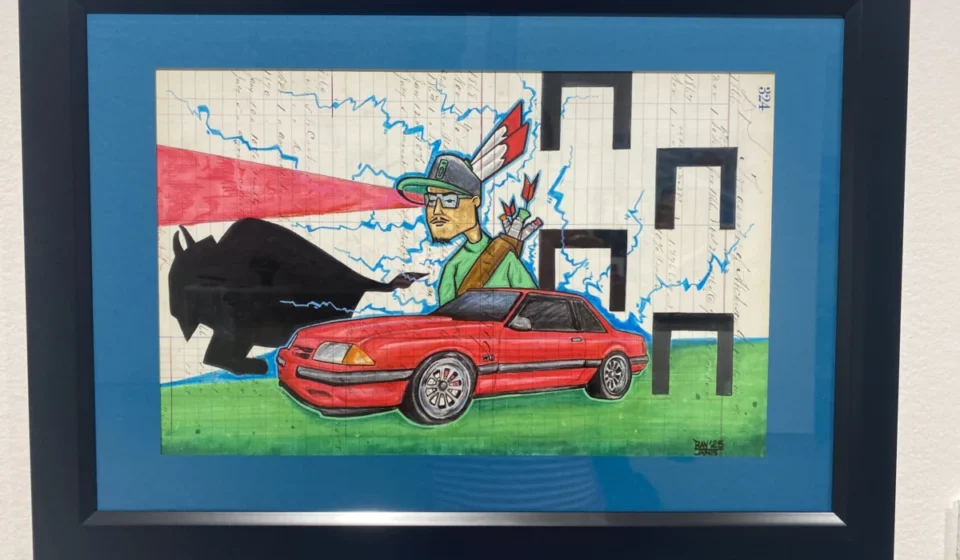
- 2025: The project began to take its final form. The catalyst was, ironically, a comic book-inspired piece by Janis. When Yellowhawk saw a painting featuring a character from "The Fantastic Four," he reached out to invite Janis to contribute to his own work. "I was like, ‘For real?’" Janis recalls. "It’s one of my heroes growing up in the art world."
- January 2026: The exhibition was originally slated to open in early winter. However, the gallery made a pivotal decision to delay the opening to serve as a hub for mutual aid in the wake of "Operation Metro Surge," an anti-ICE enforcement action that deeply impacted the local community.
- July 9, 2026: The exhibition officially opened, transformed from its original concept into a celebration of resilience, community, and creative solidarity.
Ledger Art: A Tradition Reclaimed
Central to the technical prowess on display is the use of ledger art. This practice, which involves creating drawings and paintings on the pages of historical bookkeeping ledgers, originated in the 19th century as a response to the scarcity of traditional materials like buffalo hides.
In "Sakowin Synergy," the ledger format is not merely a nostalgic choice; it is a medium for evolution. The showpiece, titled "Rez Boys Boogie" (2026), is a massive, long-form canvas that serves as a masterclass in collaboration. The painting depicts a pow wow circle viewed from a bird’s-eye perspective.
The division of labor within the piece is a testament to the artists’ mutual respect:
- Janis provided the foundational geometry, drawing the central circle and the celestial elements.
- Starr contributed complex, dynamic geometric forms and bat imagery, adding a layer of contemporary flair.
- Wilcox and Yellowhawk, both seasoned pow wow dancers themselves, rendered themselves as figures on either side of the circle, framing the composition.
Remarkably, despite the four distinct voices involved, the piece feels entirely unified. It marks a historic moment in the local art scene: although Wilcox and Yellowhawk have been friends for years, "Rez Boys Boogie" represents the first time they have ever physically worked on the same sheet of paper together.
Official Perspectives and Community Impact
The atmosphere at the opening reception on July 9 was one of profound community celebration. Attendees were treated to fry bread and refreshments from the adjacent Pow Wow Grounds coffee shop, and the gallery was filled with the families of the artists. This festive environment stood in stark contrast to the gravity of the gallery’s work just months prior.

By pivoting to support mutual aid efforts in January, the All My Relations Gallery underscored a fundamental tenet of their mission: that art is not separate from the lived experience of the community. This commitment to social justice is reflected in the art itself.
Janis’s piece "Tatanka O’sni" (2026) is perhaps the most pointed example of this. The painting, an "anti-ICE" work, features a bison rendered in jarring, icy shades of blue. The animal is depicted charging through diagonal lines—an artistic metaphor for breaking through the metaphorical and physical "ice" of exclusionary policies. The angular, radiating streaks of blue suggest a spiritual, unstoppable force, providing a visual representation of resistance that feels both ancient and urgently modern.
Broader Implications for the Indigenous Arts Scene
"Sakowin Synergy" is not an isolated success; it is part of a larger, vibrant wave of Indigenous art currently defining the cultural landscape of the Twin Cities. As the region continues to grapple with its history and future, these exhibitions offer a roadmap for reconciliation and creative expression.
The exhibition invites viewers to consider the "synergy" mentioned in its title not just as an artistic concept, but as a survival strategy. In an era where cultural identity is often commodified or silenced, the collaborative nature of this show serves as a bold statement. By centering mentorship, the artists ensure that the knowledge of the "old school" is passed to the next generation, while the younger artists push the boundaries of what that knowledge can look like in a digital age.
The exhibition remains on view at the All My Relations Gallery through September 5, 2026. As summer turns to autumn, the show serves as a poignant reminder that while individual artists may achieve renown, the true power of the Oceti Sakowin lies in its collective, interconnected strength.

Other Notable Exhibitions to Explore
For those interested in the broader context of Indigenous art in the Twin Cities, the following exhibitions are currently recommended:
- "Encounters" (Bockley Gallery): A deep dive into the intersections of contemporary and traditional visual storytelling.
- "Queering Indigeneity" (Minnesota Museum of American Art): A vital exploration of the intersectional identities within the modern Indigenous experience.
- "Merciless: Indigenous Lands Since 1776" (Weisman Art Museum): A powerful historical retrospective that examines the impact of colonial policy on the landscape of the United States.
Ultimately, "Sakowin Synergy" is a must-see for its technical brilliance, but it is an essential experience for its heart. It proves that when artists come together—not just as colleagues, but as relatives—they can create something that transcends the canvas and touches the very soul of the community.