























































The Road to PlayStation 6: Hardware Leaks, Patent Breakthroughs, and Sony’s Evolving Launch Strategy

As the PlayStation 5 generation approaches its sixth year, industry analysts, game developers, and consumers are turning their attention to Sony Interactive Entertainment’s next hardware transition. The current console landscape—marked by the original PlayStation 5 launch in November 2020 and the mid-generation PlayStation 5 Pro four years later—is entering a critical phase of speculation and technical development.
Recent developments from silicon supply chains, patent databases, and executive briefings offer a clearer picture of Sony’s internal direction. While reports indicate that primary chip designs for the PlayStation 6 have reached a major engineering milestone, corporate leadership remains cautious regarding a fixed commercial launch window. Simultaneously, newly published patent filings reveal radical proposals for input devices, hinting at a potential departure from traditional controller architectures.
1. Main Facts: Core Leaks, Hardware Specs, and Patent Discoveries
The recent swell of information regarding Sony’s next-generation hardware centers on three primary developments: main processor tape-out status, modular controller patents, and potential multi-device hardware ecosystem strategies.
       PLAYSTATION 6 DEVELOPMENT & INDUSTRY INDICATORS
+----------------------------------------------------------------+
|  PROCESSOR MILESTONE  | Main SoC achieved "Tape-out" status    |
|  PERFORMANCE TARGET   | ~40 Teraflops (~2x PS5 raw GPU power)  |
|  KEY CONTROLLER PATENT | US20260199776 (Modular, Touchscreen)   |
|  EXECUTIVE WINDOW     | Undecided (Evaluating 2027 vs 2028/29) |
+----------------------------------------------------------------+
Main Processor Tape-Out
Hardware insider KeplerL2 reported that the central processing unit and graphics architecture for the PlayStation 6 have completed the design phase and achieved "tape-out." In semiconductor manufacturing, tape-out signifies that the integrated circuit layout is finalized and ready to be sent to the foundry for initial mask fabrication and physical prototyping.
Unverified performance metrics linked to these leaks suggest early target thresholds of approximately 40 teraflops of compute power—roughly double the raw graphical throughput of the base PlayStation 5—alongside substantial architectural overhaul dedicated to real-time ray tracing and hardware-accelerated ray bending.
Modular Touchscreen Controller Patent
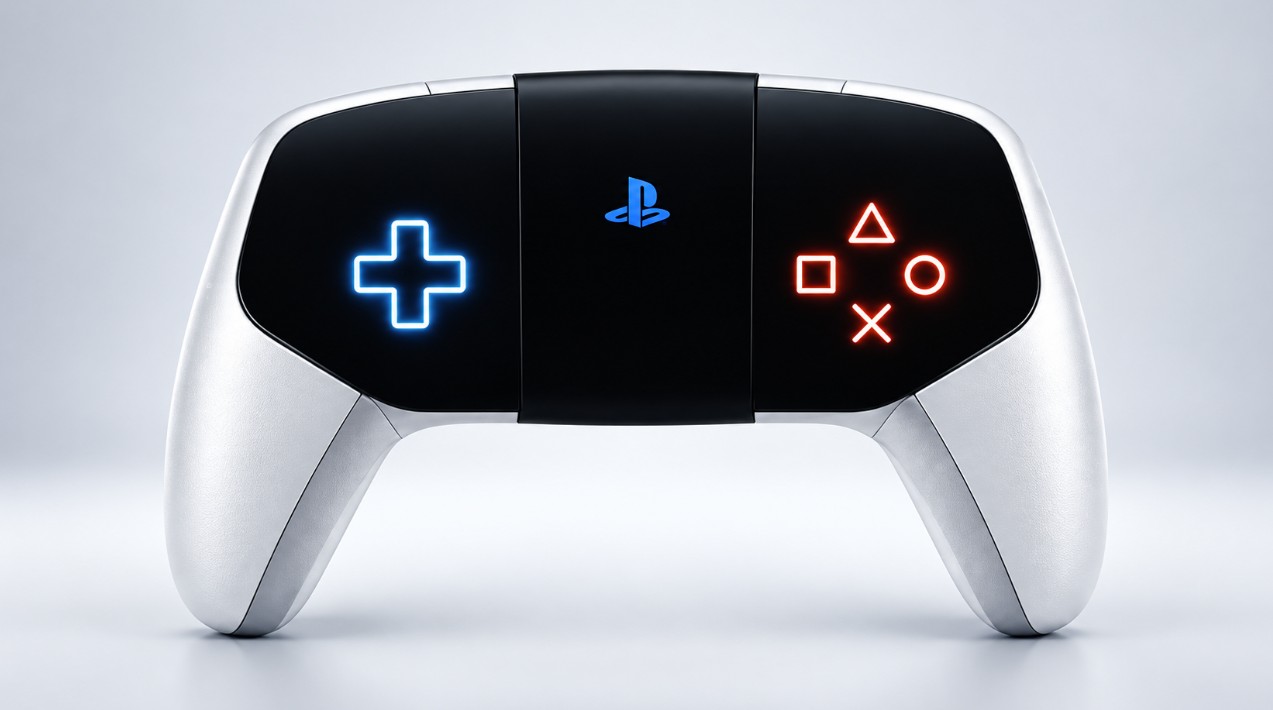
On July 16, 2026, the United States Patent and Trademark Office (USPTO) published a detailed Sony patent application (Publication US20260199776). The document describes an advanced, modular input device featuring:
- An integrated central interactive display (touchscreen) replacing the static DualSense capacitive touchpad.
- A contextual control interface paired with physical rotational dials for real-time menu navigation.
- A magnetic grid sub-layer allowing physical components—including analog thumbsticks, directional pads, and screen modules—to be detached, swapped, or physically reconfigured.
Handheld Ecosystem Expansion
Concurrently, supply chain reports and executive commentary suggest Sony is evaluating a multi-device strategy for the next generation. This includes a native handheld companion system capable of local game rendering, moving away from the cloud-and-remote-play-only framework of the PlayStation Portal.
2. Chronology of Events and Industry Developments
Understanding the path toward the PlayStation 6 requires contextualizing key milestones across hardware releases, executive disclosures, and intellectual property filings:
                          CHRONOLOGY OF EVENTS

   Nov 2020    Late 2024   Feb 2026     Jul 2026     Aug 2026    Sep 2026    Oct 2026
      |------------|----------|------------|------------|-----------|-----------|
    PS5          PS5 Pro    Internal    Modular     Sony CEO    Processor   PSSR AI
   Launch       Release     Costing     Controller   Defers     Tape-Out    Upscaling
                           Delay Risk    Patent     PS6 Date    Reported     Detailed
Surfaces Published (Totoki) (KeplerL2) (AMD)- November 2020: Sony launches the base PlayStation 5, establishing a standard home console baseline utilizing AMD Zen 2 CPU architecture and RDNA 2 graphics.
- Late 2024: Sony introduces the PlayStation 5 Pro, featuring an expanded GPU, enhanced ray-tracing blocks, and PlayStation Spectral Super Resolution (PSSR) hardware upscaling technology.
- February 2026: Market intelligence summaries published via Bloomberg indicate that internal Sony projections are weighing potential launch delays into 2028 or 2029 due to component procurement inflation and semiconductor supply chain volatility.
- June 2026: During a corporate business strategy presentation, Sony Interactive Entertainment CEO Hideaki Nishino highlights the development of flexible architectural frameworks capable of running software across varied form factors and locations, fueling speculation regarding a dedicated handheld device.
- July 16, 2026: The USPTO publishes Sony’s modular touchscreen controller patent (US20260199776), revealing internal R&D into dynamic, reconfigurable input hardware.
- August 17, 2026: In an earnings call, Sony Group Corporation CEO and President Hiroki Totoki explicitly states that an official release date for the PlayStation 6 has not yet been finalized, citing macroeconomic conditions and volatile component markets.
- September 24, 2026: Outlets including Push Square report hardware insider disclosures claiming the main system-on-chip (SoC) for the PS6 has successfully taped out, pointing to a potential target launch window of late 2027.
- October 1, 2026: Sony publicly unveils advances in software-driven image reconstruction, detailing its Quick Spectral Super Resolution initiative in collaboration with AMD under Project Amethyst.
3. Supporting Technical Data and Market Factors
The Semiconductor Timeline: From Tape-Out to Retail Production
While news of a chip design achieving "tape-out" generates consumer enthusiasm, the timeline between tape-out and global retail availability is extensive.
                       SEMICONDUCTOR DEVELOPMENT LIFECYCLE

  +------------------+     +-------------------+     +--------------------+     +-------------------+
  | Logic & IP Design| --> | Tape-Out (Foundry) | --> | Silicon Validation | --> | Mass Production & |
  |   (Completed)    |     |   (18-24 Months)  |     | & SDK Distribution |     | Retail Packaging  |
  +------------------+     +-------------------+     +--------------------+     +-------------------+
In modern high-performance computing (HPC) engineering, tape-out triggers a multi-phase validation cycle:
- Engineering Samples (A0 Silicon): Initial physical chips are produced in low volumes to verify basic logic, clock stability, thermal output, and power consumption.
- Silicon Revisions & Validation: Iterative mask tweaks fix physical design flaws, taking between 6 to 12 months.
- Developer Kit Production: Early development kits containing near-final silicon are assembled and shipped to major software studios.
- Mass Production Lead Time: Wafer fabrication, packaging, testing, and final board assembly require an additional 6 to 9 months before global logistical distribution can occur.
Consequently, a September 2026 tape-out aligns mathematically with a target launch window spanning late 2027 to mid-2028, assuming silicon yields remain stable and mask revisions are minimal.
Component Cost Pressures and Memory Scarcity
The primary operational challenge facing Sony’s hardware division stems from global dynamic random-access memory (DRAM) and high-bandwidth memory (HBM) allocation. The global expansion of enterprise artificial intelligence data centers has drastically heightened demand for advanced memory node production at major foundries like TSMC, Samsung, and SK Hynix.
+----------------------------------------------------------------------------------+
|                          MACROECONOMIC HARDWARE PRESSURES                        |
+--------------------------+-------------------------------------------------------+
| Market Variable          | Direct Impact on PlayStation 6 Planning               |
+--------------------------+-------------------------------------------------------+
| Enterprise AI Demand     | Consumes foundry capacity for high-density DRAM/HBM.  |
| Component Inflation      | Drives up bill-of-materials (BOM) cost per console.   |
| Consumer Price Threshold | Limits maximum launch MSRP without heavy subsidies.    |
| Process Node Yields      | Advanced nanometer nodes yield fewer viable chips.    |
+--------------------------+-------------------------------------------------------+
High bill-of-materials (BOM) estimates complicate target pricing. Historically, console manufacturers operated on a loss-leader hardware model offset by software royalties. However, elevated wafer prices at leading-edge nanometer nodes make producing a massive leap in raw hardware specifications at a traditional $499 or $599 consumer price point difficult to achieve without heavy financial subsidies.
Patent US20260199776: Architectural Mechanics
The technical schematics accompanying Patent US20260199776 reveal an intricate mechanical design:
               PATENT US20260199776: MODULAR CONTROLLER CONCEPT

          +--------------------------------------------------------+
          | [ Removable ]   +------------------+   [ Removable ]   |
          |  Stick Module   |  Touchscreen &   |    Control Module |
          |                 |  Rotary Dial     |                   |
          |   (Magnetic)    +------------------+    (Magnetic)     |
          +--------------------------------------------------------+
          |         [ Structural Magnetic Grid Sub-layer ]         |
+--------------------------------------------------------+- Interactive Display Module: A low-power OLED or LCD touchscreen designed to handle secondary user interfaces (UI), inventory management, chat feeds, or mini-maps directly on the controller, taking processing load off the main TV output.
- Rotary Actuator Interface: Physical dials integrated around or adjacent to the screen provide tactile haptic feedback when scrolling through complex contextual wheels in-game.
- Magnetic Matrix Sub-layer: Uses polar-aligned magnetic arrays, allowing components to lock securely in place during high-actuation gameplay while remaining easily detachable via releasing switches. This offers significant accessibility advantages for gamers with limited mobility who require customized spatial button arrangements.
4. Official Responses and Executive Perspectives
Sony’s corporate leadership has maintained a measured position, managing public expectations while maintaining focus on the active lifecycle of the PlayStation 5.
Executive Commentary
Speaking during an August 2026 financial report, Sony Group CEO Hiroki Totoki clearly addressed public market speculation regarding launch schedules:
"Regarding our next-generation hardware planning, we have not finalized a specific commercial release window. Internal evaluations remain ongoing as we closely analyze market conditions, raw material expenditures, and component supply stability. Our focus remains on maximizing the installed base of the PlayStation 5 ecosystem while delivering value through our current hardware offerings."
This official stance highlights the tension between hardware development cycles and economic realities. While engineering teams continue technical development, executive management reserves the right to shift commercial timelines depending on unit cost efficiency.
Multi-Form Strategy Considerations
Sony Interactive Entertainment CEO Hideaki Nishino touched upon structural hardware adaptability during a mid-2026 corporate strategy session, stating:
"The landscape of interactive entertainment is expanding across mediums and environments. Looking forward, we are heavily leveraging underlying computing architectures that can be deployed across various form factors and physical locations, ensuring the PlayStation experience remains scalable without fragmenting our developer base."
Nishino’s remarks line up with industry reports indicating that Sony’s future silicon strategy emphasizes scale, enabling software to scale down to low-power handheld platforms or scale up to multi-terabyte dedicated home consoles using uniform instruction sets.
External Industry Assessment
Former PlayStation executive Shuhei Yoshida offered context during industry discussions, suggesting that a extended lifecycle for current platforms remains commercially sensible:
"Seven to eight years has traditionally represented the benchmark duration for a console generation. Given the prolonged transition period of the current generation and the ongoing technical maturity of mid-cycle consoles, allowing developers additional headroom on current architectures before forcing a generation shift is a logical course of action."
5. Industry and Consumer Implications
The technical parameters, patents, and timeline variables surrounding the PlayStation 6 carry wide-ranging implications for software developers, hardware vendors, and consumers.
                             INDUSTRY IMPACT MATRIX

  +----------------------+----------------------------------------------------------+
  | AUDIENCE             | KEY IMPLICATIONS                                         |
  +----------------------+----------------------------------------------------------+
  | Game Developers      | • Longer reliance on scaleable engine platforms          |
  |                      | • Transition toward hardware AI upscaling (PSSR/Amethyst) |
  |                      | • Dual-target builds (Home Console vs Portable Nodes)    |
  +----------------------+----------------------------------------------------------+
  | Consumers / Gamers   | • Extended longevity for PS5 and PS5 Pro investments     |
  |                      | • Likely higher entry price for PS6 due to BOM costs     |
  |                      | • Novel input options via modular control mechanics      |
  +----------------------+----------------------------------------------------------+
  | Hardware Competitors | • Shift toward hybrid ecosystem battles (Home + Portable)|
  |                      | • Race for machine-learning-driven rendering supremacy   |
  +----------------------+----------------------------------------------------------+
For Software Developers
A potential target launch window spanning 2027 to 2028 gives game studios critical breathing room to maximize current game engines like Unreal Engine 5. Rather than forcing an immediate jump to completely new hardware primitives, studios can refine techniques around AI image reconstruction (PSSR) and dedicated ray-tracing pipelines.
Furthermore, if Sony introduces a modular hardware ecosystem containing both a primary home system and a lower-power handheld unit, studios will need to design game engines that scale smoothly across a wide range of power targets, similar to modern PC and multi-platform development.
For Consumers and Hardware Purchasing Cycles
For consumers, the extension of the current generation reassures those who invested in the base PlayStation 5 or the PlayStation 5 Pro. The PS5 Pro, in particular, serves as an intermediate hardware bridge, ensuring high-end 60FPS ray-traced performance for upcoming blockbusters while the PS6 remains in development.
Additionally, the modular controller concepts outlined in Patent US20260199776 suggest that future hardware upgrades will focus heavily on ergonomics, accessibility, and unique physical interaction, rather than relying solely on traditional visual upgrades.
Strategic Market Positioning
The console gaming market is evolving beyond simple home box releases. With rival platforms expanding aggressively across cloud infrastructure, PC ecosystems, and portable gaming platforms, Sony’s next phase relies on balancing technical power with hardware flexibility.
Whether the PlayStation 6 arrives in late 2027 to mark a strict seven-year generational cadence, or slips into 2028 to accommodate volatile hardware market costs, the data indicates that Sony is laying the foundation for a highly adaptable ecosystem centered on custom silicon, deep machine learning integration, and reconfigurable inputs.