
























































By Claire Carlson
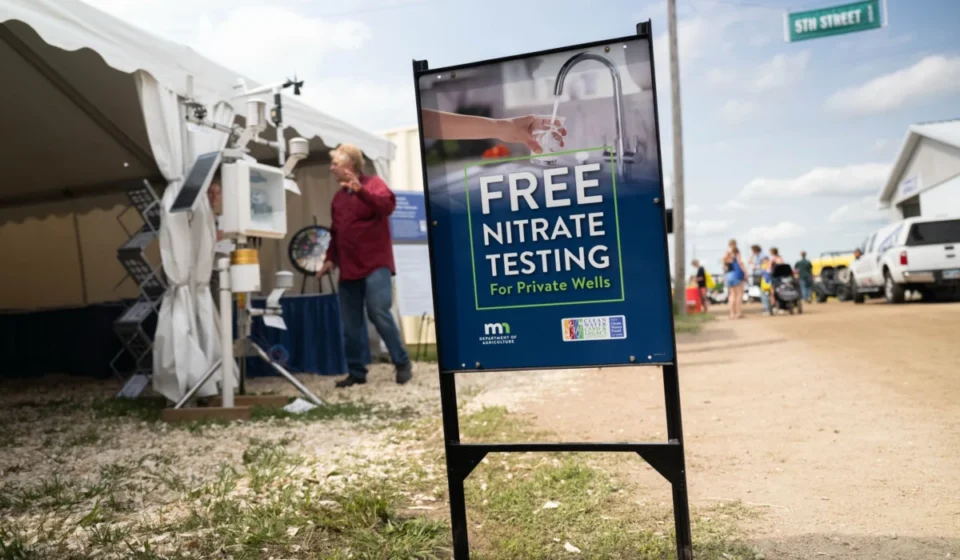
At the bustling, sun-drenched grounds of Farmfest in Morgan, Minnesota, the air is thick with the scent of deep-fried corn dogs and the low rumble of massive, state-of-the-art tractors. Politicians circulate through the crowds, shaking hands and discussing the future of the state’s multi-billion dollar agricultural industry. Yet, tucked away in a quiet corner of the event, a more sobering ritual takes place.
Denton Bruening, a representative from the Minnesota Department of Agriculture, sits before a piece of gray plastic equipment that looks more like a briefcase than a scientific instrument. Beside him, a small cup of water—harvested from a private well earlier that morning—is being processed. Through clear tubes, the liquid is drawn into a spectrophotometer, where an ultraviolet ray passes through the sample to measure light absorption. After a tense thirty-second wait, the digital screen flickers to life, displaying a single number: 7.3.
Bruening calmly records the result on a clipboard, adding it to a growing stack of approximately 40 other samples submitted by Farmfest attendees that day. For the person who brought this sample, that "7.3" is not just a number; it is an indicator of the safety of the water their family uses to bathe, cook, and drink.
This scene is a microcosm of a quiet, decades-long environmental crisis unfolding across the state: the pervasive and often invisible threat of nitrate contamination in groundwater.
The Mechanics of Contamination
Nitrates are chemical compounds that occur naturally, but their current prevalence in Minnesota’s groundwater is largely the result of intensive agricultural practices. Nitrogen-rich fertilizers and livestock manure, when applied to fields, can leach through the soil and into the aquifers that feed private wells.
The geography of the state plays a significant role in this process. In regions with porous soil—particularly in southwest, southeast, and central Minnesota—water travels rapidly from the surface to the groundwater table. When combined with shallow well infrastructure, the risk of contamination skyrockets.
While the federal government sets a Maximum Contaminant Level (MCL) of 10 milligrams per liter (mg/L) for public water systems under the Safe Drinking Water Act, private wells are largely exempt from these mandates. For the estimated 93,000 Minnesotans who rely on private wells for their daily water needs, there is no regulatory "safety net." When they receive a high-nitrate result at a clinic like the one at Farmfest, they are often left to navigate the financial and health-related consequences entirely on their own.
A Chronology of a Persistent Issue
The Minnesota Department of Agriculture’s presence at events like Farmfest is not new. In fact, the agency began offering free nitrate testing in the 1990s, recognizing that rural residents were the most vulnerable to the hidden risks of groundwater runoff.
Over the past thirty years, the narrative has remained largely consistent: as agriculture has modernized and intensified, the accumulation of nitrogen in the environment has continued to climb. The state has launched various initiatives to monitor this trend, including the Clean Water, Land and Legacy Amendment, which provides the funding necessary to keep these testing clinics free and accessible to the public.
Despite decades of awareness, the problem has proven stubbornly resistant to simple solutions. The "nitrate clinic" model serves as an educational bridge, but it lacks the enforcement power to curb the sources of the pollution. As testing technology has become more portable and accurate, the volume of data has increased, but the gap between the identification of the problem and the resolution of the contamination remains a chasm.
The Health Implications: Beyond the Legal Limit
While 10 mg/L is the federal threshold for safety, many public health experts argue that this number is insufficient to protect the population. The 7.3 mg/L reading found in the sample at Farmfest is technically "safe" by federal standards, but that definition is increasingly under fire.
"Even levels above 3.5 milligrams per liter can have adverse health consequences," says Bruening. Emerging research has linked chronic exposure to nitrates—even at levels below the 10 mg/L limit—to higher risks of certain cancers, thyroid issues, and complications during pregnancy, including miscarriages.
The disconnect between federal regulation and emerging health science creates a state of uncertainty for well owners. Those who test between 3.5 and 10 mg/L are often told to "keep an eye on it," leaving them to wonder exactly when, or if, their water will become dangerous enough to require expensive intervention.

The Economic Burden of Clean Water
For those whose wells exceed the 10 mg/L threshold, the solutions are both complex and prohibitively expensive. Reverse osmosis (RO) systems are the industry standard for removing nitrates, but they are a significant capital investment. Depending on the capacity and the quality of the system, homeowners can expect to pay anywhere from $500 to $5,000 for installation and maintenance.
For some households, this cost is insurmountable. While a few counties in southeastern Minnesota have managed to implement programs that offer free RO systems to residents with high nitrate levels, these programs are the exception rather than the rule. Most counties simply lack the tax base or the funding to sustain such an effort.
The alternative—drilling a new, deeper well—is an even more daunting prospect, with costs frequently reaching into the tens of thousands of dollars. When faced with these numbers, many residents simply opt for the stopgap measure of bottled water, a choice that adds a recurring monthly expense and creates a significant amount of plastic waste.
Policy Stalemate and Agricultural Influence
The push to lower the state’s maximum contaminant level for nitrates has gained momentum among environmental advocacy groups. Many argue that lowering the threshold to 3.5 mg/L would force the state to take more aggressive action. However, such a move faces massive political resistance.
"That would just be a huge heavy lift," says Tony Runkle, lead geologist at the University of Minnesota’s Geological Survey. "There’d be a ton of opposition from ag."
This opposition is rooted in the sheer economic power of the industry. Minnesota is the seventh-largest farming state in the nation, exporting approximately $9.3 billion worth of agricultural goods annually. This economic output grants the agricultural sector significant political leverage. At events like Farmfest, where the symbiosis between the industry and the political establishment is on full display, any policy that suggests a crackdown on current farming practices is treated with extreme caution.
The Path Forward: Mitigation vs. Regulation
The Department of Agriculture is currently walking a fine line. Employees like Bruening, many of whom have backgrounds in farming themselves, are hesitant to cast blame on the agricultural community. Instead, they emphasize a strategy of education and voluntary mitigation.
The agency has developed comprehensive nitrogen and fertilizer management plans that offer a roadmap for farmers to reduce runoff. Tactics such as planting cover crops during the off-season can effectively trap excess nitrogen in the soil, preventing it from leaching into the groundwater. However, these methods require upfront costs and management changes that many farmers are reluctant to adopt without a clear financial incentive or a state-mandated requirement.
"If we get a farmer that comes into a water clinic, we talk about some of those tactics because a lot of times that well might be affected by his own practices," Bruening says. This individualized approach is the cornerstone of the state’s current strategy: meeting the landowner where they are and hoping that awareness will lead to action.
Conclusion: A Call for Vigilance
For the residents of rural Minnesota, the water testing booth at events like Farmfest is a vital resource. It provides a rare opportunity to get free, objective data on a fundamental human need. The Department of Agriculture continues to encourage well owners to test their water annually, and through their partnerships with Soil and Water Conservation Districts, they have made the process as accessible as possible.
Yet, as the spectrophotometer at the booth continues to flash its digits, the larger question remains: at what point does the burden of clean water shift from the individual to the state? As long as nitrate levels remain high and the costs of treatment fall solely on the consumer, the issue will persist as a silent, invisible shadow over the Minnesota countryside.
For now, the agency’s goal is simple: to ensure that when a resident receives a number on a screen, they have the knowledge to understand what it means for their health and the resources to make informed, albeit difficult, decisions about their future.
Claire Carlson is a Report for America corps member, covering drinking water for MinnPost and the Mississippi River Basin Ag & Water Desk. Report for America places talented journalists in local newsrooms to report on under-covered issues and regions.