





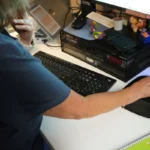






































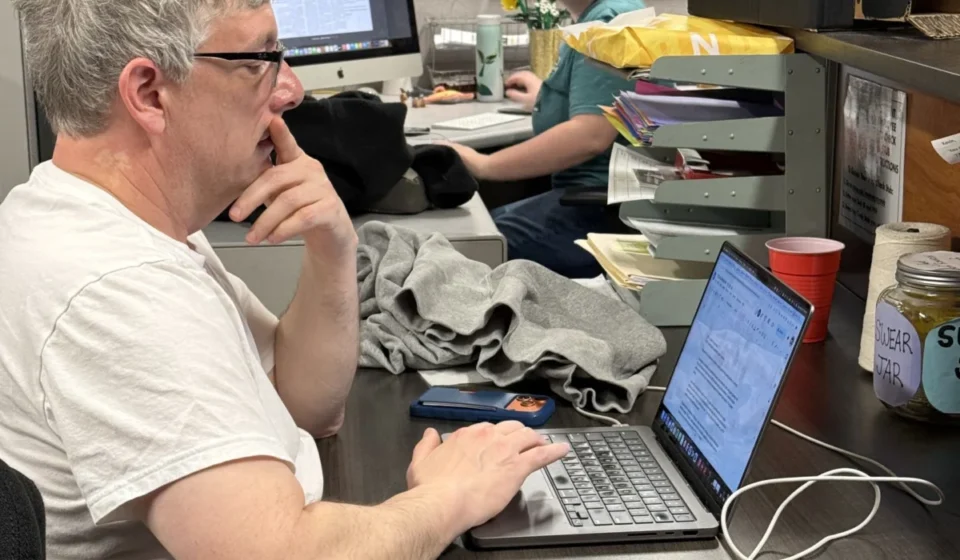

MANKATO, Minn. — One hour before the 9 p.m. hard deadline on a humid Monday, the newsroom of The Reporter at Minnesota State University, Mankato, is a study in controlled chaos. For editor-in-chief Anahi Zuniga, the atmosphere is surprisingly serene. While the rhythmic clatter of keyboards and the occasional murmur of editorial debate fill the room, Zuniga remains calm, monitoring the steady influx of copy and high-resolution images landing in the shared server.
For Zuniga, the pressure is a familiar pulse. "Everyone should be done, hopefully, in the next half hour," she says, glancing at her monitors. "It’s sometimes a close call, but that’s the nature of the beast."
Once the final files are approved, they are bundled and dispatched to the local printing press. By Tuesday morning, thousands of copies will hit newsstands across campus, headlined by a report on a looming 7% tuition hike. It is a ritual that has repeated itself for a century—a testament to the enduring, if embattled, tradition of the campus press in Minnesota.
A Legacy in Print: The Reporter at 100
The Reporter recently marked its 100th year of publication, a milestone that highlights its status as a foundational pillar of campus life. In an era where legacy media outlets are struggling to retain relevance and revenue, the survival of a twice-weekly print publication is an anomaly.
For students like Zuniga, the paper is more than just a training ground; it is a transformative environment. "I wasn’t very confident with who I was when I first enrolled here," Zuniga admits. "I feel so sure of myself now and who I want to be after graduation. I can use my words as a way to express what I feel and think is necessary."
This sentiment is echoed by alumni who returned to the Mankato campus in late March to celebrate the centennial. Among them was Myron Medcalf, a senior college basketball writer at ESPN and a columnist for the Star Tribune. Medcalf, who served as the paper’s first African-American editor-in-chief in 2003, credited The Reporter for shaping his professional ethos.
"I learned the ins and outs of actually being on deadline, the accuracy that’s necessary in your reporting, the fact that you are communicating to an audience that’s much bigger than you are," Medcalf said during his keynote address. "It’s not about you. It’s about the people who are going to pick up your story and read it."
The State of the Campus Press: A Landscape in Flux
While The Reporter maintains its print frequency, the broader landscape of student journalism in Minnesota reflects the national trend of digital migration. The industry is facing a "news desert" phenomenon, and universities are not immune to these tectonic shifts.
On many campuses, the traditional student newspaper has either vanished or undergone a radical metamorphosis. At Bemidji State University, The Northern Student has moved away from a weekly news cycle, transitioning into a magazine printed only four times per academic year. Meanwhile, at Minnesota State University Moorhead, The Advocate has pivoted to a digital-first strategy, printing a physical issue only once per semester. Some institutions, like Minneapolis College, currently lack a formal student paper, though student government leaders are exploring avenues to revive a publication.
This decline is often linked to the shrinking of journalism programs. Paradoxically, The Reporter thrives even without a dedicated mass communication department at MSU Mankato, relying instead on the tenacity of its student leadership and a small core of professional mentors.

Chronology of a Deadline
The workflow at The Reporter is a masterclass in logistics. The process begins days before the Monday print cycle, with reporters conducting interviews and photographers capturing the visual pulse of the campus.
- Mid-week: Pitch meetings determine the focus of the upcoming edition.
- Thursday-Friday: Field reporting, source verification, and initial drafting.
- Monday morning: Copy editing and layout design begin.
- Monday, 8:00 p.m.: The "final push." Editors like Addie Larson, Alexis Darkow, Isaac Rozwadowski, and Logan Schlosser review proofs, check headlines for accuracy, and ensure photo captions adhere to AP style.
- Monday, 9:00 p.m.: The "digital handover." Files are sent to the press.
- Tuesday morning: Distribution. The physical paper hits newsstands, providing a tangible record of history.
This structure requires significant support. While the editorial vision is entirely student-led, the business side is managed by university staff—Jane Tastad (business manager) and Dana Clark (production coordinator). Robb Murray, an editor at the local Mankato Free Press, serves as a vital bridge, offering professional oversight and proofreading services.
Institutional Resilience: Supporting Student Voices
Across the Minnesota State system and private colleges, advisors like Doug Westerman at Winona State University serve as the glue holding these operations together. Westerman, who advises The Winonan, notes that the primary challenge is not interest, but natural attrition.
"Every college paper has natural attrition," Westerman explains. "Through graduations and new students stepping in, the paper has been fortunate to have good student leaders over the years."
Westerman, who often receives calls from employers looking for recommendations, jokes about the irony of the situation. "Well, they graduated. I don’t think they’d want to come back," he laughs. But in the next breath, he turns serious about the necessity of the work. "You still have to check sources, you still need to do research, whether it’s going on a printed page or going on a post. The principles of journalism are as important as ever."
Supporting Data: A Statewide Snapshot
The diversity of models across Minnesota shows that there is no "one size fits all" approach to student journalism in 2025:
- University of Minnesota System: The Minnesota Daily has fully embraced the digital age, operating as a daily online publication. UMD’s The Bark utilizes a hybrid model: daily digital updates supplemented by a monthly print magazine.
- Private Colleges: Institutions like the University of St. Thomas (The Crest News), Gustavus Adolphus College (The Gustavian Weekly), Macalester College (The Mac Weekly), and Bethel University (The Clarion) maintain robust, mostly weekly schedules.
- The "No Program" Phenomenon: Surprisingly, many of the state’s most active papers, such as St. Olaf’s The Olaf Messenger and Carleton’s The Carletonian, operate entirely independently of formal journalism departments, proving that the drive to report is a student-led impulse rather than a curricular requirement.
Implications: Why It Matters
The survival of these papers has profound implications for democracy and campus governance. Student newspapers act as the primary watchdogs of university administrations. When a student paper reports on a 7% tuition hike or changes in campus policy, they are providing a level of transparency that official university press releases rarely achieve.
Beyond the institutional impact, there is the archival value. As Medcalf noted during the Reporter celebration, the written word serves as a permanent record. "One-hundred years from now, all of us are gone and what we will have left is what we contributed to this world," he said. "A big part of that will be the archives from the MSU Reporter and all of these publications."
For the students currently working in these newsrooms, the experience provides a "different lens" on the world. As Zuniga prepares for the next edition, she remains optimistic about the future of the medium. Even as the digital tide rises, the act of holding a physical, freshly printed newspaper remains an unmatched, satisfying experience—a reminder that while the delivery method may evolve, the fundamental need for information, accountability, and storytelling remains constant.
As the lights dim in the Reporter office and the staff begins to plan for the next issue, the sentiment is clear: the news cycle never truly ends, and for these young journalists, the deadline is just the beginning.