






















































Beyond the Shire: How Zephyr Theatre’s ‘The Hobbit’ Reimagines Myth for a Modern Era

In an age defined by digital fatigue and global uncertainty, the human appetite for escapism has never been more ravenous. Following the cultural phenomenon of Christopher Nolan’s The Odyssey, audiences are clearly signaling a desire to retreat into the mythic and the faraway. Stepping into this vacuum with a localized, high-spirited solution is the Zephyr Theatre, which has launched an ambitious outdoor production of J.R.R. Tolkien’s fantasy touchstone, The Hobbit.
Set against the pastoral backdrop of Aamodt’s Apple Farm in Stillwater, this production is more than a mere staging of a beloved children’s book; it is a calculated effort to examine the intersection of community, gender, and the responsibility of the individual in times of crisis.
The Artistic Vision: Why This Show, Why Now?
For Reed Sigmund, the newly appointed artistic director of the Zephyr Theatre and a veteran performer from the Children’s Theatre Company, the decision to produce The Hobbit was driven by a need for contemporary relevance. In the show’s program notes, Sigmund reflects on the fundamental question that haunts every director: "Why this show, why now?"
He found his answer in the unlikely hero of the tale: Bilbo Baggins. Bilbo is the ultimate homebody, a creature of comfort whose journey is defined by the agonizing internal conflict between the safety of the hearth and the moral necessity of intervention. In Sigmund’s interpretation, Bilbo’s reluctant transformation from a bystander to a participant serves as a mirror for the modern Minnesotan.
The production draws thematic parallels to the recent community mobilization efforts seen during the winter’s "Operation Metro Surge." The play suggests that, much like the inhabitants of the Shire, we are often forced to choose between remaining on the sidelines and engaging in a struggle that, while not strictly our own, affects the fabric of our society. As one character poignantly observes, "A wrong that is silently seen will not fix itself."
Chronology and Production Style: A Minimalist Odyssey
Playwright Greg Banks, known for his ability to distill complex narratives into their purest forms, has crafted a minimalist, droll adaptation of Tolkien’s sprawling epic. Unlike the heavy, CGI-laden "slog" of Peter Jackson’s three-part film trilogy (2012–2014), Banks’ script moves with a brisk, athletic energy.
A Small Cast, A Massive World
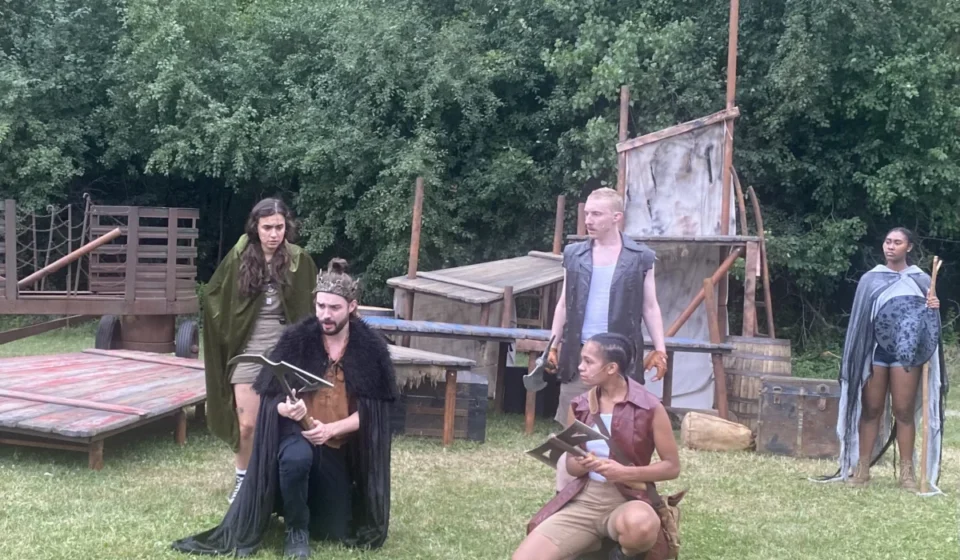
The production relies on a small, nimble cast of five performers who navigate multiple roles, stripping away the excesses of big-budget theater in favor of raw imagination. Sigmund’s direction prioritizes the "theatre of the mind." Rather than utilizing elaborate sets or live horses, the actors create the sensory experience of galloping through sheer physicality and vocalized sound effects.
The timeline of the performance is designed for accessibility, hitting the major plot points of Tolkien’s narrative without lingering on the exposition that often bogs down fantasy adaptations. By focusing on the ensemble spirit, the production emphasizes the collaborative nature of storytelling, allowing the audience to engage directly with the artifice rather than being distracted by it.
Gender Reimagining: A New Tone for Middle-earth
Perhaps the most striking departure from traditional Tolkien lore is the deliberate subversion of gender roles. In this production, the iconic figures of Bilbo Baggins and the wizard Gandalf are portrayed by women—Grace Hillmyer and Antonisia Collins, respectively—while the dwarf Balin is played with heartfelt nuance by Anya Naylor.
This casting is not merely a stylistic flourish; it fundamentally shifts the energy of the story. Collins brings a savvy, grounded calm to the role of Gandalf, while Hillmyer imbues Bilbo with an empathetic vulnerability that feels particularly potent in the 21st century. When Hillmyer declares, "I’m here because right now it’s the right time to do what’s right," the line resonates with a modern urgency that feels distinctly removed from the patriarchal structures of the original source material.

By placing women at the center of this traditionally male-dominated fantasy, the Zephyr Theatre provides a space for new perspectives. This is particularly salient given the current climate of fantasy fandom. As some major franchises, such as Harry Potter, have become inextricably linked to the controversial political stances of their creator—specifically the commitment to fund anti-trans advocacy—audiences are increasingly seeking alternatives. The Zephyr Theatre’s production stands as an inclusive, welcoming sanctuary for those who wish to engage with high fantasy without compromising their values.
Supporting Data: The Ensemble’s Economic Artistry
The technical success of the play relies heavily on its economic use of resources. The costume design is masterfully minimalist, using singular, emblematic pieces to signify shifts in character. The goblin masks, in particular, are lauded for their simplicity, proving that sophisticated world-building does not require a massive budget.
The most complex challenge—the famous barrel-escape scene—is solved with a handful of plain cylinders, a testament to the cast’s ability to manipulate the audience’s perception. Jeffrey Nolan, who shoulders the weight of several distinct roles, offers a masterclass in versatility. His portrayal of the gruff, snarly dwarf Kili contrasts sharply with his impishly silly interpretation of Smaug the dragon, and his Gollum provides a chilling homage to the physical acting style popularized by Andy Serkis, yet remains distinct in its own right.
The Auditory Experience
If the production has a flaw, it lies in the musical score. While Sophia Schott provides excellent sound effects, the inclusion of folk classics by Peter, Paul and Mary, Simon and Garfunkel, and John Denver often feels incongruous. While the thematic link of "Puff the Magic Dragon" or "Country Roads" is clear, these choices occasionally clash with the high-fantasy aesthetic, highlighting the difficulty of blending modern folk sensibilities with the archaic atmosphere of Middle-earth.
Implications: A Community-Centered Escape
The production’s setting at Aamodt’s Apple Farm serves as more than a venue; it is an integral component of the experience. The outdoor stage overlooks a tranquil, wooded area, isolating the audience from the bustle of the main orchard. For theatergoers, the opportunity to combine a performance with a visit to Saint Croix Vineyards or a taste of Thor’s Hard Cider creates a comprehensive "event" experience.
This shift toward immersive, community-based theater is gaining traction in the Twin Cities. It mirrors the broader trend of dining and culture merging, as evidenced by the concurrent success of the Guthrie Theater’s recent offerings.
The Guthrie Connection: A Parallel Development
For those seeking a full evening of culture, the Guthrie Theater’s production of Noël Coward’s Private Lives offers a high-contrast companion to the Zephyr’s The Hobbit. Following a performance at the Guthrie, theatergoers are now flocking to Indígena by Owamni, Sean Sherman’s new restaurant located adjacent to the theater.
The success of Indígena—serving dishes like maple and sumac glazed venison skewers—marks the return of high-quality, post-show dining to the Guthrie area. As audiences discuss the complexities of Coward’s farce—which, beneath its witty surface, deals with the often-problematic romanticization of volatile relationships—the synergy between high-end culinary experiences and challenging stage productions is cementing a new cultural standard in Minneapolis.
Final Reflections
The Zephyr Theatre’s The Hobbit is a triumph of ingenuity over excess. By stripping away the bloat of modern film adaptations and leaning into the inherent strengths of the stage, the creative team has produced something that feels both ancient and remarkably timely. It reminds us that at the heart of every great myth is a simple, terrifying choice: to stay home in safety, or to step out into the world and do what is right.
For those interested in witnessing this production, performances continue through August 2 at Aamodt’s Apple Farm in Stillwater. Whether through the lens of a whimsical journey to a dragon’s lair or the sophisticated wit of a Noël Coward play, it is clear that the Twin Cities theater scene is currently offering exactly the kind of mythic, communal escape that the modern world so desperately requires.