























































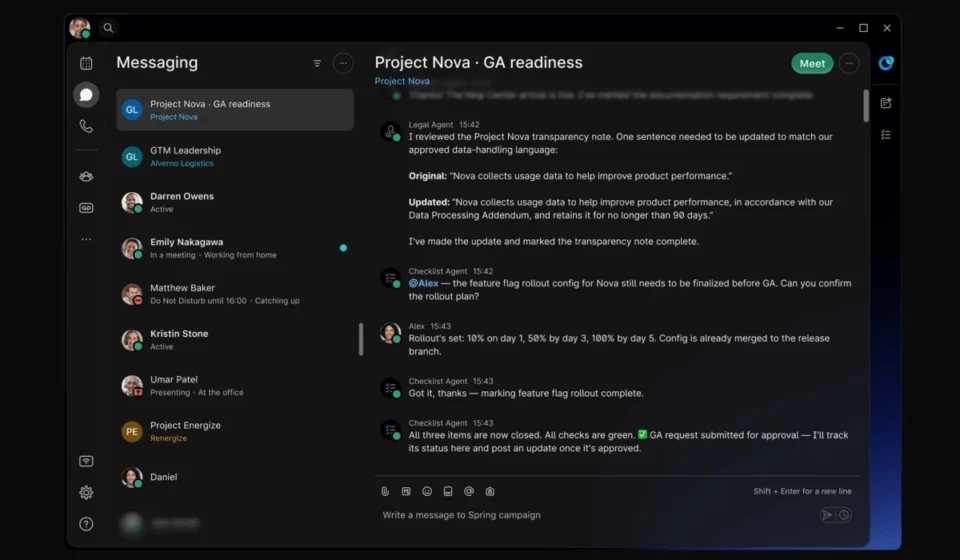

The landscape of professional collaboration is undergoing a fundamental shift. Cisco has officially announced a sweeping transformation of its Webex platform, moving beyond simple video conferencing and messaging to introduce a sophisticated ecosystem of AI agents. By embedding these agents directly into group “spaces,” Cisco is attempting to redefine the software from a tool used to communicate into a collaborative partner that actively participates in the workflow.
This strategic pivot, unveiled at the WebexOne conference, positions Cisco to compete directly with industry rivals like Slack and Zoom, both of which are aggressively deploying their own agentic strategies. As enterprises struggle with the sprawl of disconnected AI tools, Cisco’s vision is to keep the workforce centralized, making Webex the primary hub for both human and machine-driven productivity.
The Core Transformation: Agents as Teammates
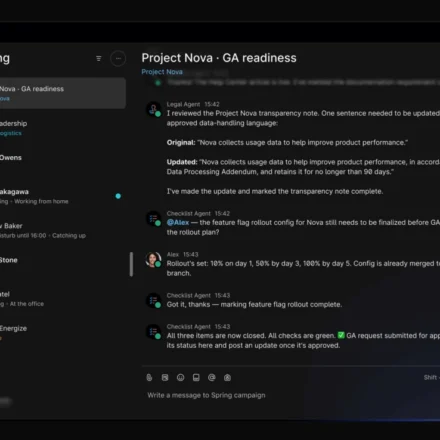
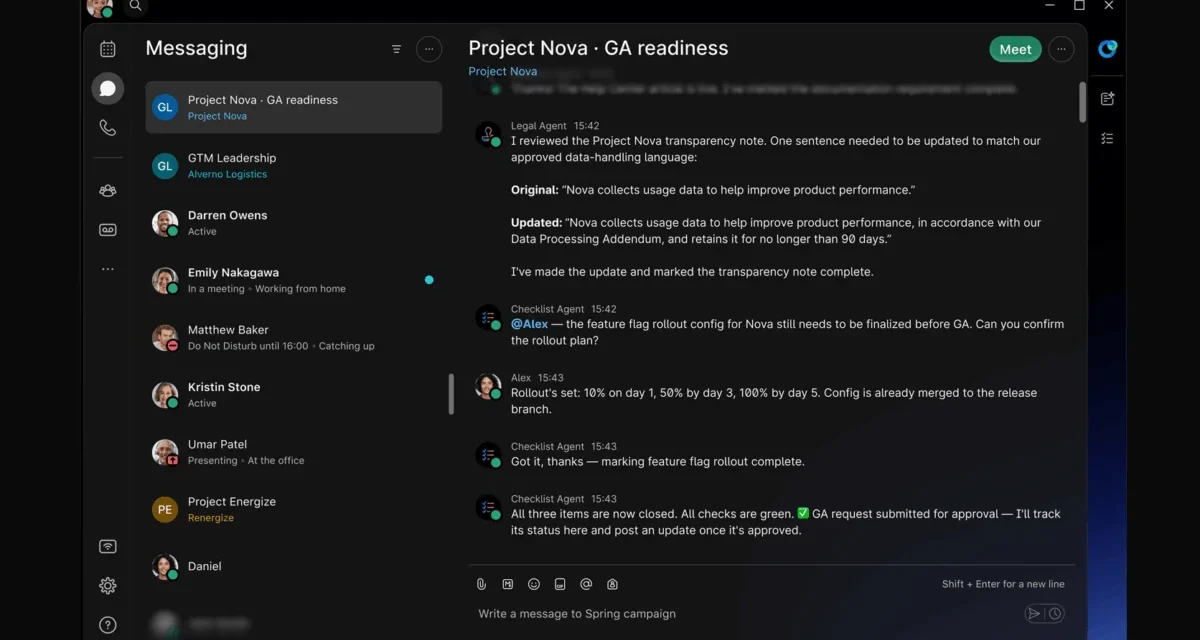
The most significant change to the Webex ecosystem is the introduction of collaborative AI agents that can be @mentioned in group chats. Unlike traditional personal AI assistants—which are confined to individual silos—these new agents are designed to be visible to entire teams.
Bridging the Silos
For years, employees have used AI to summarize notes or draft emails, but that work often remained trapped in personal interfaces. Amit Barave, Cisco’s vice president and general manager for Webex Suite and AI, emphasized that the goal is to break down these barriers. "You work with AI, but your teammates may never see that work—they can’t build on it, contribute to it, or reuse it," Barave noted. By allowing agents to operate within shared spaces, Cisco ensures that the context of a project is preserved, allowing the AI to contribute to the collective intelligence of the team.
Operational Capabilities
These collaborative agents are designed to handle the "heavy lifting" of administrative project management. They are capable of:
- Meeting Coordination: Managing complex scheduling across time zones and team availability.
- Note-Taking and Synthesis: Capturing action items during calls and distributing them to the relevant team members.
- Task Tracking: Monitoring project progress and reminding team members of upcoming deadlines.
Chronology: A Roadmap to Intelligent Collaboration
Cisco’s trajectory toward this "AI-native" environment has been methodical, building upon foundational updates to arrive at the current, high-functionality ecosystem.
- Foundation Phase: Cisco introduced the Webex Suite, establishing a core platform for voice, video, and messaging.
- Integration Phase (Ongoing): The company began integrating third-party AI, such as Anthropic’s Claude and OpenAI’s "dot" agents, into the Webex environment.
- November 2024: The scheduled general release of the Translator Agent, which has been in "controlled availability." This tool provides real-time translation for video calls and desk phones across ten major global languages, including Mandarin, Hindi, and German.
- Immediate Availability: The AI Coach for Vidcast is currently available. This tool serves as a real-time feedback loop for presenters, analyzing tone, pacing, and vocabulary to improve communication effectiveness.
- Q1 2027: The anticipated launch of Personal Agents for Webex Calling. This release will mark the next leap in productivity, as these agents will autonomously screen incoming calls, determine the urgency of the communication, and act on behalf of the user.
Supporting Data and Technical Implementation
Cisco’s refresh includes a significant overhaul of the user interface. A new personalized landing page will serve as the "control tower" for the employee, aggregating priorities, upcoming meeting agendas, and suggested follow-up actions.
The "Enhanced AI" Add-On
While core AI features remain part of the standard Webex Suite ($25/user/month), Cisco is segmenting its most advanced agentic capabilities behind a new "Enhanced AI Offer" add-on. This structure reflects a broader trend in B2B SaaS where "premium intelligence" is treated as a tiered utility rather than a standard feature.
Third-Party Ecosystem
Cisco is avoiding a closed-loop approach by embracing external models. By allowing Anthropic’s "Claude Managed Agents" to participate in group conversations, Cisco allows teams to leverage specialized AI expertise without leaving the Webex environment. This strategy is essential for adoption; enterprise customers are often hesitant to move data into proprietary silos, preferring platforms that allow them to plug in the specific AI models they already trust.
Official Responses and Industry Perspectives
The reception from industry analysts has been largely positive, though experts caution that the success of these tools depends on data interoperability.

The Analyst Viewpoint
Irwin Lazar, principal analyst at Metrigy, points out that the effectiveness of any agent is tied to its "data diet." "The strength of the agent is dependent on its access to information," Lazar said. "The key is enabling connectivity to external data sources such as CRM, ERP, and project management tools."
Lazar also noted a key competitive gap. While Webex is powerful, it currently lacks the ability to "listen in" on non-Webex meetings—a feature that Zoom has already begun to exploit. This means that if a team uses a competitor’s platform for a quick sync, the Cisco AI agent remains "blind" to that context, potentially creating gaps in the project history.
The "Unified" Vision
Jim Lundy, CEO of Aragon Research, offered a more bullish assessment of the platform’s potential. "The new assistant literally knows what you are doing and your upcoming schedule and knows more than other major providers," Lundy noted. He suggested that the sophistication of Cisco’s assistant is so high that it could theoretically be sold as a standalone, unbundled product, independent of the Webex communication suite.
Implications: The Future of the Digital Workforce
The move to integrate AI agents as full-fledged team members carries several profound implications for the future of work.
1. The Death of Administrative Overhead
By automating the "connective tissue" of collaboration—scheduling, note-taking, and follow-up—Cisco is attempting to reclaim hours of lost time per week for the average knowledge worker. If the AI Coach for Vidcast and the Personal Agent for Calling function as promised, the administrative burden of being "always on" will shift from the human to the machine.
2. Contextual Continuity
One of the greatest challenges in remote work is the loss of context. When a team member leaves a project, the institutional knowledge often vanishes with them. Cisco’s vision of a "shared capability" agent means that the agent becomes the repository of project context. Even if team members rotate in and out, the AI agent remains, maintaining a continuous stream of project history that is accessible to all.
3. The "Platform Wars" Intensify
Cisco’s move underscores a critical shift: the "Collaboration War" is no longer about who has the best video quality or the most stable connection. It is now about who has the most intelligent digital workspace. By forcing a choice between the Cisco ecosystem and the "Claude Cowork" or "ZoomMate" ecosystems, vendors are trying to lock in enterprise customers by making their AI agents indispensable.
4. Ethical and Practical Considerations
The integration of agents into phone calls and group chats raises new questions regarding privacy and corporate governance. Cisco has noted that some features will have usage-based limits, such as the 50-minute-per-month cap on real-time translation, suggesting that the costs of compute-intensive AI will be passed down to the enterprise. Organizations will need to develop robust policies on when and how these agents are permitted to record, process, and act upon sensitive corporate communications.
Conclusion
Cisco’s aggressive expansion into AI agents represents a major milestone in the evolution of enterprise software. By shifting the role of AI from a "personal assistant" to a "teammate," the company is betting that the future of work is not just about communicating better, but about managing the sheer volume of information that modern collaboration generates. As the company moves toward the 2027 rollout of its most advanced agentic features, the industry will be watching closely to see if Cisco can maintain its dominance in the face of rapidly evolving competition from specialized AI startups and established software giants. For now, the message is clear: the desk of the future is not just a place where you work—it is a place where you work with intelligence.