


























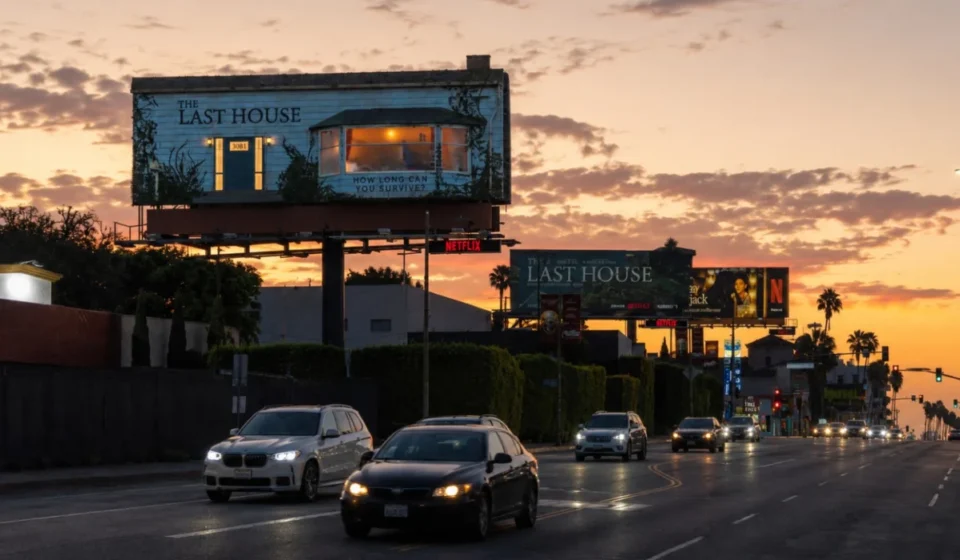
Suspended in West Hollywood: How a Living Billboard on the Sunset Strip Redefines Experiential Marketing

WEST HOLLYWOOD, CA — Motorists and pedestrians navigating the sun-drenched corridor of Sunset Boulevard near Selma Avenue were treated to an unusual sight: a fully furnished, three-dimensional room suspended 30 feet in the air inside a billboard structure. Inside, a lone man spent his weekend reading, eating, looking through binoculars, and sleeping—all in full view of the public below.
The striking installation was not an avant-garde housing protest or a high-altitude art piece, but rather a highly coordinated, experiential marketing stunt orchestrated by streaming giant Netflix. The live performance, which began on Thursday and concluded at the end of the weekend, was designed to promote The Last House, a sci-fi thriller starring Greta Lee and Wagner Moura, which premiered on the platform on August 7.
By replacing static imagery with a living, breathing human occupant, Netflix succeeded in cutting through the visual noise of one of the world’s most heavily advertised thoroughfares, capturing both local curiosity and global social media attention.
1. Main Facts: The Anatomy of a Living Billboard
At first glance, the installation above Sunset Boulevard appeared to be a structural anomaly. Rather than a traditional flat vinyl print, Netflix constructed a literal micro-apartment recessed into the billboard frame. The elevated room was meticulously detailed to resemble a cozy, domestic living space, complete with:
- A comfortable reading chair
- Potted houseplants and bookshelves
- Framed wall art and functional windows with curtains
- Household necessities, including food, water, and change of clothing
The Thematic Connection to The Last House
The design of the billboard directly mirrors the narrative engine of The Last House. The sci-fi thriller follows a family who suddenly finds themselves trapped inside their suburban home by an invisible, unexplained force. Unable to step outside without facing unknown consequences, the characters are forced to adapt to confinement while observing the outside world from their windows.
By placing a performer in a transparent, elevated room on the Sunset Strip, Netflix physicalized this exact psychological tension. The actor was confined to a small, domestic space, separated from the bustling metropolitan environment just feet below him. His primary tool for interacting with the outside world was a pair of binoculars—a direct nod to the film’s themes of surveillance, isolation, and voyeurism.
2. Chronology of the Stunt: A Weekend in the Public Eye
The promotional campaign unfolded over a carefully scheduled four-day period, transitioning from an overnight construction project into a multi-day public spectacle.
Thursday: The Occupant Arrives
The installation officially went live on Thursday morning. Commuters on their morning drive were the first to notice the addition to the West Hollywood skyline. The performer moved into the space with minimal fanfare, immediately establishing a routine of quiet domesticity. He was observed reading books, tending to his plants, and looking down at the heavy Sunset Boulevard traffic through his binoculars.
Friday: Media Mobilization and Whiteboard Diplomacy
By Friday, word of the living billboard had spread across social media platforms, drawing local news crews to the scene. Because the performer was isolated 30 feet in the air and lacked a public address system, he adopted a low-tech method of communication: a handheld whiteboard.
When a camera crew from CBS Los Angeles arrived on-site, the actor wrote a personalized greeting on his whiteboard and pressed it against the window. Throughout the day, he used the board to answer questions from curious onlookers, write humorous observations, and remind passersby to stream The Last House on Netflix.
[Thursday Morning]  --> Installation goes live; performer occupies the billboard room.
[Friday Afternoon]  --> Local news outlets arrive; performer communicates via whiteboard.
[Friday Night]      --> Performer transitions to evening routine (pajamas/robe) under spotlights.
[Saturday-Sunday]   --> Viral social media pickup; Citizen app alerts draw crowds.
[Sunday Night]      --> Stunt concludes; performer vacates the installation.
The Nighttime Shift
As night fell over West Hollywood, the nature of the performance shifted. Powerful spotlights illuminated the billboard, turning the micro-apartment into a glowing terrarium. The performer changed into pajamas and a bathrobe, continuing his routine of reading and relaxing before eventually sleeping in full view of the neon-lit Strip. This transition emphasized the literal "living" aspect of the advertisement, proving to skeptics that the actor was indeed residing in the space overnight.
3. Supporting Data: Netflix’s History of Disruption in Out-of-Home (OOH) Advertising
This high-altitude stunt is not an isolated experiment, but rather the latest iteration of Netflix’s aggressive, multi-million-dollar investment in physical, Out-of-Home (OOH) advertising.
In 2018, Netflix made waves in the media industry by acquiring Regency Outdoor Advertising’s billboard assets along the Sunset Strip for a reported $150 million. This strategic acquisition gave the streaming service permanent, exclusive control over some of the most valuable physical advertising real estate in the world.
Previous Guerilla Campaigns
The living billboard for The Last House builds on a lineage of physical, sometimes controversial, promotional stunts executed by the company:
| Year | Campaign / Title | Location | Description | Public Reaction |
|---|---|---|---|---|
| 2018 | Altered Carbon | West Hollywood Bus Stop | A lifelike, anatomically detailed mannequin wrapped in plastic that appeared to "breathe" via a mechanical lung. | Generated widespread intrigue; some commuters reported feeling "creeped out" by the hyper-realism. |
| 2021 | Squid Game | Global Metros (e.g., Manila) | Giant, motion-detecting "Red Light, Green Light" dolls placed at pedestrian crosswalks. | Highly viral; millions of shares on TikTok and Instagram. |
| 2024 | The Last House | Sunset Boulevard | A 30-foot-high, fully furnished room with a live actor living inside for a weekend. | Amused curiosity; prompted neighborhood safety alerts and high organic search traffic. |
By utilizing physical performers and interactive installations, Netflix consistently bypasses "ad blindness"—the cognitive bias where consumers unconsciously ignore traditional static banner ads and billboards.
4. Public Reaction and Community Responses
The sheer strangeness of seeing a man living on a billboard quickly triggered reactions from the local community, law enforcement, and digital networks.
The Citizen App Phenomenon
In modern Los Angeles, unusual public behavior is rapidly indexed by safety and neighborhood-monitoring applications. Shortly after the performer settled into the billboard, local residents began receiving notifications on the Citizen app—a platform that crowdsources police scanner activity and safety alerts.
One notification warned of a "man inside a billboard" in West Hollywood. Rather than causing panic, the alert acted as an unintentional promotional push. Local residents, realizing the bizarre nature of the report, drove to the intersection of Sunset and Selma specifically to verify the claim.
"I got a notification on my phone saying there was a guy living in a billboard," said one local resident interviewed by CBS Los Angeles. "I live just a few blocks away, so I had to drive over and see it for myself. Honestly, in LA, you think you’ve seen everything, but a guy in pajamas eating lunch 30 feet above traffic is definitely a new one."
The Digital Echo Chamber
While the physical stunt was limited to those driving down Sunset Boulevard, its true reach was achieved online. Videos of the performer, captured by pedestrians and influencers, accumulated millions of views on TikTok, Instagram, and X (formerly Twitter). The contrast of a quiet, domestic life being lived high above one of the busiest, loudest streets in California proved to be highly shareable content, successfully converting local foot traffic into global digital impressions.
5. Implications: The Future of Experiential Marketing in the Streaming Era
The success of The Last House billboard highlights a broader shift in how major entertainment companies approach marketing in an increasingly fragmented digital landscape.
Cutting Through Digital Fatigue
With consumers inundated by digital trailers, targeted social media ads, and pre-roll videos, the efficacy of traditional digital marketing has plateaued. Experiential marketing—often referred to as "guerilla marketing"—forces engagement by disrupting the consumer’s physical environment.
A standard billboard for The Last House would likely feature a static image of Greta Lee or Wagner Moura looking terrified, accompanied by a release date. While informative, such an ad requires the viewer to actively process the premise of the film. The living billboard, conversely, demonstrates the film’s core concept—forced confinement and isolation—without requiring the viewer to read a single line of text.
The Sunset Strip as an Interactive Theater
For decades, the Sunset Strip has served as a historical gallery for the entertainment industry, famous for its hand-painted rock-and-roll billboards in the 1970s and its massive, neon-lit movie promotions today.
Netflix’s living billboard represents the next logical step in this evolution: transitioning the Strip from a gallery of static images into a venue for interactive, public theater. By turning a commercial advertisement into a live performance, the campaign blurred the lines between public space, performance art, and corporate promotion, setting a new benchmark for how Hollywood sells its stories to a distracted world.