















































Main Facts
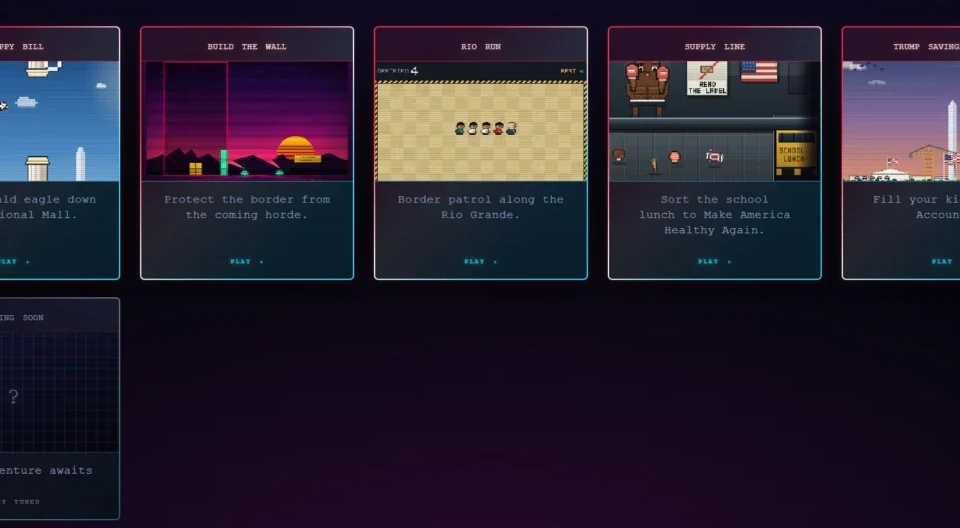
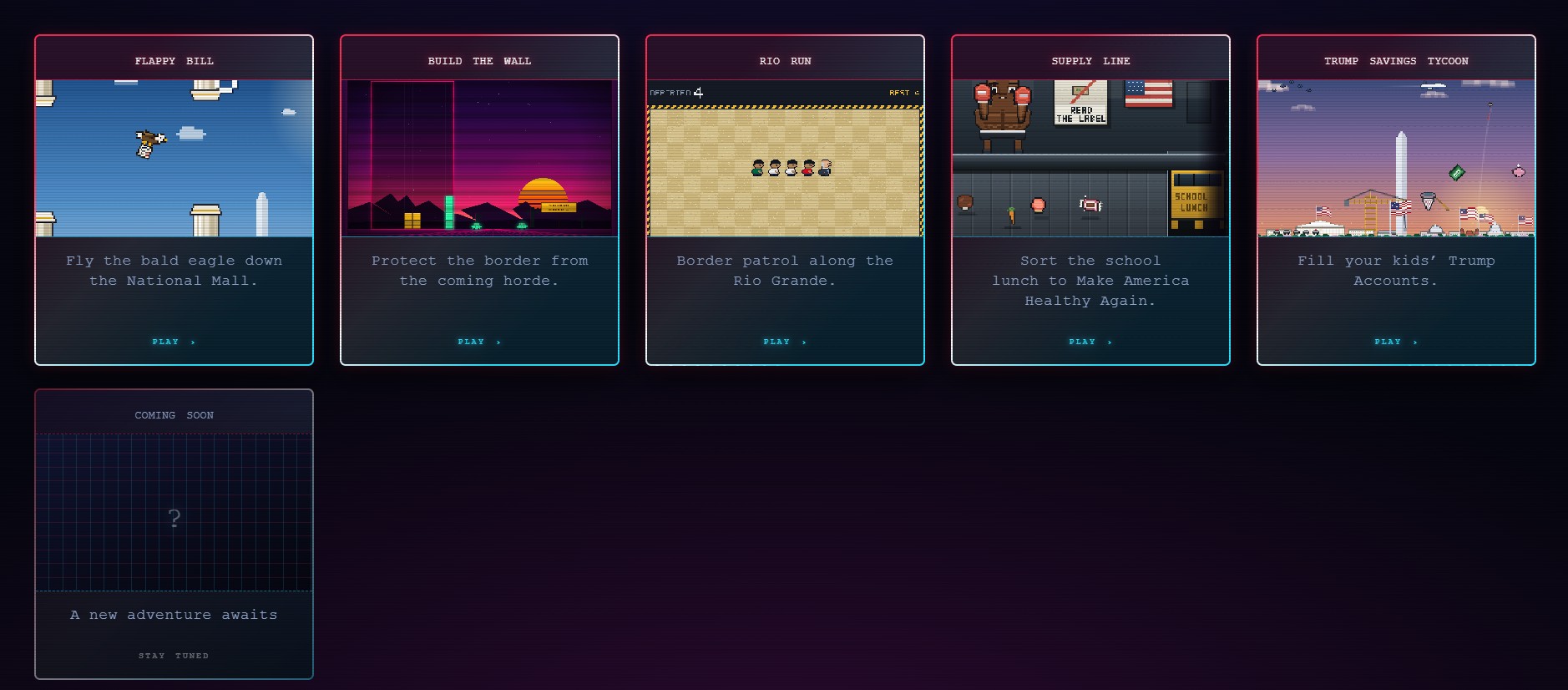
In an unprecedented fusion of digital pop culture and executive-branch communication, the official White House website has launched a dedicated "Arcade" section (whitehouse.gov/arcade). The portal features five low-resolution, retro-style browser games that translate the administration’s flagship legislative priorities and controversial policy platforms into simplistic interactive formats.
The current catalog includes:
- Build the Wall (a Tetris-style puzzle game)
- Rio Run (a border-enforcement variant of the classic Snake)
- Supply Line (a conveyor-belt sorting game modeled after Tapper)
- Flappy Bill (a physics-based side-scroller utilizing the mechanics of Flappy Bird)
- Trump Savings Tycoon (an airborne collection game representing federal child savings accounts)
A sixth tile on the landing page is marked "Coming Soon," indicating that the administration plans to expand this interactive digital catalog.
+-------------------------------------------------------------------+
|                       WHITEHOUSE.GOV/ARCADE                       |
+------------------+------------------+-----------------------------+
|  BUILD THE WALL  |     RIO RUN      |         SUPPLY LINE         |
| (Tetris Clone)   |  (Snake Clone)   |     (Conveyor Sorting)      |
+------------------+------------------+-----------------------------+
|   FLAPPY BILL    |  SAVINGS TYCOON  |         COMING SOON         |
| (Flappy Bird)    | (Platform Grab)  |      (To Be Announced)      |
+------------------+------------------+-----------------------------+
Rather than abstracting political concepts, the games directly align gameplay victory conditions with the realization of specific, highly debated domestic and foreign policy objectives. The release represents a stark departure from traditional government public relations, embedding partisan rhetoric—such as protecting borders from a "coming horde" and promoting "Make America Healthy Again" (MAHA) nutritional standards—into the mechanics of classic video games.
The placement of these interactive elements on a primary .gov domain, situated alongside formal executive orders, federal budgets, and official press releases, marks a significant shift in how the executive branch engages with the public online.
Chronology of the Digital Rollout
The launch of the White House Arcade represents the latest phase in the evolution of presidential communications in the digital age.
The Evolution of Executive Web Presence
To understand the context of this release, it is necessary to examine how the executive branch has historically utilized its official web domain:
- 1994 (The Clinton Administration): The first iteration of
WhiteHouse.govwas launched, serving primarily as a static digital archive for press releases, executive speeches, and basic organizational charts of the federal government. - 2009–2017 (The Obama Administration): The platform shifted toward multimedia integration, utilizing embedded YouTube videos, interactive town halls, blog posts, and petitions via the "We the People" portal to foster two-way digital communication.
- 2017–2021 (The First Trump Administration): The website returned to a highly streamlined, press-release-heavy format, while the administration primarily relied on external social media platforms like Twitter to drive public engagement.
- Present Day: The launch of the White House Arcade represents a transition from passive consumption of media to active, gamified participation, utilizing nostalgia-driven web design to build support for executive policies.
The Marketing Campaign and Launch Aesthetics
The debut of the Arcade section was characterized by a distinct aesthetic choices designed to appeal to internet culture and retro-gaming enthusiasts.
The promotional materials released by the White House featured stylized parodies of classic 16-bit console startup screens. Most notably, marketing assets transformed the iconic, blue-and-white "SEGA" logo and vocal jingle into "MAGA" (Make America Great Again).
Inside the West Wing, the project was approved through standard digital strategy channels, signaling a deliberate administrative decision to bypass traditional, sober policy explainers in favor of viral, gamified content. The casual juxtaposition of these low-fidelity games alongside official state documents indicates a calculated strategy to normalize controversial policies through lighthearted digital interaction.
Supporting Data: A Technical and Policy Breakdown
Each game in the White House Arcade serves as a direct digital surrogate for a specific administrative policy. Below is a detailed technical and thematic breakdown of the five active games.
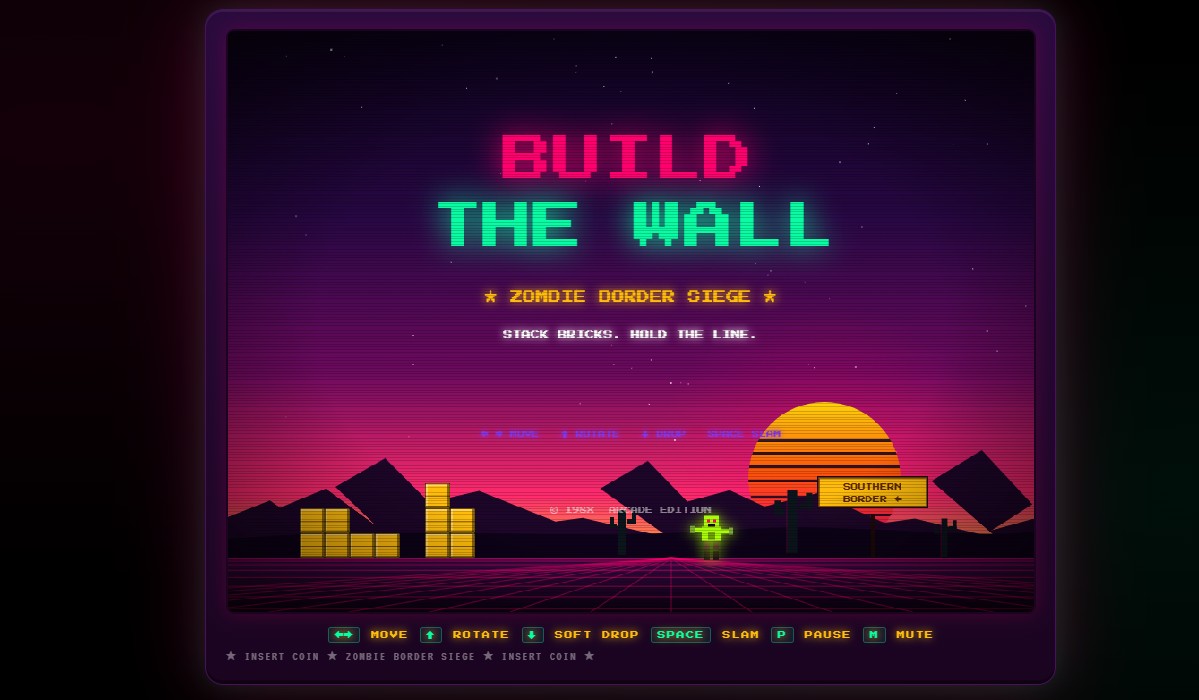
1. Build the Wall
- Inspirational Ancestor: Tetris (1984)
- Gameplay Mechanics: Players must manipulate and arrange falling, multi-colored geometric blocks to form solid, unbroken horizontal lines.
- Policy Alignment: The game serves as a literal representation of the administration’s border wall construction policy.
[ Falling Block ] ->  V
                      V
+---------------------------+
|      [   ]                |  <- Play Area
|   [     ]                 |
+===========================+
|###|###|   |###|###|###|###|  <- Unfinished Border Wall
+---------------------------+- Thematic Rhetoric: The official White House description instructs players to construct a continuous barrier to protect the southern border from what it explicitly characterizes as "the coming horde." The game contains no metaphorical abstraction; the completion of the puzzle is directly tied to the physical restriction of migration.
2. Rio Run
- Inspirational Ancestor: Snake (1976)
- Gameplay Mechanics: The player controls a digital avatar resembling President Donald Trump, navigating a grid-based map.
- Policy Alignment: The game simulates border apprehension and enforcement operations along the Rio Grande.
- Thematic Rhetoric: As the player guides the presidential avatar along the riverbanks, they collect small, pixelated figures representing migrants crossing the border. With each figure collected, the migrant joins a growing, single-file line trailing directly behind the player’s character, mimicking a chain of apprehensions. The player’s score increases relative to the length of the line of detained figures.
3. Supply Line
- Inspirational Ancestor: Tapper (1983) / Conveyor-belt sorting games
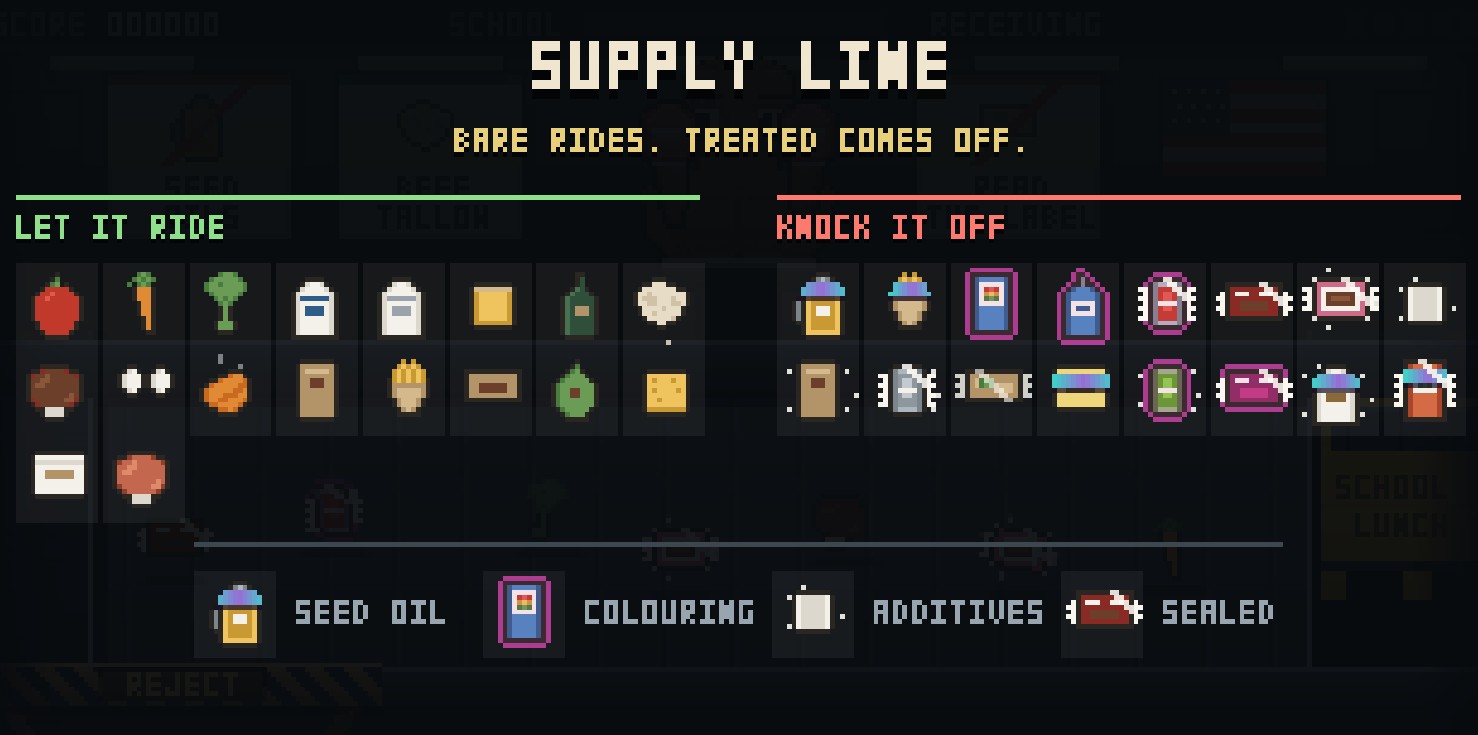
- Gameplay Mechanics: Items move rapidly across the screen along a series of automated conveyor belts. The player must use fast reflexes to identify, select, and discard items that do not meet specified criteria before they reach the end of the line.
Conveyor: [ Apple ] ---> [ Soda ] ---> [ Whole Grain ] ---> [ Out of Bounds ]
(Keep) (Discard) (Keep)- Policy Alignment: This game serves as an interactive advertisement for the administration’s school nutrition reforms, aligned with the "Make America Healthy Again" (MAHA) campaign.
- Thematic Rhetoric: Unlike the politically charged immigration titles, Supply Line functions similarly to traditional educational browser games found on public health websites. Players are tasked with sorting school lunch ingredients, discarding processed foods and sugars while retaining whole grains, fruits, and vegetables to meet federal MAHA standards.
4. Flappy Bill
- Inspirational Ancestor: Flappy Bird (2013)
- Gameplay Mechanics: A side-scrolling, physics-based game requiring precise, rhythmic inputs to keep an avatar aloft while navigating a series of narrow vertical gaps between obstacles.
- Policy Alignment: The game represents the legislative process and the journey of a bill through Congress.
- Thematic Rhetoric: The player controls a bald eagle carrying a rolled-up legislative bill in its talons, navigating the bird through obstacles modeled after the monuments of the National Mall in Washington, D.C. The official description is minimalist: "Fly the bald eagle down the National Mall."
5. Trump Savings Tycoon
- Inspirational Ancestor: Classic arcade platformers / collecting games
- Gameplay Mechanics: The player maneuvers an avatar through a vertical airspace to collect falling gold coins and paper currency.
- Policy Alignment: The game promotes the administration’s proposed "Trump Accounts" initiative—a federal savings program designed for children.
- Thematic Rhetoric: Under the proposed policy, eligible children born during a specified period would receive a one-time federal contribution of $1,000. In the game, this policy is translated into a literal skyward grab for cash over a digital skyline of Washington, D.C. The objective is to gather as much floating currency as possible to fill virtual deposit accounts.
Official Positioning and Administrative Strategy
The White House has framed the Arcade section as an innovative civic outreach tool designed to increase public engagement and make complex federal policies accessible to a broader, digitally native demographic.
By utilizing retro-gaming formats, the administration seeks to achieve several strategic communication goals:
- Bypassing Traditional Media Intermediaries: The games allow the administration to present its narrative directly to citizens without editorial framing, fact-checking, or contextualization from journalists.
- Simplifying Complex Issues: By reducing intricate socio-economic and geopolitical policies (such as border security or federal savings programs) to simple "win/lose" binary mechanics, the administration presents its policies as straightforward, common-sense solutions.
- Viral Engagement: The novelty of an official government website hosting retro games naturally generates organic social media discussion, meme creation, and media coverage, expanding the reach of the administration’s messaging.
+-----------------------------------------------------------------+
|               TRADITIONAL VS. GAMIFIED OUTREACH                 |
+--------------------------------+--------------------------------+
| Traditional Policy Explainer   | White House Arcade Game        |
+--------------------------------+--------------------------------+
| - Text-heavy reports           | - Interactive 8-bit gameplay   |
| - Complex data & statistics    | - Simple "win/lose" mechanics  |
| - Formal, academic tone        | - Humorous, nostalgic tone     |
| - Low viral potential          | - High shareability & memes    |
+--------------------------------+--------------------------------+
While critics argue that hosting partisan, campaign-style messaging on a .gov domain blurs the line between official state communication and political campaigning, the administration has maintained that the games are a creative, modern application of public information funds.
Implications: Gamified Propaganda and the Digital Presidency
The launch of the White House Arcade has significant implications for political communication, digital ethics, and the gamification of public policy.
The History of State-Sponsored Video Games
While the White House Arcade is unique in its explicit partisan branding, state-sponsored video games have a long history. However, previous federal gaming initiatives have generally fallen into distinct categories:
- Military Recruitment: The U.S. Army famously developed and published America’s Army (2002), a highly realistic first-person shooter designed to educate potential recruits about military life and boost enlistment rates.
- Public Health and Education: Agencies like NASA, the EPA, and the NIH have frequently hosted simple interactive games on their
.govdomains to teach children about space exploration, environmental conservation, and human anatomy.
The White House Arcade differs fundamentally from these precedents. Rather than promoting non-partisan civic education or national service, it gamifies highly polarized, active political debates, such as immigration enforcement and border wall construction.
The Gamification of Populist Rhetoric
By translating policy into arcade mechanics, the administration utilizes a technique known as "procedural rhetoric"—using a game’s rules and structure to make a political argument.
In Build the Wall and Rio Run, the gameplay rules dictate that immigration is a problem to be solved through mechanical containment and apprehension. The complexity of human migration, international law, and humanitarian concerns are erased, replaced by an addictive gameplay loop where success is defined by keeping the border clear.
Furthermore, the nostalgic, low-fidelity aesthetic of the games serves to soften the impact of controversial policies. By presenting border enforcement through the lens of harmless, 8-bit retro gaming, the administration attempts to shield its policies from serious ethical scrutiny, reframing intense political struggles as lighthearted entertainment.
Ethical and Legal Boundaries
The hosting of these games on WhiteHouse.gov raises important questions regarding the appropriate use of executive resources.
Official government websites are funded by taxpayers and are historically expected to maintain a degree of institutional neutrality, serving as repositories of objective public information. By integrating campaign-style slogans ("Make America Healthy Again") and highly partisan policy framing into interactive entertainment, the administration challenges the traditional boundary separating official state operations from political campaign machinery.
As the "Coming Soon" slot on the Arcade landing page suggests, this initiative is not a temporary marketing stunt but a permanent expansion of the administration’s digital strategy. The integration of play and policy on the nation’s primary executive portal suggests a new era of political communication—one where governance is not just reported, but played.