

























































Nextcloud Bridges the Productivity Divide: New Euro-Office Desktop Client Challenges the Microsoft Hegemony

In a significant move to solidify its position as the premier European alternative to the Microsoft 365 ecosystem, Nextcloud has announced the launch of a dedicated desktop client for its "Euro-Office" suite. This release, part of the broader "Nextcloud Hub Summer 26" update, marks a pivotal moment in the organization’s mission to provide digital sovereignty to enterprises and government bodies that are increasingly wary of handing their data to non-European cloud vendors.
By bridging the gap between web-based productivity and the traditional desktop experience, Nextcloud is signaling its intent to capture the enterprise market, offering a comprehensive, open-source workspace that combines collaboration, file management, and document editing in a single, privacy-focused package.
The Core Development: Bridging the Desktop Gap
For years, the primary barrier to widespread adoption of open-source office suites in the corporate sector has been the "desktop experience." While web-based editors have improved significantly, the familiarity and power of local applications—such as Word, Excel, and PowerPoint—remain the gold standard for office productivity.
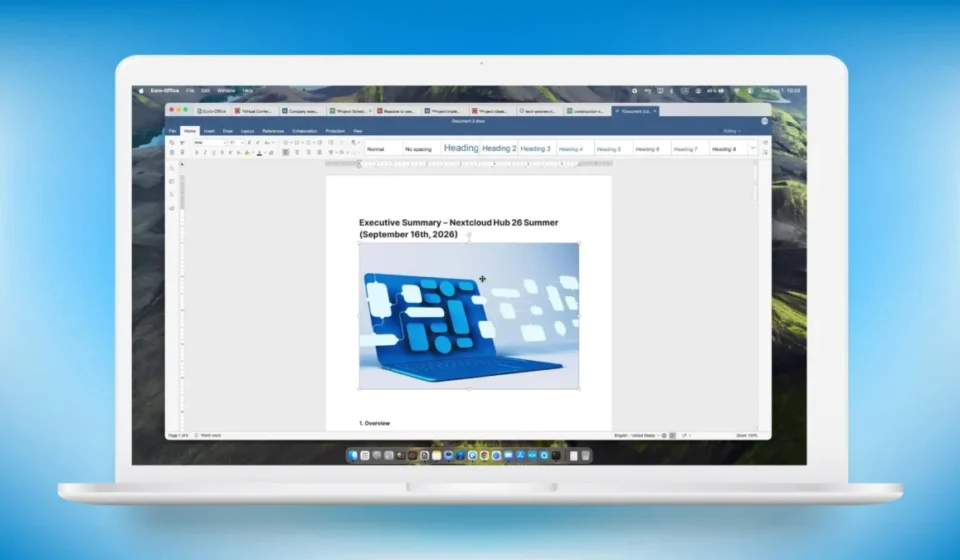
Nextcloud’s introduction of the Euro-Office desktop client aims to eliminate this friction. Available for Linux, macOS, and Windows, the new client allows users to edit documents, spreadsheets, and presentations locally. Crucially, it integrates seamlessly with the Nextcloud Hub backend, allowing for real-time synchronization and collaborative editing.
"For organizations and individuals who prefer a traditional desktop experience, this closes one of the last gaps between Euro-Office and Microsoft Office, without handing control of their data to a non-European vendor," Nextcloud stated in its official press release. By keeping the document ecosystem within a controlled, self-hosted or European-hosted environment, the company is directly targeting organizations subject to strict GDPR compliance and those seeking to mitigate the risks associated with extraterritorial data access.
A Chronology of the Euro-Office Initiative
The journey of Euro-Office has been marked by rapid development and high-profile industry friction, reflecting the high stakes of the European sovereign software market.
- Early 2024: Nextcloud, alongside partners like Ionos, Proton, and XWiki, formalizes the Euro-Office initiative. The project is designed as an integration component—not a standalone suite—to be embedded into productivity platforms like Nextcloud Hub.
- June 2025: The first major integration of Euro-Office into the Nextcloud Office suite is unveiled, initially restricted to web-browser and mobile access.
- Mid-2025: Tensions arise within the open-source community as OnlyOffice, the codebase provider for Euro-Office, accuses the initiative of licensing violations, leading to a temporary suspension of partnerships.
- Late 2025: Development continues with community-driven support. Nextcloud reports that over 40 individual contributors have joined the project, with 15% of code contributions coming from outside the core founding organizations.
- August 2026: The official launch of the Nextcloud Hub Summer 26 updates, featuring the debut of the dedicated Euro-Office desktop client.
Supporting Data and Technical Architecture
Euro-Office is architected to prioritize compatibility and modularity. Recognizing that the corporate world is built on the foundation of Microsoft’s OOXML file formats (.docx, .xlsx, .pptx), the suite offers native support for these formats, alongside the OpenDocument Format (ODF) standards (.odt, .ods, .odp).
However, this decision to prioritize OOXML has not been without its detractors. The Document Foundation, the body behind LibreOffice, has publicly questioned the initiative’s prioritization of Microsoft-owned formats over the more neutral, open-source ODF standards. Critics argue that by catering to Microsoft’s legacy file types, Euro-Office may be perpetuating the very vendor lock-in it claims to circumvent.
Despite this, the adoption metrics, while nascent, show promise. Nextcloud has identified high-profile early adopters, including Germany’s Deutsche Telekom Security and the Turkish IT consultancy Destek. Furthermore, the company notes that organizations in Switzerland, France, and the Philippines are currently in the evaluation phase, signaling a growing international appetite for "sovereign" cloud solutions.
Expert Analysis and Industry Implications
While the technological advancement is clear, analysts remain cautious about the challenges of breaking into a market dominated by the entrenched Microsoft 365 and Google Workspace platforms.
Martha Bennett, VP and principal analyst at Forrester, highlights the "chicken-and-egg" dilemma inherent in the open-source enterprise software market. "Euro-Office hasn’t really proven itself at the kind of scale that large enterprises are looking for," Bennett noted. "That’s, of course, not unique to Euro-Office; all potential open-source alternatives face the same issue. Without somebody taking the leap, it’s not possible to provide that proof."
For large-scale enterprises, the decision to migrate involves more than just software functionality; it requires a massive shift in organizational culture and workflows. Nextcloud’s challenge is to prove that its suite can handle the complex, high-volume needs of multinational corporations without the stability issues that sometimes plague emerging open-source platforms.
Nextcloud Hub Summer 26: A Holistic Overhaul
The Euro-Office desktop client is only one piece of a much larger update. Nextcloud Hub Summer 26 introduces a suite of features designed to enhance team collaboration and internal data management, clearly modeling itself after the workflows established by Microsoft Teams and SharePoint.
Redefining Teamwork
The updated "Nextcloud Teams" app allows for better categorization of collaborative efforts. Users can now view all teams they belong to via a centralized menu. Each team is assigned a dedicated folder containing shared resources, files, and tasks. A key addition is "team-owned files," a feature that ensures organizational continuity; if a specific team member leaves the company, the files they created remain accessible to the rest of the team, preventing the "data silos" that often occur when employees move on.
Enhanced Productivity Tools
- Nextcloud Text: The platform’s lightweight editor now includes advanced features such as version comparison, footnote support, and inline comments, narrowing the gap with high-end word processors.
- Nextcloud Tables: The database app has received significant upgrades, including relational columns that allow for data linking across multiple tables, as well as the ability to import/export table structures without compromising the underlying data.
- AI Assistant: Nextcloud’s AI integration has been expanded. The assistant can now process image uploads for analysis and translation, and the chatbot feature has been updated with long-term memory to recall information from previous conversations, providing a more coherent user experience.
User Interface and Experience (UI/UX)
Acknowledging that ease of use is a primary driver of adoption, Nextcloud has overhauled its interface. The search experience has been improved to index across files, messages, and events, with granular filtering options for date ranges and participants. Furthermore, the application menu icons have been refreshed, and new interface animations have been introduced to ensure that navigating the platform feels fluid and intuitive.
Implications: The Future of Digital Sovereignty
The launch of the Euro-Office desktop client represents a critical escalation in the fight for European digital sovereignty. By providing a viable, localized alternative to US-based cloud giants, Nextcloud is offering a path for organizations to regain control over their data infrastructure.
However, the path forward is complex. The tension between supporting proprietary Microsoft formats for compatibility versus the ideological push for open-source standards (ODF) will continue to be a point of debate. Furthermore, the ultimate success of Nextcloud will depend on its ability to prove that its platform is not just a "sovereign" alternative, but a robust, scalable, and superior tool for modern enterprise collaboration.
As Europe continues to tighten its regulatory grip on data privacy through frameworks like the GDPR and the upcoming Data Act, the demand for local, compliant alternatives will only grow. If Nextcloud can successfully navigate the "chicken-and-egg" hurdle identified by Forrester, it may well provide the template for the next generation of enterprise productivity. For now, the Summer 26 update stands as a robust declaration that the "sovereign office" is no longer just a vision—it is a functional, evolving, and increasingly capable reality.