























































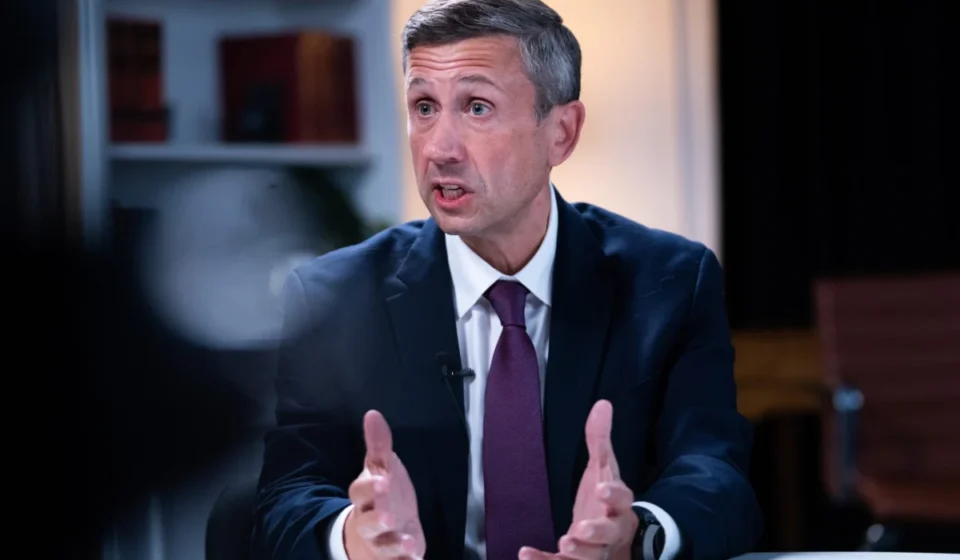
DNC Chair Ken Martin Faces Deepening Crisis of Confidence Amidst Electoral Wins and Financial Woes

NEW YORK, NY – Despite a string of undeniable electoral victories across the nation, Ken Martin, the man at the helm of the Democratic National Committee (DNC), finds himself embroiled in a burgeoning crisis of confidence among senior party officials. Barely a year into his term, questions are mounting about the health and operational efficacy of the Democratic Party’s central political machinery, raising concerns that internal strife could jeopardize future electoral prospects, particularly the pivotal 2026 midterm elections.
The paradox is stark: Democrats are consistently winning at the ballot box, yet the DNC, under Martin’s leadership, is struggling with a reported reluctance from major donors, public scrutiny from influential liberal voices, and whispers of a coordinated effort to seek his replacement. Critics point to Martin’s steadfast refusal to release a promised internal report detailing the party’s performance in the recent 2024 elections as a primary catalyst for the escalating discontent. While most operatives believe Martin’s position is secure for the immediate future, the growing disquiet represents an unwelcome distraction for a party aiming to consolidate power and challenge the Republican Party’s influence in Washington.
A Leader Under Fire: Main Facts Unfold
Ken Martin’s tenure as DNC chair, which began in early 2025, has been marked by a peculiar dichotomy. On one hand, the Democratic Party has enjoyed a remarkably successful run in various elections, from gubernatorial races to special elections for state legislative and congressional seats, and even local contests for state supreme court, county executive, and county sheriff. These victories, achieved even with Republican President Donald Trump back in the White House, are often cited by Martin’s allies as proof of an effective strategy.
However, beneath this veneer of success, a profound sense of unease permeates the party’s ranks. Major donors, crucial for sustaining national party operations, are reportedly withholding contributions, signaling a lack of faith in the DNC’s current direction. Adding to the pressure, prominent liberal commentators and organizations have publicly challenged Martin, particularly regarding his decision to keep an internal post-2024 election "autopsy report" under wraps, a report he had pledged to release upon taking office.
Amanda Litman, who heads Run For Something, a Democratic-aligned organization focused on recruiting and supporting progressive candidates, confirmed the extent of the internal dissatisfaction. Litman revealed that she has been approached by senior strategists in recent days to gauge her interest in potentially replacing Martin. While she declined, her assessment of the situation was blunt: "I think it’s a really hard job, and also Ken is not doing it very well," Litman told The Associated Press. "I honestly think he’s going to have a hard time rebuilding trust." The challenge for those seeking a change, she noted, is the lack of a clear alternative candidate, which somewhat insulates Martin for now.
Sources close to Martin, who requested anonymity to discuss private conversations, describe a leader increasingly isolated and paranoid within party headquarters in Washington. This sentiment is amplified by the fact that Martin did not install his own team upon taking over, instead largely inheriting the existing DNC staff. This environment of distrust and internal division threatens to undermine the party’s cohesion at a critical juncture, with the 2026 midterms looming just months away.
Chronology of Discontent: A Timeline of Martin’s Tenure
February 2025: Taking the Helm Amidst Frustration
Ken Martin assumed the chairmanship of the Democratic National Committee in February 2025, inheriting a party described by many as "divided" and "suffused with frustration" in the aftermath of the 2024 presidential election. His ascent was accompanied by promises of transparency and accountability, notably a commitment to release a comprehensive "after-action report" on the party’s performance and perceived shortcomings in the preceding election cycle. This pledge was seen as a crucial step toward rebuilding trust and ensuring lessons were learned from past campaigns. The expectation was that such a report would be made public on his first day, setting a tone of openness for his leadership.
Throughout 2025: Electoral Triumphs and Nascent Unease
Despite the internal anxieties, Martin’s initial year was characterized by significant electoral successes for the Democratic Party. Across the country, Democrats secured victories in numerous gubernatorial contests, flipped state legislative and congressional seats in special elections, and even won races for state supreme court, county executive, and county sheriff. These wins, often achieved in challenging political landscapes and with a Republican in the White House, were celebrated as evidence of the party’s resilience and effective ground game. Martin’s supporters often pointed to these "scoreboard" victories as proof that his strategic direction, particularly a focus on a 50-state spending plan, was yielding tangible results. However, even as the victories accumulated, a quiet dissatisfaction began to simmer among some party factions regarding fundraising strategies and a perceived lack of clear national messaging.
November 2025: A Brief "Victory Lap"
By November 2025, Martin appeared to be in a stronger position, with some D.C. political observers noting a "victory lap" for the DNC chair. This period likely coincided with a peak in positive electoral outcomes and perhaps a temporary lull in internal criticism. It suggested a moment where Martin’s strategy seemed validated, and the focus was on the party’s forward momentum rather than its internal health. However, this period of relative calm proved to be short-lived.
Early 2026: Intensifying Scrutiny and Public Confrontation
As 2026 progressed and the 2024 election grew more distant, the unfulfilled promise of the "after-action report" became a flashpoint. Liberal influencers and media outlets, including the popular "Pod Save America" podcast, began publicly pressing Martin on the issue. During a recent episode, podcast hosts challenged Martin directly about why he had reneged on his promise to release the post-election autopsy. Even Martin’s close allies reportedly described the interview as a "cringeworthy moment," highlighting the growing discomfort with his handling of the transparency issue.
Mid-2026 (Present): The Crisis Peaks
The current period, less than six months before the critical 2026 midterm elections, sees the crisis of confidence reach its zenith. Major donors have grown increasingly reluctant to contribute, and informal discussions about finding a new chair are underway. Amanda Litman’s revelation about being approached to replace Martin underscores the severity of the internal sentiment. Martin himself has reportedly become more withdrawn, preferring to avoid media interviews and focus on fundraising efforts and scouting sites for the 2028 presidential convention. This critical juncture, with the party needing maximum unity and financial strength, is instead marked by division and doubt, posing a significant challenge to the DNC’s ability to coordinate effectively for the upcoming electoral battles.
Supporting Data: Electoral Wins, Financial Disparities, and the Unseen Autopsy
The most compelling argument for Martin’s leadership stems from the Democratic Party’s consistent performance in elections since he took office. Under his watch, Democrats have demonstrated a surprising capacity to win across diverse political landscapes. This includes high-profile gubernatorial contests, crucial special elections for congressional and state legislative seats, and even lower-ballot races for state supreme court judges, county executives, and sheriffs. These victories, especially noteworthy given the prevailing political climate with a Republican president, suggest that the DNC’s operational strategies on the ground are yielding positive results.
However, this electoral success stands in stark contrast to the DNC’s financial health. According to its most recent federal filing at the end of March, the national party reported a cash-on-hand total of $22.1 million, burdened by $18.4 million in debt. This financial position pales in comparison to its Republican counterpart, the Republican National Committee (RNC), which reported a robust $116.8 million in the bank with zero debt during the same period.
Martin’s team defends this disparity by pointing to an intentional "50-state spending strategy." This approach involves the DNC distributing $1 million each month among party organizations in every state and key U.S. territories. Additionally, nearly two dozen Republican-controlled states receive an extra $5,000 per month specifically to bolster local party infrastructure. DNC national finance co-chair Chris Lowe explained the rationale: "We made a conscious decision to spend money." Lowe elaborated that Martin’s view, which he shares, is that "the best way to position ourselves for the presidential (election) in ’28 is not just to amass a bunch of money, it’s to have a history of winning elections all across the country up and down the ballot. And that’s what we’ve done." Lowe further highlighted that Martin has reportedly raised more money in his first year as chair than any of his predecessors during an equivalent period when Democrats did not control the White House, and that the committee has exceeded its big-dollar fundraising targets every month in 2026 so far.
Michael Kapp, a DNC member from California and a vocal ally of Martin, echoed this sentiment, prioritizing electoral outcomes over bank balances. While acknowledging he would "love to have big donors come on board," Kapp asserted, "Republicans can brag about having more money but they’re not spending it, and they’re not winning. At the end of the day the scoreboard matters more than the spreadsheet." This perspective underscores a fundamental strategic difference within the party: whether to prioritize building a massive war chest or investing directly in grassroots infrastructure and immediate electoral contests.
Beyond the financial debate, the lingering controversy surrounding the "after-action report" from the 2024 election continues to fuel internal dissent. Martin’s allies, including Kapp, concede that the report "is certainly something that should be made public." However, they support Martin’s argument that releasing it now, less than six months before the midterms, would be an unwelcome distraction. "I know there are lessons to be learned from that," Kapp stated, "I trust Ken. I’ve known the man for 10 years. But at this point, when we’re six, seven months away from the midterms, we need to be focused on the midterms." Despite this defense, the refusal to release the report remains a significant point of contention, contributing to the perception of a lack of transparency and accountability from the DNC leadership. Martin has reportedly acknowledged the pressure regarding the autopsy in private conversations with donors, hinting that changes might be forthcoming, according to two sources with direct knowledge of these discussions.
Official Responses: Defenses, Criticisms, and Cautious Support
The DNC crisis has elicited a range of responses from within the party, from staunch defenses of Martin to sharp criticisms and carefully worded expressions of support.
Former DNC Chair Jaime Harrison, whom Martin replaced, has emerged as one of Martin’s most vocal defenders against public attacks. Harrison expressed significant frustration with those in his party who are publicly challenging Martin’s leadership, specifically calling out Democratic operatives from the "Pod Save America" podcast for their persistent questioning of Martin regarding the unreleased post-2024 election autopsy. "Am I happy with everything that goes on in the party? No. Am I happy with leadership that sometimes you get? No. But do you see me going out at this juncture trying to make that case? This is not the moment for that," Harrison asserted. He emphasized the paramount importance of party unity ahead of the midterms: "We have to be as strong as we possibly can going into November, because we have to win. Once we win, we can fight like hell." When asked directly if he believed Martin’s job was at risk, Harrison responded with a firm, "I don’t think so."
Conversely, Amanda Litman’s comments to The Associated Press represent a significant public criticism from a prominent figure within the Democratic ecosystem. Her assessment that "Ken is not doing it very well" and that he will "have a hard time rebuilding trust" underscores the depth of concern among some progressive leaders and operatives. The fact that senior strategists are already sounding out potential replacements for Martin, even if informally, speaks volumes about the level of dissatisfaction.
Ken Martin himself has maintained a low profile amidst the storm, declining to comment for this article and avoiding media interviews in recent weeks. His strategy appears to be to "keep his head down," focusing instead on improving the DNC’s financial health through aggressive fundraising efforts and scouting potential sites for the 2028 presidential convention. His actions, such as hosting crowded fundraising events and conducting multiple one-on-one donor meetings, demonstrate a focus on the practical aspects of his role, perhaps as a way to weather the internal criticisms.
DNC national finance co-chair Chris Lowe and DNC member Michael Kapp have offered strong defenses of Martin’s financial strategy and his overall approach. Lowe’s explanation of the "conscious decision to spend money" on building infrastructure rather than simply amassing a large cash reserve provides the official rationale for the DNC’s financial position relative to the RNC. Kapp’s emphasis on the "scoreboard" over the "spreadsheet" encapsulates the argument that winning elections, even with a leaner bank account, is the ultimate measure of success.
Even potential 2028 presidential prospects are navigating the intraparty conflict with caution. Kentucky Governor Andy Beshear, widely expected to launch a presidential bid, offered a diplomatic, non-committal response when asked directly about Martin’s continued leadership. "Ken and I work well together. And I say that being somebody who wasn’t originally on board," Beshear said, indicating a previous lack of alignment but now a working relationship. He concluded with a general statement on party health: "But he made an effort to reach out to me. And, listen, I want to work with whoever’s there. We need a healthy DNC. We need it to work." This cautious stance highlights the delicate political tightrope potential candidates must walk, avoiding alienating any faction while signaling a desire for a strong, functional national party.
Implications: Midterms, 2028, and the Future of Democratic Unity
The ongoing crisis of confidence surrounding Ken Martin’s leadership carries significant implications for the Democratic Party’s immediate and long-term future.
The 2026 Midterm Elections: Less than six months away, the midterms are a critical test for the party, offering an opportunity to challenge the Republican Party’s grip on power in Washington. The internal conflict within the DNC, characterized by donor reluctance, public criticism, and leadership doubts, represents, at best, an unwelcome distraction. At worst, it could actively hinder the party’s ability to effectively coordinate resources, messaging, and campaign efforts, potentially making it harder for Democrats to achieve their electoral goals in November. A DNC perceived as internally fractured or financially unstable could struggle to energize its base and attract crucial independent voters.
The 2028 Presidential Nomination Process: Looking further ahead, the DNC is tasked with building out the essential political infrastructure for the party’s next presidential nominee. A prolonged period of instability or a perception of weak leadership at the national committee could undermine faith in its capacity to execute this vital role. Presidential prospects, like Governor Beshear, are already approaching the internal conflict with caution, signaling a potential for candidates to either distance themselves from a struggling DNC or, conversely, attempt to leverage its perceived weaknesses to assert their own vision for the party’s future. The DNC’s ability to unify disparate factions, raise substantial funds, and project a coherent national message will be paramount for a successful presidential cycle, all of which are currently under question.
Party Unity and Strategic Direction: The current infighting highlights deeper tensions within the Democratic Party regarding its strategic direction. The debate between Martin’s 50-state spending strategy, which prioritizes grassroots infrastructure and consistent electoral wins "up and down the ballot," versus a more traditional approach of amassing a large national war chest, underscores a fundamental ideological split. While local leaders largely support the 50-state strategy, the financial disparity with the RNC concerns national donors and some operatives who believe a strong central bank account is essential for rapid response and high-stakes campaigns. The public nature of the critique, from liberal influencers to former party chairs, also risks deepening divides at a time when external threats from the Republican Party demand maximum cohesion. The refusal to release the 2024 election autopsy report further exacerbates these tensions, fostering distrust and fueling accusations of a lack of transparency, which can only undermine the party’s ability to learn and adapt.
Ultimately, Ken Martin’s gamble on a diffuse, infrastructure-focused spending strategy, combined with his opaque handling of the post-election report, has created a volatile environment within the DNC. While the party continues to rack up electoral victories, the internal health of its national committee is undeniably fragile. How Martin navigates these challenges in the coming months, and whether he can rebuild trust and financial strength before the midterms, will determine not only his own political future but also significantly influence the Democratic Party’s trajectory in the crucial elections of 2026 and 2028. The question remains whether the party can put aside its internal battles to present a united front, or if the current crisis of confidence will continue to fester, potentially costing Democrats vital opportunities on the national stage.
AP writer Joey Cappelletti in Washington contributed.