
















































Suspended in Mid-Air: How a Living Billboard on Sunset Boulevard Capthes the Essence of Netflix’s Newest Thriller

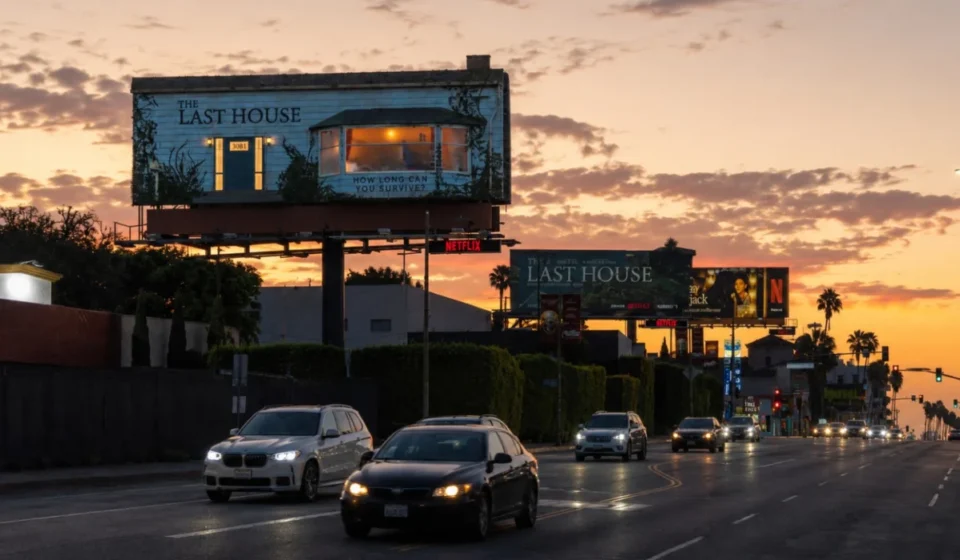
WEST HOLLYWOOD, CA — Drivers and pedestrians navigating the bustling, neon-lit corridors of the Sunset Strip this weekend were treated to a highly unusual sight: a fully furnished, glass-fronted room suspended 30 feet in the air. Perched directly above the intersection of Sunset Boulevard and Selma Avenue, the structure is not a high-concept micro-apartment, but rather a meticulously engineered, living billboard. Inside, a lone performer is spending his weekend eating, sleeping, reading, and watching the city below, all in the name of viral marketing.
The elaborate installation was commissioned by streaming giant Netflix to promote its latest science-fiction thriller, The Last House, which premiered on the platform on August 7. Starring Greta Lee and Wagner Moura, the film explores the psychological claustrophobia of a family trapped inside their home by an inexplicable, invisible force. By placing a real human being in a state of highly visible, elevated confinement, Netflix has transformed a high-concept cinematic premise into a tangible public spectacle.
1. Main Facts: The Anatomy of a Living Advertisement
The installation represents a significant departure from traditional out-of-home (OOH) advertising. Rather than relying on static imagery, digital screens, or 3D extensions, the campaign centers on a fully realized, three-dimensional domestic environment built directly into the framework of a massive billboard structure.
The Physical Setup
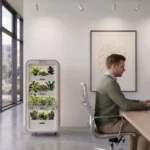
The suspended room is designed to resemble a cozy, albeit highly exposed, modern living space. It features:
- A comfortable armchair and reading lamp.
- Potted houseplants and shelves stacked with books.
- Curtains that can be drawn for privacy, though they remain open for most of the day.
- A large pair of binoculars, which the performer uses to observe the streets below.
- A whiteboard and dry-erase markers, serving as the performer’s sole medium for communicating with the public.
+-----------------------------------------------------------+
|                       BILLBOARD FRAME                     |
|  +-----------------------------------------------------+  |
|  |  [Window]           [Furnished Room]       [Window] |  |
|  |   Plant               Armchair              Books   |  |
|  |   (Performer with Binoculars & Whiteboard)          |  |
|  +-----------------------------------------------------+  |
+-----------------------------------------------------------+
|========= [30-Foot Steel Support Pillars] =================|
|                                                           |
|~~~~~~~~~~~~~~~~~ SUNSET BOULEVARD TRAFFIC ~~~~~~~~~~~~~~~~|
The performer, who entered the structure on Thursday morning, is scheduled to remain inside through Sunday night. Because the room is sealed to maintain the illusion of absolute isolation, he cannot shout down to onlookers over the roar of Sunset Boulevard traffic. Instead, he relies on handwritten messages scrawled on his whiteboard to interact with the crowds gathering below.
2. Chronology: Seventy-Two Hours in a Glass Cage
The logistics of the stunt require a careful balance of endurance, performance art, and strict scheduling. The timeline of the installation highlights how a static piece of real estate was transformed into a dynamic narrative over the course of a single weekend.
Thursday Morning           Friday Afternoon             Saturday Evening             Sunday Night
     [●]--------------------------[●]--------------------------[●]------------------------[●]
Performer moves into        Local news crews arrive;     Citizen app alerts go viral;  Stunt concludes;
the suspended room.         whiteboard communication.    Pajama routine begins.        performer departs.
Thursday: The Arrival
On the morning of Thursday, August 8, the performer ascended into the billboard structure assisted by a production crew. By midday, commuters began noticing signs of life inside what had previously appeared to be a highly realistic, but empty, 3D advertisement. The performer spent his first afternoon organizing his books, watering his plants, and adjusting to the constant vibration of heavy traffic passing directly beneath his floorboards.
Friday: Media Mobilization
By Friday, word of the "billboard man" had spread across social media platforms, drawing local news outlets to the scene. When a camera crew from CBS Los Angeles arrived at the intersection of Sunset and Selma, the performer was ready. Spotting the news van, he wrote a custom greeting on his whiteboard and held it against the glass, acknowledging the cameras with a wave before returning to his book.
As afternoon turned to evening, onlookers watched the performer transition into his nighttime routine. He changed into a flannel robe and pajamas, brushed his teeth, and eventually turned off his reading lamp, sleeping in full view of the glowing digital signs of West Hollywood.
Saturday and Sunday: Public Integration
Over the weekend, the installation became a temporary landmark. Pedestrians timed their walks to catch the performer eating meals, stretching, or staring back at them through his binoculars. The performance is scheduled to conclude late Sunday evening, at which point the performer will descend, and the room will return to being a vacant, static display.
3. Supporting Data: Thematic Alignment and the Legacy of "Out-of-Home" Stunts
The decision to place a human being in a suspended box is directly tied to the narrative architecture of The Last House.
Thematic Synergy
In the film, the protagonists are forced to adapt to a sudden, inexplicable confinement. They are safe inside their home, yet they are prisoners to an unseen force that prevents them from crossing their own threshold.
The Sunset Boulevard installation mirrors this tension:
- Confinement vs. Exposure: The performer has all the comforts of a modern home (furniture, entertainment, food), yet he is entirely cut off from physical human contact.
- The Observer and the Observed: While the public gathers to watch the performer, he actively watches them back using his binoculars, turning the act of marketing into a two-way psychological study of surveillance.
| Stunt Element | Cinematic Theme in The Last House |
|---|---|
| Glass-fronted room | The illusion of safety and the vulnerability of the home. |
| No direct vocal contact | The breakdown of communication with the outside world. |
| Suspension above traffic | Isolation amidst a crowded, moving society. |
Netflix’s History of Experiential Marketing
This is not the first time Netflix has used physical, occasionally unsettling installations to capture the public’s attention in Los Angeles.
- The Altered Carbon Bus Stop (2018): To promote its cyberpunk series Altered Carbon, Netflix installed a highly realistic, plastic-wrapped humanoid figure inside a bus shelter on Santa Monica Boulevard in West Hollywood. The figure, which appeared to be in a state of suspended animation, featured a subtle mechanical chest movement that mimicked breathing. The installation drew significant attention, with some local commuters expressing fascination and others expressing discomfort at the hyper-realistic display.
- The Sunset Strip Dominance: Netflix has long recognized the value of physical space in Los Angeles. In 2018, the company acquired dozens of billboard assets along the Sunset Strip from Regency Outdoor Advertising in a deal valued at over $150 million. This acquisition gave the streaming giant permanent, high-visibility canvases to experiment with creative, physical marketing campaigns in the heart of the entertainment industry.
4. Public Reaction: From Confusion to Digital Virality
The success of experiential marketing campaigns relies heavily on the reaction of the public, and the Sunset Strip installation quickly achieved its goal of generating organic, word-of-mouth buzz.
The "Citizen App" Phenomenon
One of the most notable indicators of the campaign’s success was its crossover into public safety networks. On Friday, local residents began receiving notifications on Citizen—a crowd-sourced mobile app that alerts users to nearby police activity and emergencies—reporting a "man living inside a billboard."
For many, the notification was strange enough to warrant a detour. "I was sitting at home and got a Citizen app alert about a guy inside a billboard just a few blocks away," one local resident told reporters. "On the Strip, you see a lot of weird advertisements, but usually they’re just flat images. I had to drive over and see if there was actually a real person up there. Sure enough, he was just sitting there reading a book."
Social Media Amplification
Images and videos of the performer quickly flooded TikTok, Instagram, and X (formerly Twitter). The contrast of a quiet, domestic scene suspended high above a chaotic, multi-lane thoroughfare provided the perfect visual fodder for short-form video platforms. Users shared clips of the performer drinking coffee in his robe while morning traffic crawled below him, transforming a localized physical stunt into a global digital campaign.
5. Implications: The Evolution of Advertising in the Streaming Era
The Sunset Boulevard installation highlights a broader shift in how major entertainment companies approach consumer engagement in an increasingly saturated digital landscape.
Overcoming "Ad Blindness"
In a city like Los Angeles, where billboards are an intrinsic part of the visual landscape, traditional advertisements often fade into the background. Consumers have developed a natural resistance to standard key art—the classic movie poster featuring a cast lineup and a release date.
By introducing a living, breathing human element, Netflix successfully bypassed this "ad blindness." The installation forces passersby to engage with the advertisement on a cognitive level:
- Inquiry: "Why is there a man in that box?"
- Observation: Watching the performer’s movements and reading his whiteboard.
- Discovery: Connecting the performance to the title of the movie printed on the surrounding billboard framework.
The Premium on Experiential Marketing
As streaming services compete for subscriber retention and opening-weekend viewership, the industry has placed a premium on experiential marketing. Physical installations that invite curiosity, create photo opportunities, and generate organic news coverage often yield a higher return on engagement than traditional digital banner ads or television spots.
The "living billboard" for The Last House demonstrates that in the modern media landscape, the best way to get people to watch a screen at home may be to make them look up at a window in the sky.