





































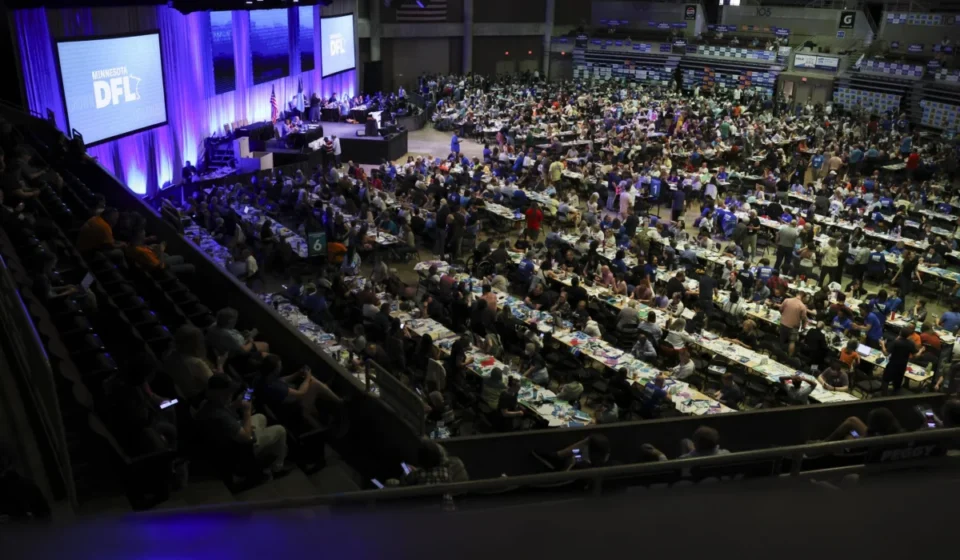
DFL Convention 2026: Klobuchar Dominates Gubernatorial Endorsement Amidst Progressive Challenge, Flanagan Crowned for Senate

Rochester, MN – May 30, 2026 – The Minnesota Democratic-Farmer-Labor (DFL) Party’s 2026 State Convention, held at the Mayo Convention Center in Rochester, concluded this weekend with a decisive endorsement for U.S. Senator Amy Klobuchar in the gubernatorial race and a largely ceremonial anointing of Lieutenant Governor Peggy Flanagan for the open U.S. Senate seat. While Klobuchar’s victory was anticipated, a spirited, if ultimately unsuccessful, challenge from 26-year-old progressive newcomer Kobey Layne injected an unexpected jolt of energy and ideological debate into an otherwise predictable gathering.
Layne, a political neophyte whose passionate plea for policy over personality resonated with many delegates, managed to secure enough support to deliver a compelling 15-minute address, forcing Klobuchar to directly confront a burgeoning progressive flank within her party. On the U.S. Senate front, Flanagan’s ascent was solidified following Congresswoman Angie Craig’s strategic withdrawal from the endorsement contest, paving the way for a historic candidacy as potentially the first Native American woman elected to the U.S. Senate. Beyond the headline endorsements, the convention served as a crucial barometer for the DFL’s internal dynamics, highlighting the tension between established electability and emerging progressive demands, while also underscoring the party’s perennial efforts to bridge the urban-rural divide in Minnesota.
A Convention Defined by Unexpected Sparks and Calculated Moves
The DFL State Convention, often a platform for rallying the party base and formalizing endorsements, unfolded with a mix of anticipated outcomes and unforeseen dramatic turns. Delegates converged on Rochester with a sense of purpose, yet an undercurrent of procedural fatigue and internal debate simmered throughout the proceedings. The Republican Party’s concurrent convention in Duluth meant that the DFL gathering lacked the cross-party suspense of previous cycles, shifting the focus inward.
Friday Evening: The Layne Challenge and Klobuchar’s Assertive Response
The convention’s most riveting episode emerged on Friday evening with the unexpected, yet highly anticipated, challenge posed by Kobey Layne for the gubernatorial endorsement. Prior to Layne’s appearance, the atmosphere had been described by attendees as "grousing about procedural motions and the lack of food options," a common lament at large political gatherings. However, a palpable shift occurred as "Let her speak" chants rippled through the hall, signaling the delegates’ readiness for a fresh voice.
To qualify for a 15-minute speech arguing for an endorsement, a candidate needed the support of 10% of the over 1,200 voting delegates, alongside at least 12 votes from each of Minnesota’s eight Congressional delegations. Layne, despite her youth and relative inexperience in statewide politics, garnered the requisite backing, setting the stage for a direct confrontation with a political titan.
However, the path to the podium was not without its unconventional obstacles. Both Layne’s and Klobuchar’s speeches faced delays, partly attributed to a seemingly "innocuous decision" by Klobuchar’s campaign to distribute strobe lights to delegates. What was likely intended as a vibrant display of support quickly devolved into a source of frustration and concern. State Senator Scott Dibble of Minneapolis, visibly weary, sternly warned, "The strobe lights need to be turned off. No strobe lights." His plea, however, was met with a chorus of "boos" from other conventioneers who demanded the immediate confiscation of the glowing wands. This seemingly minor incident highlighted the diverse sensitivities within the delegate body, with some expressing genuine concern over the potential for photosensitive epilepsy triggers, a condition that affects a small but significant portion of the population.

When Layne finally took the stage, her "jittery energy" quickly translated into "high-velocity remarks" that captivated many. A 26-year-old with a Master’s in Public Policy from the University of Minnesota, Layne’s resume included a stint as a legislative assistant for moderate Republican Jim Abeler of Anoka. Her political evolution, she revealed in an interview, began after being laid off from the Legislature in 2022, coinciding with a personal transition to identifying as female after previously as a gay man. This personal narrative, combined with her current work as an assistant manager at the cosmetics company Aveda, painted a picture of a candidate deeply rooted in contemporary social and economic realities.
Layne’s speech was a direct challenge to conventional political rhetoric, focusing on "concrete goals" and a clear ideological vision. She proposed a "bonding bill that would integrate Minnesota’s clean energy goals" and advocated for "capping rent increases across the state to 3%." Her most memorable line, delivered while bobbing left to right at the podium and pointing to her eyes and ears, was a pointed declaration: "Politics is about policy, not personalities, not platitudes." This statement, a thinly veiled critique of traditional political campaigning, drew "raucous applause," underscoring a segment of the party’s yearning for substantive action over generic promises. Layne also pushed for a more "substantive diversity, equity and inclusion statement for the DFL," asserting, "Just because we are not the Republican Party does not mean that our anti-racism work is done."
Immediately following Layne, Senator Klobuchar presented her case, leveraging her two decades of experience representing Minnesota in the U.S. Senate. Her message was a stark contrast to Layne’s policy-driven specificity, instead emphasizing a proven track record of electability and leadership. Klobuchar’s declaration, "When you look at my track record, when I lead the ticket, we win," elicited a "much louder ovation," a testament to the delegates’ pragmatic desire for a candidate who can secure victory in a competitive general election. She also played up her widespread appeal, asserting, "I think there are some counties where I have met nearly literally every person."
The ideological divide was further highlighted when Layne drew boos for announcing her intention to continue campaigning through the August primary, even without the party’s endorsement – a move that often runs counter to party unity. Klobuchar, in turn, affirmed her commitment to abide by the endorsement process.
The endorsement vote itself, conducted digitally, presented its own set of minor frustrations, with "scores of delegates" likened to "your parents trying to use a QR code," descending upon an IT support table. Delegates were repeatedly reminded to hit the crucial "submit" button after casting their vote. Ultimately, after 1 a.m., the results were announced: Klobuchar sailed to the endorsement with 68% of the vote, Layne garnered 28%, and 4% voted for "no endorsement."
Saturday Afternoon: Flanagan’s Coronation for the Senate
The mood shifted on Saturday afternoon as the focus turned to the U.S. Senate race. With Congresswoman Angie Craig’s decision to no longer seek the endorsement for the seat vacated by the retiring Tina Smith, the path was cleared for Lieutenant Governor Peggy Flanagan. Craig’s withdrawal, described as a "risky new strategy," had caused "an overall sense of consternation" among delegates, many of whom, like Don Slaten, a long-time DFL attendee from Hastings, wished she would remain in her House seat, which he called "a hard seat to keep." The party subsequently endorsed Matt Little, a former state senator, to replace Craig in the U.S. House, further underscoring the ripple effects of her decision.

Flanagan’s endorsement was indeed a "coronation party," celebrating a candidacy that holds significant historical weight. If elected, she would become the first Native American woman to serve in the U.S. Senate. Asked why primary voters should heed the delegates’ endorsement, Flanagan powerfully articulated the democratic foundation of the process: "The delegates who are here today, they represent the nearly 40,000 Minnesotans who went to the caucus on Feb. 3," she said, referencing the caucuses held during the height of "Operation Metro Surge" – an event that, according to previous reporting, involved federal immigration enforcement activities and likely impacted community participation. She proudly proclaimed the delegates to be "the heart of our party."
Supporting Data: Deepening the DFL’s Internal Dynamics
Layne’s 28% showing, while not enough to secure the endorsement, represents a significant vote of confidence for a progressive challenger against an established incumbent. Many delegates were "impressed with Layne’s speech," with Andrew Ulasich from South Minneapolis noting, "I really appreciated how specific she was at the things that she wanted to do." This suggests a desire within the DFL for clear, actionable policy proposals, especially among the party’s more progressive wing.
However, Klobuchar’s overwhelming 68% victory clearly demonstrated the delegates’ pragmatic preference for "electability" and "competence." Several delegates explicitly cited these as deciding factors, with two noting that Klobuchar would "run a tighter ship" than outgoing Governor Tim Walz, whose administration has faced scrutiny over "fraud committed by social service providers." This indicates that while delegates may appreciate progressive ideals, the imperative to win and govern effectively often takes precedence. Klobuchar, for her part, acknowledged the need for a robust policy platform, stating at a media availability, "I have so many ideas," covering housing, childcare, and healthcare. "So, stay tuned," she added, "We’re going to release a lot more ideas." This measured response suggests a strategic approach to policy rollout, designed to appeal to a broad base without alienating the progressive energy Layne tapped into.
The Senate race highlights a different kind of party dynamic. Craig’s withdrawal, while potentially clearing Flanagan’s path to the endorsement, has created a vacuum in a critical House district and forced the DFL to reallocate resources. The delegates’ "consternation" reflects a concern for the broader electoral map and the challenge of retaining hard-won seats. Flanagan’s candidacy, on the other hand, offers the DFL an opportunity to make history and energize a diverse coalition of voters, aligning with the party’s stated commitment to diversity and representation. Her emphasis on the caucus participants reinforces the grassroots legitimacy of the endorsement process, a vital message to carry into a potential primary or general election.
The Enduring "F" in DFL: Rural Minnesota’s Economic Plight
Beyond the individual races, the convention also provided a stark reminder of the DFL’s historical roots and ongoing challenges in rural Minnesota. The refrain, "Remember, the F in DFL stands for farmer," was uttered with such frequency that one might imagine an attendee "in one of Rochester’s many hospitals right now" if they had a sip of coffee for each instance. This reflexive pandering, however, points to genuine and deepening concerns in the state’s agricultural heartland, even as Minnesota’s population continues its demographic shift towards urban centers.
Mary Sullivan, who has presided over a livestock farm with her husband near Redwood Falls since 1980 and is active in the DFL’s rural caucus, articulated the severity of the economic crisis facing farmers. She noted that "tariffs and the war in Iran have led to skyrocketing costs for fertilizer and fuel for tractors, among other price hikes." Sullivan grimly compared the current economic situation to the infamous "farm crisis of the mid-1980s," a period of widespread foreclosures and financial hardship that deeply scarred rural communities. This historical parallel underscores the profound sense of vulnerability felt by many in the agricultural sector.

This economic distress, however, presents a potential "opportunity for Democrats," as one might awkwardly paraphrase Rahm Emanuel. Don Slaten, from Hastings, observed that while many voters in his area are "conservative Catholics driven by their views on ‘guns, gay people and abortion’," the economic realities might force a reconsideration. He posited, "If what Trump has done to farmers doesn’t get them voting DFL, I don’t know what can." This sentiment reflects a strategic hope within the DFL that economic hardship, particularly those attributed to national policies, could override traditional cultural and social conservative leanings in rural areas, potentially shifting crucial votes in future elections. The party faces the complex task of demonstrating that its policies offer tangible relief and support for farmers, transcending the deeply ingrained partisan divides.
Official Responses and Strategic Silences
The official responses at the convention were a mix of strategic messaging and carefully chosen words. Klobuchar’s brief "stay tuned" regarding her policy platform is a classic move of an experienced politician, allowing her to maintain flexibility and roll out detailed plans at a later, more impactful time. It also subtly acknowledged Layne’s demand for specific policy without committing to any of her particular prescriptions, demonstrating Klobuchar’s balancing act between appeasing the party’s progressive wing and maintaining a broad, electable appeal.
Flanagan’s direct appeal to the democratic legitimacy of the delegate process ("heart of our party") was a clear effort to bolster her position against any potential primary challenge, especially from Craig who chose not to seek endorsement. By linking the delegates to the 40,000 caucus participants, she framed her endorsement not just as a party formality, but as a direct reflection of grassroots sentiment. The mention of "Operation Metro Surge" also served to implicitly connect her candidacy to broader social justice issues that resonate with the DFL base, positioning her as a champion for vulnerable communities.
The DFL leadership, while not explicitly quoted on the internal debates, demonstrated its commitment to party process by allowing Layne to speak and managing the potentially disruptive strobe light incident. The digital voting system, despite its initial hiccups, represented an attempt to modernize and streamline the endorsement process, reflecting the party’s broader efforts to adapt to contemporary challenges.
Implications: A Glimpse into Minnesota’s Political Future
The 2026 DFL State Convention offers several key implications for the upcoming election cycle and the future trajectory of Minnesota politics.
For Amy Klobuchar: Her dominant endorsement for governor positions her as the clear frontrunner for the DFL nomination. However, Layne’s robust 28% showing signals that Klobuchar cannot ignore the progressive wing of the party. She will need to articulate a detailed policy platform that appeals to both her centrist base and the more ideologically driven progressives. Her challenge will be to translate her strong track record and electability into specific solutions for issues like housing, climate change, and healthcare, without appearing to co-opt Layne’s ideas inauthentically. The shadow of Walz’s administrative challenges also means Klobuchar will likely emphasize governmental efficiency and accountability in her campaign.
For Kobey Layne: While unsuccessful in securing the endorsement, Layne’s "quixotic quest" was far from a failure. Her passionate speech and significant delegate support establish her as a rising voice within the DFL’s progressive movement. Her decision to continue campaigning to the August primary, despite drawing boos, underscores a commitment to her principles and a belief in the power of direct voter engagement, even without party backing. Whether she can build a sustainable political movement or merely served as a catalyst for a moment remains to be seen, but her specific policy proposals may well influence the broader DFL platform.

For Peggy Flanagan: Her seamless endorsement for the U.S. Senate puts her in a strong position. As the presumed DFL nominee, she will carry the weight of potential history as the first Native American woman in the U.S. Senate. Her challenge will be to unify the party, particularly if Angie Craig decides to bypass the endorsement and run in the primary. Flanagan’s ability to connect with diverse communities, coupled with her strong progressive credentials, will be crucial in a statewide race. The party will undoubtedly rally behind her historic candidacy, aiming to maximize turnout and enthusiasm.
For Angie Craig: Her withdrawal from the Senate endorsement race is a high-stakes gamble. While it potentially allows her to focus resources on a primary challenge or preserve her current House seat, it has undoubtedly complicated matters for the DFL. The party’s endorsement of Matt Little for her House seat indicates an immediate need to secure that district. Craig’s future political moves will be closely watched, as her decision could either streamline or disrupt the DFL’s electoral strategy.
For the DFL Party: The convention highlighted the ongoing internal tensions between maintaining a broad, electable coalition and satisfying the demands of an energized progressive base. The "F" in DFL remains a potent symbol, reminding the party of its need to address rural economic anxieties. The ability to articulate policies that appeal to both urban progressives and struggling rural farmers, while also demonstrating competence and electability, will be paramount for the DFL’s success in 2026. The challenges of a digital voting system and the unexpected strobe light controversy also underscore the logistical complexities of managing a large political gathering and the need for meticulous planning in future conventions. The 2026 DFL State Convention served as a crucial early test, offering both clear direction and lingering questions as Minnesota heads into a pivotal election cycle.