





















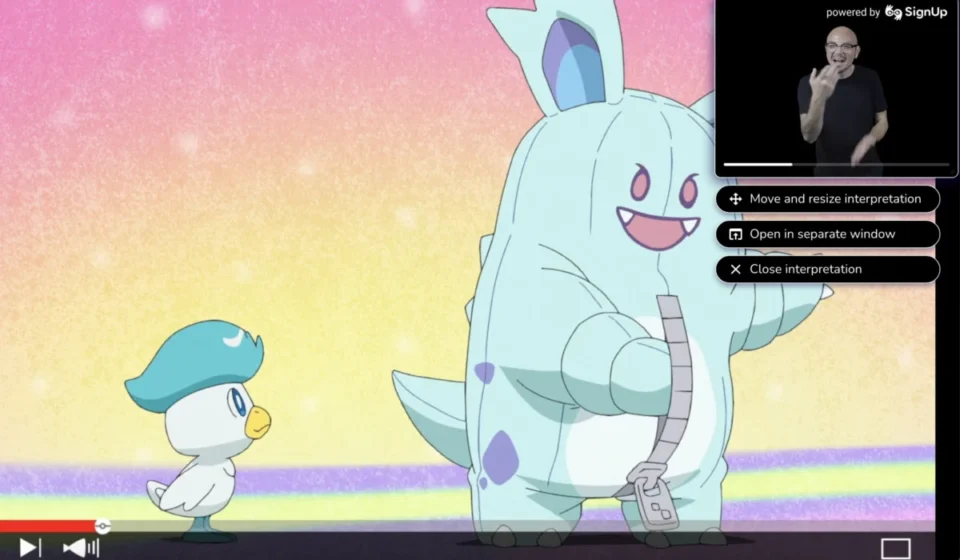

For decades, the standard for media accessibility for the Deaf and hard-of-hearing community has been static: a line of text at the bottom of the screen. While closed captioning was a groundbreaking development in the 1970s, it has long remained an imperfect solution. Today, a new wave of digital innovation, spearheaded by platforms like SignUp Media, is shifting the paradigm from text-based accessibility to a more dynamic, inclusive model: American Sign Language (ASL) translation.
By integrating ASL interpreters directly into the on-screen experience, this movement is addressing the linguistic, educational, and emotional gaps that traditional captions have struggled to bridge for nearly half a century.
The Limitations of Text: A Lingering Accessibility Gap
The reliance on closed captioning assumes a high level of English literacy, a hurdle that has created an inadvertent barrier for millions. Research into the educational outcomes of Deaf students has been sobering; for over a century, the median reading level of Deaf high school graduates in the United States has hovered around a fourth-grade level.
This data point highlights a systemic issue: language deprivation. Many Deaf children do not have consistent, early access to a fully accessible language—whether that is a signed language or a robust written one—during their critical developmental years. Consequently, when a child who has not yet mastered English-language reading attempts to watch a film, captions become an impenetrable wall of text rather than a tool for inclusion.
"Those words go by so fast," explains Everett Glenn, a Minneapolis-based translator whose work has become a cornerstone of this new accessibility initiative. For Glenn, who uses ASL as his native language, reading English captions is a cognitive burden. It forces the viewer to process a second language while simultaneously attempting to track the emotional cadence and visual action of the scene. "Captions are hard to sometimes match up with the emotion of what’s happening," Glenn says. "I’m trying to figure out what they’re saying and reading it at the same time."
Chronology of a Movement: From Startup to Global Streaming
The drive toward integrated ASL translation began in earnest in 2021, when a 17-year-old entrepreneur named Mariella Satow founded SignUp Media. What started as an ambitious project featuring just three translated titles has ballooned into a thriving platform with over 25,000 monthly active users.
The growth trajectory of SignUp Media represents a rapid evolution in how tech companies approach inclusion. By 2023, the platform began securing high-profile collaborations, most notably with streaming giant Netflix. This partnership has allowed for the creation of on-screen ASL translation for over 70 movies and television shows, with a strategic focus on content for children and families—a demographic where early exposure to language is paramount.
The expansion is not merely quantitative; it is qualitative. Translators like Glenn are now working on high-profile intellectual properties, ranging from the Marvel Cinematic Universe’s Shang-Chi and the Legend of the Ten Rings to the long-running Pokémon franchise. The recent completion of 45 hours of Pokémon Horizons marks a milestone in the partnership, demonstrating that complex, dialogue-heavy animation can be made fully accessible without sacrificing the nuance of the original performance.
The Art of the Translation: Behind the Scenes with Everett Glenn
The process of translating a television show into ASL is far more than a simple word-for-word substitution. It is an art form that requires a deep understanding of character, context, and visual storytelling.
For Glenn, the process begins with a comprehensive viewing of the source material. "I just try to have some background," he explains. He breaks down the narrative, identifies key vocabulary, and determines the most effective way to convey the meaning and tone of the dialogue. When the camera rolls, Glenn’s performance—which appears in a dedicated window on the screen—becomes a companion to the animation.
His physical performance is a masterclass in narrative translation. By utilizing expressive facial movements, shifts in posture, and intricate hand gestures, he doesn’t just translate words; he translates the character’s soul. This is particularly vital in animation, where the voice acting is often exaggerated to convey specific archetypes.

The Power of "Sign Names"
One of the most innovative aspects of Glenn’s work on Pokémon Horizons is the development of "sign names." In the Deaf community, sign names function as unique identifiers that go beyond the fingerspelling of a name. They are shorthand tags that often incorporate a person or character’s physical traits or personality.
"Coming up with appropriate name signs to give those characters identity is very important for Deaf kids because they’re associating the names and the characters the same way that a hearing kid would be when they hear the name of a character," Glenn notes.
For the iconic character Pikachu, Glenn didn’t simply spell out "P-I-K-A-C-H-U." Instead, he developed a unique sign that incorporates the character’s signature dimples. This level of creative detail allows Deaf children to build the same deep, personal connection to the media that their hearing peers experience.
Supporting Data and the Call for Inclusivity
The urgency of this initiative is underscored by global health statistics. According to the World Health Organization, there are more than 430 million Deaf people globally, 34 million of whom are children. When media is presented without native-language accessibility, these millions are effectively excluded from the shared cultural experiences that define modern society.
The research is clear: early access to language—whether through formal education or accessible media—is the single greatest predictor of future success for Deaf children. By providing a platform where they can watch content in their primary language, SignUp Media is not just providing entertainment; it is providing a critical tool for linguistic development.
Furthermore, the benefits extend beyond the Deaf community. The platform is increasingly used by hearing people interested in learning ASL. "It’s an enjoyable way to have access to the language and to learn," Glenn says. In this sense, the platform acts as a bridge, fostering greater empathy and understanding between the Deaf and hearing worlds.
Implications: A New Standard for Digital Content
The success of the Netflix-SignUp Media collaboration suggests that the industry is at a turning point. As streaming services compete for global audiences, the "one-size-fits-all" approach to accessibility is no longer sufficient.
The Professionalization of Accessibility
The involvement of professionals like Glenn—who is also a social worker pursuing licensure as a mental health therapist—highlights the growing professionalization of the field. This is not a volunteer hobby; it is a vital service that requires expertise in linguistics, psychology, and performance.
Moving Toward Universal Design
The ultimate goal of this movement is "Universal Design"—the idea that products should be accessible to all people, regardless of ability, without the need for adaptation. While we are not yet at a point where every film is released with an ASL option, the progress made in the last three years provides a roadmap for the future.
"Every generation figures out a way to do it better," Glenn reflects. His work on Pokémon and other films is proof that the next generation of accessibility is already here. By shifting from the cold, static text of the 1970s to the vibrant, emotive, and native-language communication of ASL, we are witnessing the democratization of media. For the first time, millions of children who once felt isolated by the "barrier of text" are being invited to experience the magic of storytelling in a language that is truly their own.
As this technology continues to scale, it serves as a powerful reminder that true accessibility is not about accommodating a disability—it is about removing the obstacles that prevent full participation in the human experience.