























































The Visionary Legacy of Patrick DesJarlait: Reclaiming the Native Narrative in Modern Art

In the mid-20th century, when American popular culture frequently relegated Indigenous peoples to the background of "Western" tropes—depicting them as mere foils for cinematic cowboys or nameless figures in a vanishing frontier—a Red Lake Ojibwe artist was quietly orchestrating a visual revolution. Patrick DesJarlait, a modernist painter whose career spanned from the post-war era to the early 1970s, did more than just create art; he fundamentally altered the way the American public perceived the dignity, agency, and living culture of the Ojibwe people.
Though his name is often associated with the ubiquitous commercial icons of mid-century Americana—most notably the Hamm’s Beer bear and the reimagined Land O’Lakes butter maiden—DesJarlait’s true legacy lies in his fine art. Through a bold, heroic style that centered on the daily lives of the Red Lake Nation, DesJarlait bridged the gap between traditional Indigenous aesthetics and the demands of modern commercial design, leaving behind a roadmap for future generations of Native artists to reclaim their own narratives.
Chronology: A Life Shaped by Resilience and Observation
The trajectory of Patrick DesJarlait’s life was defined by both personal hardship and an unwavering commitment to his artistic vision. Born on March 2, 1921, on the Red Lake Reservation in Minnesota, he was given the Ojibwemowin name Nagawbo, or "Boy in the Woods."

Early Struggles and Artistic Awakening
His childhood was marked by intense challenges that would have stifled a less determined spirit. At age five, he contracted trachoma, a condition that left him temporarily blind. During this period of darkness, his internal world expanded, and upon regaining his sight, he began to document his surroundings with obsessive detail. His relatives began calling him Gwiwizens Odayn Ozhibii’ignaak—"Boy with a Pencil."
His formal education was a series of traumatic interruptions common to the era’s federal Indian boarding school policies. After the death of his mother when he was seven, DesJarlait was moved through several institutions, including the Pipestone Indian School, where traditional cultural practices were strictly forbidden. Despite this environment, he found a mentor in his high school English teacher, Dorothy Ross, who recognized his talent and encouraged his development.
Military Service and Artistic Maturation
The onset of World War II interrupted his formal collegiate training at Arizona State College. In a poignant intersection of history, DesJarlait served the government in two capacities: first as an art supervisor at the Poston War Relocation Center (a Japanese concentration camp) and later as a recruit in the U.S. Navy. In the Navy, he utilized his technical skills to produce propaganda and instructional films, refining his visual storytelling abilities.

The St. Paul Years and Commercial Success
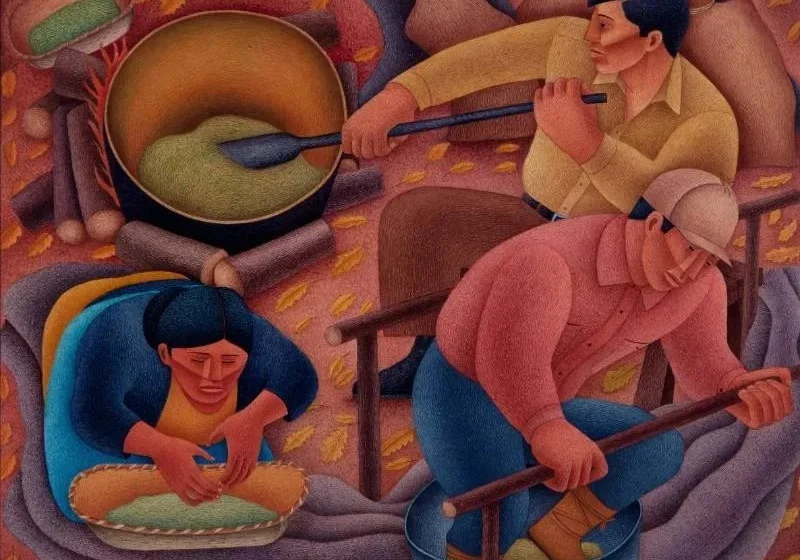
Returning to Minnesota in 1945, DesJarlait entered his most prolific decade. In 1947, he relocated to St. Paul, where he balanced his fine art career—producing masterpieces like Maple Sugar Time and Red Lake Fishermen—with a demanding role in the Twin Cities’ burgeoning advertising industry. It was during these years that he cemented his status as a commercial innovator, eventually passing away in 1972 at the age of 51.
Supporting Data: The Intersection of Fine Art and Commercial Design
To understand DesJarlait’s impact, one must look at his dual career path. He operated simultaneously as a high-art practitioner, winning prestigious honors like the first prize at the 1947 Philbrook Indian Annual, and a savvy commercial artist who understood the power of iconography.
The Land O’Lakes Revision
Perhaps his most famous contribution to American visual culture was his 1954 redesign of the Land O’Lakes butter maiden, Mia. The original design, created by a white artist in 1928, was a generic caricature. DesJarlait, drawing from his Ojibwe identity, transformed the figure. He added intricate, culturally accurate beadwork to her dress and adjusted the "O" in the brand logo to form a halo-like structure, reminiscent of Byzantine religious iconography. This was a subversive act of reclamation: he took a corporate symbol and injected it with the dignity and aesthetics of his own heritage.

The Hamm’s Beer Bear
Working with agencies like Campbell-Mithun, DesJarlait’s influence extended into the world of animation. His work on the Hamm’s Beer commercials integrated the Northern Woodland aesthetic into the homes of millions of Americans. While these were commercial advertisements, they subtly normalized the inclusion of Native-inspired motifs in the American living room.
Official Perspectives and Cultural Context
DesJarlait’s work did not exist in a vacuum. During the 1960s and 70s, as the American Indian Movement (AIM) rose to prominence in Minneapolis, the discourse surrounding Native representation shifted from assimilation to self-determination.
While DesJarlait was not an official member of AIM, his later work aligned perfectly with the movement’s goals. In 1970, he produced Indian Educations, a series that explicitly countered the damaging stereotypes prevalent in media. By depicting loving Native fathers and thriving, cohesive families, DesJarlait utilized his art as a tool for public education.

"He wanted to show loving Native families," historians note, "with the belief that his paintings were relevant for the younger generation of urban Native Americans." His public lectures at schools and colleges were an extension of this mission—he was a bridge-builder who aimed to dismantle the ignorance of non-Indigenous populations through the power of visual representation.
Implications: The Enduring Significance of DesJarlait
The implications of DesJarlait’s career are profound for contemporary Indigenous art. He demonstrated that a Native artist could successfully navigate the commercial world without losing their cultural soul.
Breaking the "Vanishing Race" Myth
For much of the early 20th century, art involving Native subjects was largely focused on the "vanishing race" narrative—static, sepia-toned images that implied Indigenous cultures were a thing of the past. DesJarlait’s work was the antithesis of this. His subjects were modern, active, and rooted in a living, breathing community. He painted the Red Lake Ojibwe not as historical artifacts, but as people participating in the rhythmic, seasonal cycles of life—wild rice harvesting, maple sugaring, and family interaction.

The Blueprint for Future Generations
Today, as Indigenous artists continue to challenge the mainstream media’s narrow view of Native identity, DesJarlait’s work remains a cornerstone of the movement. He proved that an artist could be both a modernist—embracing bold lines, flat color planes, and stylized figures—and a traditionalist, honoring the nuances of tribal life.
His ability to synthesize these two worlds allowed him to reach audiences that were otherwise unreachable. By placing his imagery in advertisements and public spaces, he ensured that the Ojibwe presence was felt throughout the Midwest.
Conclusion: A Legacy of Dignity
Patrick DesJarlait’s life was cut short, but his influence remains as vibrant as the watercolors he applied to paper. By choosing to depict his people with "heroic dignity," he ensured that his community was seen on its own terms. He was a pioneer who used his pencil—the tool that earned him his childhood moniker—to rewrite the script of Native representation in American art.

As we continue to analyze the cultural history of the 20th century, DesJarlait stands as a pivotal figure. His art serves as a reminder that the act of representation is, in itself, an act of resistance. From the boarding schools that sought to silence his culture to the boardrooms where he forced the world to acknowledge it, DesJarlait’s journey was one of constant reclamation. His legacy is not just in the logos he designed or the galleries that held his shows, but in the path he cleared for every Native artist who picks up a brush today with the intent to show their world as it truly is: vibrant, resilient, and enduring.