























































The Iron-Nitride Revolution: Niron Magnetics and the $1.8 Billion Quest to Resurrect Minnesota’s Industrial Heart

In the rugged landscape of Northern Minnesota’s Iron Range, a region defined by over a century of taconite mining and industrial grit, a new era of manufacturing is beginning to take shape. While national headlines have long been dominated by the contentious debate over the Twin Metals plan to extract copper and nickel near the Boundary Waters Canoe Area (BWCA), a different, arguably more transformative opportunity is quietly gaining momentum.
Minneapolis-based Niron Magnetics is currently evaluating the Iron Range as the potential site for its third and largest production facility—a massive $1.8 billion undertaking that could fundamentally redefine the state’s economic trajectory. By utilizing a breakthrough technology that replaces rare-earth minerals with common iron and nitrogen, Niron aims to break the global stranglehold held by China over the permanent magnet market, while simultaneously breathing new life into a region struggling with the decline of traditional ore mining.
Main Facts: A Paradigm Shift in Magnet Production
Niron Magnetics represents a pivot point in both material science and domestic industrial policy. For decades, the high-performance magnets required for electric vehicle (EV) motors, wind turbines, defense systems, and consumer electronics have relied on "rare-earth" elements like neodymium and dysprosium. The mining and processing of these materials are notoriously dirty, expensive, and—crucially—dominated by China, which controls approximately 90% of the global manufacturing supply chain.
Niron’s value proposition is centered on "Clean Earth Magnets." Developed from proprietary technology birthed at the University of Minnesota, these magnets utilize iron nitride—a compound made from two of the most abundant elements on the planet.
Key project details include:
- The Investment: A projected $1.8 billion for a "mega-plant" slated for construction by 2028-2029.
- Job Creation: The proposed facility would employ more than 700 workers, significantly offsetting the loss of hundreds of jobs in the declining taconite industry.
- Production Scale: The facility is designed to produce 10,000 tons of magnets annually, a massive leap from the 1,500-ton capacity of the company’s current project in Sartell.
- Strategic Location: The Iron Range is being scouted due to its existing transportation infrastructure, high-skilled workforce, and proximity to raw iron feedstock.
Chronology: From University Lab to Industrial Scale
The journey of Niron Magnetics is a decades-long narrative of academic innovation transitioning into a commercial powerhouse.
The Discovery (2010s): The technology was invented by University of Minnesota Professor Jian-Ping Wang. His research focused on the magnetic properties of iron nitride, a material that had been theorized to have high magnetic potential but was notoriously difficult to stabilize for industrial use.
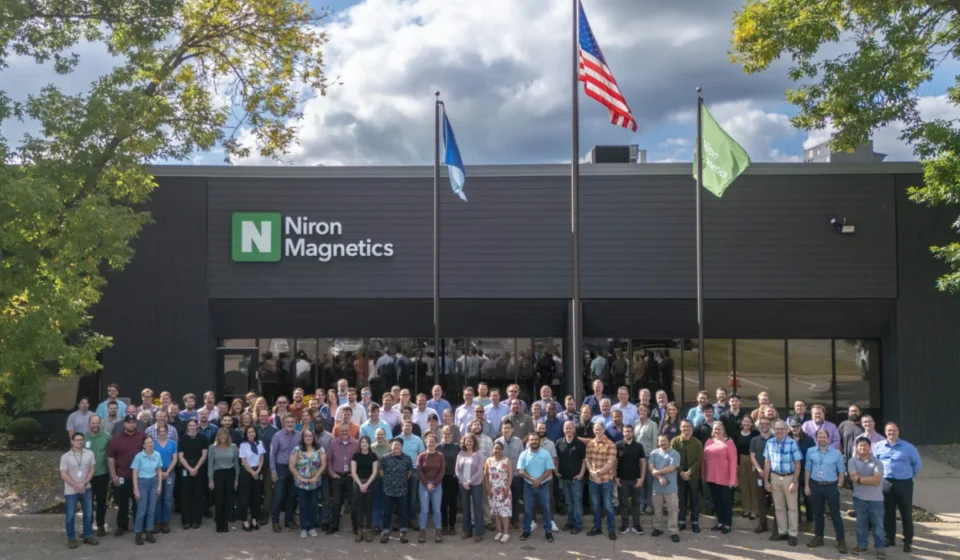
Founding and Early Growth: Niron was established to commercialize Wang’s patents. The company set up its headquarters and a pilot plant in Northeast Minneapolis, which currently employs 185 people. This facility served as the "proof of concept" stage, where the chemical processes were refined to ensure the magnets could be produced reliably without rare-earth inputs.
The Sartell Expansion (2023-2024): In a major step toward commercialization, Niron broke ground on its first full-scale production plant in Sartell, near St. Cloud. Backed by a $10 million investment from the state, this plant is expected to employ 175 people and act as the bridge between laboratory success and global market entry.
The 2029 Vision: Looking toward the end of the decade, Niron CEO Jonathan Rowntree and state officials began formalizing plans for a third facility. Earlier this year, Niron hired Savills, a global commercial real estate adviser, to conduct a site selection process across Minnesota and several other unidentified states. The goal is to have this $1.8 billion facility operational by 2029.
Supporting Data: The Geopolitical and Economic Context
The urgency behind Niron’s expansion is underscored by stark data regarding the global supply chain. According to the Center for Strategic and International Studies, China mines 70% of the world’s rare-earth minerals but controls nearly 90% of the manufacturing process that turns those minerals into magnets.
The Scarcity Crisis
Rare-earth mining is an environmentally hazardous process that requires intensive chemical separation. Because the U.S. largely abandoned its domestic rare-earth processing capacity in the late 20th century due to environmental and cost concerns, American manufacturers—including those in the defense sector—are currently beholden to Chinese export policies.
Niron’s Financial Momentum
The company’s rapid ascent is fueled by a robust capital stack. Niron has raised approximately $300 million in private and public capital. Its investor list reads like a "Who’s Who" of global industry:
- Automotive: GM Ventures, Volvo, and Stellantis (the parent company of Chrysler and Fiat).
- Technology: Samsung Ventures and Western Digital.
- Government: The U.S. Department of Energy.
With designs on reaching $1 billion in annual revenue, Niron officials have hinted at a potential public stock offering (IPO) within the next few years to secure the hundreds of millions in additional capital required for the Iron Range expansion.
Official Responses: A Bipartisan Industrial Consensus
In a rare display of political unity, the prospect of a Niron mega-plant has drawn support from across the ideological spectrum in Minnesota.
Jonathan Rowntree, CEO of Niron Magnetics, emphasized the strategic importance of the project during a congressional committee hearing last November. "Manufacturing permanent magnets from iron and nitrogen reduces the need for rare-earth mining, chemical separation facilities, and complex metallurgical processing," Rowntree stated. "A single integrated facility transforms commodity iron ore and atmospheric nitrogen into finished magnets that automotive powertrains, headphones, and refrigerators need."
State officials see the project as a perfect fit for the Iron Range’s unique heritage. Ryan Malich, executive director of business development at the Minnesota Department of Iron Range Redevelopment and Resources (IRRR), noted the alignment between the company’s needs and the region’s assets. "These are the types of jobs that we’re trying to add to the area in evolving, innovative technologies. We have a highly skilled, available workforce. All the elements seem to line up well for this potential development," Malich said.
Kevin McKinnon, Deputy Commissioner of the Department of Employment and Economic Development (DEED), echoed this enthusiasm. "The promise, the trajectory of where they are going is very exciting," McKinnon said. "The third project would dwarf Sartell. The scale is exciting. We believe Minnesota is a compelling location for such a project."
Even Republican U.S. Rep. Pete Stauber, a staunch advocate for traditional mining and the Twin Metals project, has voiced support for Niron. This bipartisan backing is critical, as any project of this scale will likely require significant government participation in the form of infrastructure grants, tax abatements, and workforce training programs.
Implications: Environmental Stewardship and Economic Resilience
The potential arrival of Niron on the Iron Range carries profound implications for the future of Minnesota’s environmental and economic policy.
The "Clean Mining" Alternative
For years, the Iron Range has been a battleground over the Twin Metals project. While Twin Metals promises jobs and minerals for the green energy transition, its proximity to the Boundary Waters has led to fierce legal and legislative opposition from environmentalists who fear sulfuric acid drainage could permanently damage the pristine watershed.
Niron offers a different path. Because its process uses iron and nitrogen—materials already abundantly available and processed in Minnesota—it does not require the same type of controversial "hard-rock" mining within sensitive watersheds. By locating outside the BWCA watershed and focusing on a manufacturing-based solution rather than an extractive-only one, Niron could potentially lower the political temperature on the Range while still delivering the economic "shot in the arm" the region craves.
Rebuilding the Middle Class
The Iron Range has suffered for decades from the globalization of the steel industry. Modern domestic mills now use more recycled steel feedstock, and imported steel has squeezed the margins of taconite operations. The loss of high-paying mining jobs has led to a slow "brain drain" of the local workforce.
A $1.8 billion magnet plant would represent the most significant industrial investment in the region in a generation. With 700-plus high-tech manufacturing jobs, Niron wouldn’t just be replacing lost mining jobs; it would be upskilling the workforce for the 21st-century green economy.
National Security
Beyond Minnesota’s borders, the Niron project is a linchpin in U.S. national security. As the Department of Defense seeks to decouple its supply chains from Chinese influence, the ability to produce high-performance magnets from domestic iron and nitrogen is a strategic asset. If Niron succeeds, Minnesota will not just be a provider of raw ore, but the epicenter of a global technological shift that ensures American energy and defense independence.
As the site selection process continues, the eyes of the industrial world remain on Minnesota. Whether the "Iron-Nitride Revolution" takes root on the Range depends on the ability of state leaders and private investors to finalize a partnership that matches the scale of Niron’s ambition. If they succeed, the Iron Range may once again become the engine of American industrial might—this time, with a cleaner, more sustainable heartbeat.