


























































The High Cost of Home: Rural Minnesota Confronts the Existential Crisis of School Consolidation

On a sun-drenched late summer morning in Hibbing, Minnesota, the rhythm of childhood remains unchanged. Dave Benz and his daughter, Sabrina Weberg, guide his twin granddaughters, Maya and Lucy, across the woodchips of the Greenhaven Elementary playground. The girls, soon to be three, navigate the climbing structures with tentative steps, relying on the gentle encouragement of family.
Yet, the innocence of the scene is sharply contrasted by the reality looming just a few yards away. In front of the school, a large, weathered yellow sign reads simply: "For Sale."
"Yeah, it was a sad one," Benz says, watching the girls. In March, the Hibbing School Board voted to shutter the facility, a casualty of a $2 million deficit that has left the district grasping for solutions. Greenhaven is not an outlier; it is a symptom of a systemic collapse facing school districts across Minnesota and the rural United States. As enrollment numbers—the lifeblood of state funding—plummet and operational costs spiral, the architecture of rural life is being fundamentally dismantled, one classroom at a time.
The Financial Pressure Cooker: Why Schools are Failing
The struggle to keep rural schools afloat is a modern echo of a historical trend. In the 1990s, Minnesota experienced a seismic shift in its educational landscape, losing one-fifth of its school districts to consolidation. Over 150 districts, pushed by the state Legislature and pulled by the gravity of declining populations and fiscal instability, merged campuses in an attempt to survive.
Today, that pressure has returned with renewed intensity. Education funding is notoriously complex, but the mathematical reality is brutal: state funding is primarily tied to the number of students in seats. As the population in northeastern Minnesota ages and young families migrate toward urban centers, the per-pupil revenue no longer covers the baseline costs of maintaining a functioning district.
"Every small district has these same needs," explains Aaron Fischer, Executive Director of the Minnesota Rural Education Association. "You need a superintendent, principals, an activities director, custodians, office support staff, and a business manager. At a certain point, there simply aren’t enough students to pay for the basics."

A Chronology of Decline and Transformation
The timeline of this crisis is measured in the quiet disappearance of local institutions.
- The 1990s: The first major wave of rural consolidation in Minnesota, driven by legislative incentives and widespread farming community population loss.
- 2010s: A period of relative stabilization, though underlying demographic trends continued to worsen.
- 2023–2026: The current "pressure cooker" era. Districts are no longer just closing single schools; they are exploring full-scale district mergers.
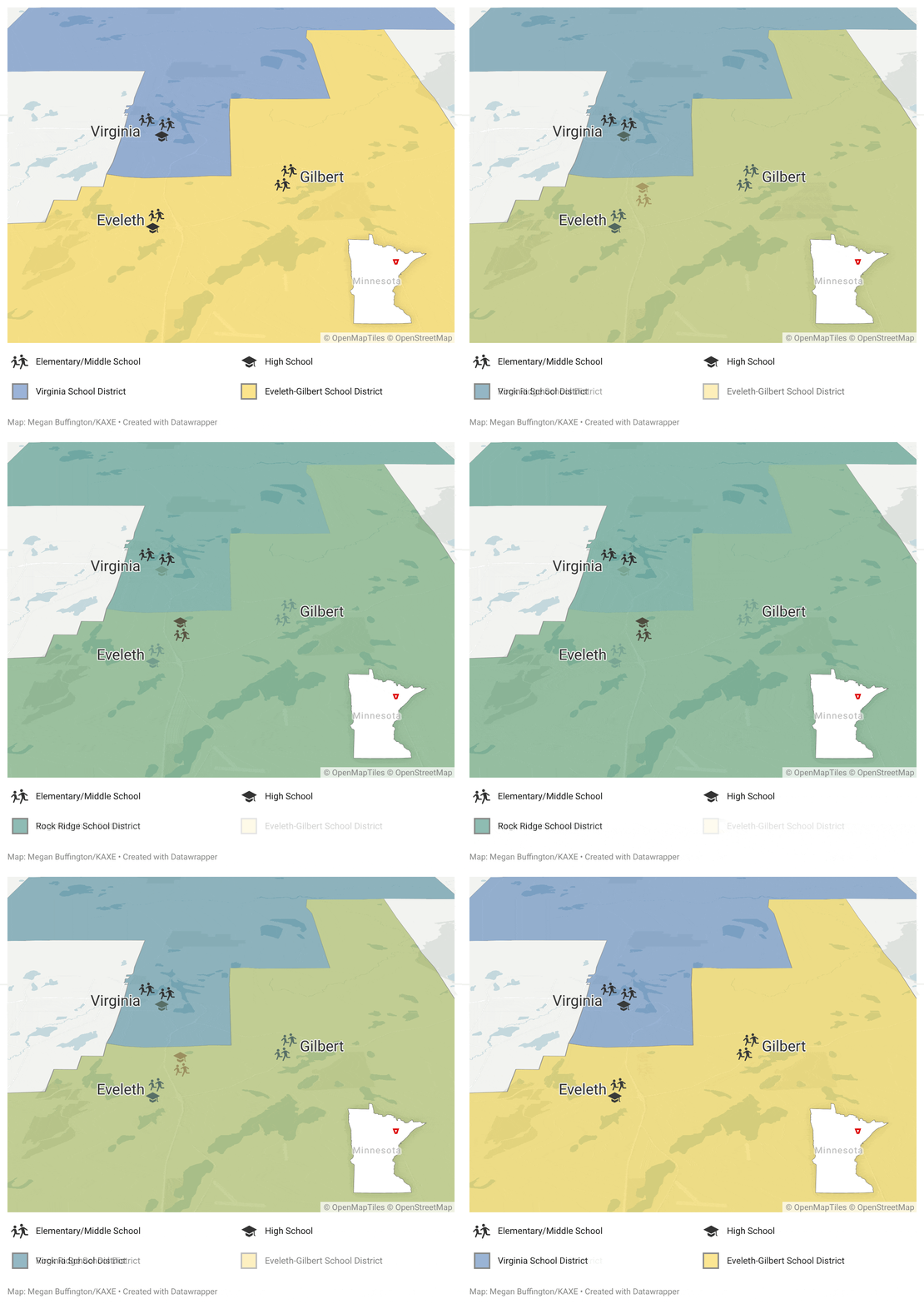
- 2026 (Present): Hibbing and neighboring Chisholm engage in serious, albeit informal, discussions regarding consolidation. Meanwhile, the Rock Ridge district—a merger of Virginia and Eveleth-Gilbert—enters its fourth year of operations.
This is not a sudden catastrophe, but rather what Superintendent Noel Schmidt describes as a "death by a thousand paper cuts." For districts like those on the Iron Range, the choice is increasingly binary: consolidate and evolve, or face an inevitable, slow-motion insolvency.
The Identity Crisis: Schools as Cultural Anchors
In rural America, a school is rarely just a building. It is a town square, a historical archive, and a primary engine of local identity. When a school closes, the community often feels as if a piece of its soul has been excised.
Paul Peltier, who leads the Range Association of Municipalities and Schools (RAMS), understands this visceral loss better than most. Having attended four different schools before graduating, he recalls the feeling of being "bounced around."
"We were just Balsam boys," Peltier says, reflecting on his youth. "That’s what happens when you live 30 miles away from a school. Communities and families anchor themselves in their school, and schools owe it to them to make sure they are custodians and stewards of that identity."
This sentiment is particularly acute in the Iron Range, a region defined by its unique history of mining and immigration. Here, the school mascot on a jersey or the trophy case in a lobby serves as a repository for generations of collective memory. When a school is torn down, that tangible history often disappears with it.

Official Responses and the "No-Brainer" Defense
For proponents of consolidation, the emotional weight of tradition must be balanced against the pragmatic needs of the 21st-century student. Noel Schmidt, the superintendent who spearheaded the creation of the Rock Ridge district, argues that the status quo was a disservice to children.
"I had one advantage: I did not grow up here," Schmidt says. "It just took a little different viewpoint on how things are going."
At the Rock Ridge campus, the contrast with the old, aging infrastructure is stark. The facility boasts a grand piano in the cafeteria, a high-tech career academy, and a 3-ton crane in the shop space. John Uhan, School Board Chair and a lifelong resident of the area, calls the consolidation a "no-brainer."
"The curriculum catalog is way better than what Eveleth-Gilbert was able to offer," Uhan notes. "Athletically, it’s been more successful. The facilities are great. Eveleth-Gilbert would have been in huge trouble." For Uhan, the choice was between clinging to a fading past and embracing a future where students have access to modern technology and specialized trade training.
Implications for the Future: A New Model for Rural Education
Despite the successes of consolidated districts like Rock Ridge, the move is not without fierce opposition. During the recent open house, one parent expressed deep resentment, characterizing the loss of the local school as a betrayal of the community’s heritage.
The challenge for leadership is navigating the transition from a sentimental past to a functional future. As Mayor Adam Roen of Eveleth notes, the loss of the school district building in the heart of town has changed the flow of the community. "We don’t have our school district building right in the heart of it," he admits. "But it’s here now; we have to make the best of it."

The broader implications of this trend are sobering:
- Economic Impact: As Aaron Fischer points out, schools are significant economic drivers. When a neighboring town visits for a football game, they bring revenue. When the school is gone, that interaction ceases.
- State-Level Apathy: Peltier expresses concern that state legislators are experiencing "fatigue" regarding rural education issues. He warns that the lack of consistent, robust support from the state level is forcing local communities to make increasingly desperate, unpopular decisions.
- The "Survival of the Fittest" Mentality: Schmidt warns that if rural districts wait for an external crisis to force their hand, they will lose the ability to shape their own destiny.
As Hibbing and other rural hubs look toward the future, the lessons of the Iron Range are clear: consolidation is an agonizing process that requires more than just fiscal planning; it requires a delicate negotiation of civic identity.
"We have a very proud history, and people like hanging on to that," Uhan says. "I like embracing the new."
Ultimately, the story of the rural school is the story of a changing America. As the small towns that once blossomed around mines and fields grapple with demographic decline, they are forced to confront the reality that to save the education of their children, they may have to sacrifice the very institutions that once defined their neighborhoods. It is a "no-brainer" for some, a tragedy for others, and an unavoidable reality for all.
This reporting is part of a collaboration with the Institute for Nonprofit News’ Rural News Network and Big Local News at Stanford University.