










































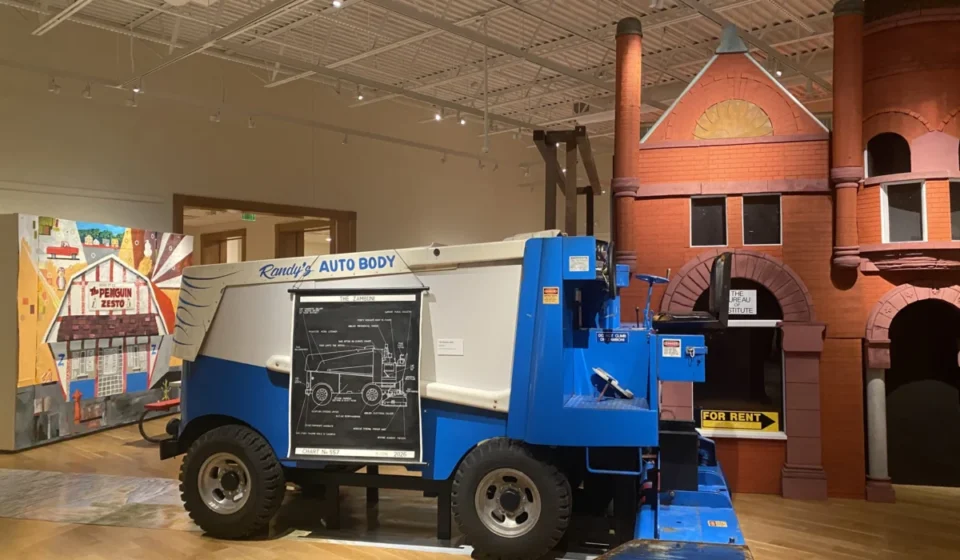

In the quiet, river-hugging city of Winona, Minnesota, the lines between a public museum and a local pizza joint have begun to blur. At the Minnesota Marine Art Museum (MMAM), visitors are currently confronted with a curious sight: a fully functional, ice-smoothing Zamboni parked in the gallery, and the displaced, booth-seating infrastructure of Rocco’s Pub and Pizza, a local institution. This surreal convergence is the centerpiece of "Home(town)," an ambitious, multi-layered installation by Minneapolis-based artist Andy DuCett.
The exhibition is more than a mere showcase of local memorabilia; it is a profound, often humorous, and deeply analytical investigation into how a community constructs its own history, identity, and future. By pulling the tangible artifacts of Winona—from restaurant furniture to civic machinery—into the hallowed halls of an art museum, DuCett is challenging the traditional boundaries of institutional curation and the nature of "marine art" itself.
The Displaced Landscape: Rocco’s and the Institutional Void
The narrative of "Home(town)" begins with a conspicuous absence. At the real-world location of Rocco’s Pub and Pizza in Goodview, a neighboring city to Winona, a large, rectangular patch of discolored wall marks the spot where Ron Hunt’s 1972 painting, Coming In, once hung. The painting, an idyllic rendering of ducks navigating a marshy riverbed, was a gift from the artist to Tom Barth, the founder of Rocco’s.
Today, that painting—along with two tables and three booth seats from the restaurant—resides at the MMAM. In its place at the restaurant hangs a sign, bearing both the logos of the museum and the pub, signaling the work is "out on loan." This institutional labeling serves as the exhibit’s first act of theater. It transforms a simple, lived-in pizza parlor into an archaeological site, elevating the mundane decor of a local eatery to the status of a protected artifact.
For the visitor, the experience is disorienting. When one encounters the "Rocco’s corner" within the museum, complete with a flickering neon Miller Lite sign and carefully placed menus, the feeling of nostalgia is palpable. It is a space designed for intimacy, bridging the gap between the high-culture setting of an art museum and the blue-collar comfort of a neighborhood hangout.
A Chronology of Collaboration and Mythogeography
The genesis of "Home(town)" lies in DuCett’s long-standing interest in the power of institutional storytelling. Long before this exhibition, he was already experimenting with the concept of fictionalized bureaucracy. In 2024, his contribution to the MMAM’s Fluid: What Is Marine Art, and What Can It Be? exhibit featured On Loan (2019), a kinetic sculpture that simulated the rocking motion of a ship at sea. The work was credited to the "South London Museum of Maritime Kinetics"—a completely fabricated institution.

By inventing these agencies, DuCett creates a "mythogeography"—a blend of real-world history and imaginative storytelling that allows him to critique how institutions codify culture. "Home(town)" expands on this by inviting a chorus of collaborators to weigh in on what defines the Winona experience.
The exhibition’s timeline is not linear but thematic, moving from the industrial to the social. Visitors are greeted by a massive Zamboni, not as a static sculpture, but as a symbolic engine of the North. It is paired with a hand-drawn map by artist Allen Brewer, which traces a fanciful route from the Mississippi River’s source at Lake Itasca down to Winona. This juxtaposition suggests that our understanding of geography is as much about the tools we use to navigate it as it is about the physical landscape itself.
The Architecture of Advocacy: Supporting Data and Installations
The intellectual weight of the exhibition is carried by its sharp, often biting, social commentary. Mounted on the side of the Zamboni is a diagram by artist Mark Dion, which reinterprets the mechanical parts of the ice-resurfacing machine as levers for political change. A tire is labeled "Overturn Citizens United"; other components are marked with instructions to "Abolish the Electoral College," "Codify Women’s Right to Choose," and establish "Term Limits for SCOTUS."
This is not merely protest art; it is a tactical manual for civic engagement. By mapping these radical political desires onto the familiar, practical machinery of a community skating rink, the artists imply that the "future" of a hometown is not something that happens to us—it is something we actively maintain, sharpen, and steer.
Adjacent to this lies a structure modeled after historic Winona architecture, featuring a "For Rent" sign and the branding of the "Bureau of Institute." This fictional agency, reminiscent of the bureaucratic absurdity found in Václav Havel’s plays, serves as a blank canvas. Throughout the exhibition’s run, this "building" will host rotating businesses and projects, proving that the city’s identity is not a static object in a display case, but a living, breathing, and shifting entity.
Official Responses and the Institutional Shift
The Minnesota Marine Art Museum has historically focused on the traditional maritime genre—vessels, naval history, and the vast, romanticized ocean. However, by hosting "Home(town)," the institution is signaling a departure. The museum is actively rethinking what "marine art" can encompass, moving beyond the literal interpretation of the sea to explore the rivers, marshes, and the communities that rely on them.

The museum’s willingness to host a project that treats a local pizza shop as a gallery-worthy institution reflects a broader trend in contemporary museology: the desire to democratize the gallery space. By allowing the "official-looking" loan signage to exist both in the museum and at the restaurant, the MMAM is endorsing a dialogue between the art world and the everyday life of Winona residents. It suggests that the value of an object is derived not from its pedigree, but from its role in the shared memory of a community.
Implications: The "Mad Love" for a Hometown
The final sections of the exhibit highlight the texture of local lore. Artist Carolyn Swiszcz’s contribution, a tribute to the multi-generational ice cream shop "Penguin Zesto," grounds the exhibition in the tactile, sugary reality of Winona. Through zines detailing the history of the shop and a mural capturing its iconic status, the exhibition acknowledges that history is often found in the places where we consume our calories and pass our leisure time.
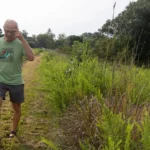
The implication of "Home(town)" is clear: the history of a place is a collective narrative, constantly being written and rewritten by its inhabitants. DuCett’s work is layered with irony, yet it is fundamentally a love letter to the region. By visiting the nearby Trempealeau National Wildlife Refuge, one can see the real-life inspiration for the marshy landscapes that populate the local imagination.
The exhibition asks: Who gets to shape a community’s history? When we place a piece of local furniture in a museum, are we preserving it, or are we distancing it from its purpose? DuCett does not offer a simple answer. Instead, he offers a "mad kind of love"—a frantic, imaginative energy that encourages us to look at our own hometowns with a mix of satire, critical inquiry, and deep, unyielding affection.
As the exhibition continues, it remains a focal point for the city. With upcoming events, such as the "Meet the Artist" session on October 3, and a participatory bingo game hosted at the Winona Athletic Club, the exhibition promises to continue its "bleeding" into the real world. "Home(town)" reminds us that art is not just something you look at; it is the infrastructure of the places we call home, and it is entirely up to us to decide what that history looks like when it is finally, and permanently, put on display.