





















































The Fragile Anchor: Rural Minnesota Schools Face an Identity Crisis in the Shadow of Consolidation

On a sun-drenched, late-summer morning in Hibbing, Minnesota, the rhythmic sound of toddler laughter echoes across a playground that will soon be silent. Dave Benz watches as his daughter, Sabrina Weberg, helps his twin granddaughters, Maya and Lucy, navigate the slides and swings. In just a few days, the girls will turn three—a milestone that should mark the beginning of their journey through the local public school system.
But for the children of Hibbing, the landscape is shifting. Looming just beyond the playground, a large, stark yellow "For Sale" sign stands in front of Greenhaven Elementary School. In March, the Hibbing School Board made the difficult decision to close the facility, citing a staggering $2 million deficit. For residents like Benz, the sign is more than a real estate listing; it is a symbol of a community losing its gravitational center.
"Yeah, it was a sad one," Benz admits, his voice trailing off as he watches the girls play. "I’m from here, so I’m a little biased. It might have to happen in order to grow and be stronger, but I’d prefer the Hibbing school stay open."
The Economic and Demographic Pressure Cooker
The crisis in Hibbing is not an isolated incident; it is the latest tremor in a tectonic shift affecting school districts across Minnesota. The formula for the crisis is simple but devastating: as rural populations age and younger families move toward urban centers, enrollment—the primary engine for state funding—is plummeting. Simultaneously, the costs of maintaining aging infrastructure, paying competitive salaries, and meeting state-mandated curriculum requirements are rising.
This is not a new problem, but it is reaching a breaking point. During the 1990s, Minnesota experienced a massive wave of restructuring, losing one-fifth of its school districts. More than 150 districts, pushed by declining enrollment and incentivized by a state legislature eager to trim administrative costs, opted for consolidation. In almost every instance, the result was the closure of neighborhood schools. While the pace of such mergers slowed over the last decade, with only seven districts consolidating in the last ten years, the underlying stressors are once again flaring up, forcing rural communities to reconcile their historical identities with the harsh realities of modern fiscal viability.
A Chronology of Change: From Local Schools to Regional Hubs
The history of rural education in the Iron Range is one of pride and, eventually, profound transition. For generations, small towns were built around mines and mills, and the school was the community’s beating heart.
Paul Peltier, a former educator and the current director of the Range Association of Municipalities and Schools (RAMS), remembers the "bouncing around" that occurred during the earlier waves of consolidation. "We felt like we were bounced around, but we were just ‘Balsam boys,’" he says, reflecting on his childhood in a district where he attended four different schools before graduation. "That’s what happens when you live 30 miles away from a school."

Peltier emphasizes that for many, the school is more than a building; it is a repository of community identity. "Communities and families anchor themselves in their school," he notes. "Schools owe it to them to make sure they are custodians and stewards of that identity."
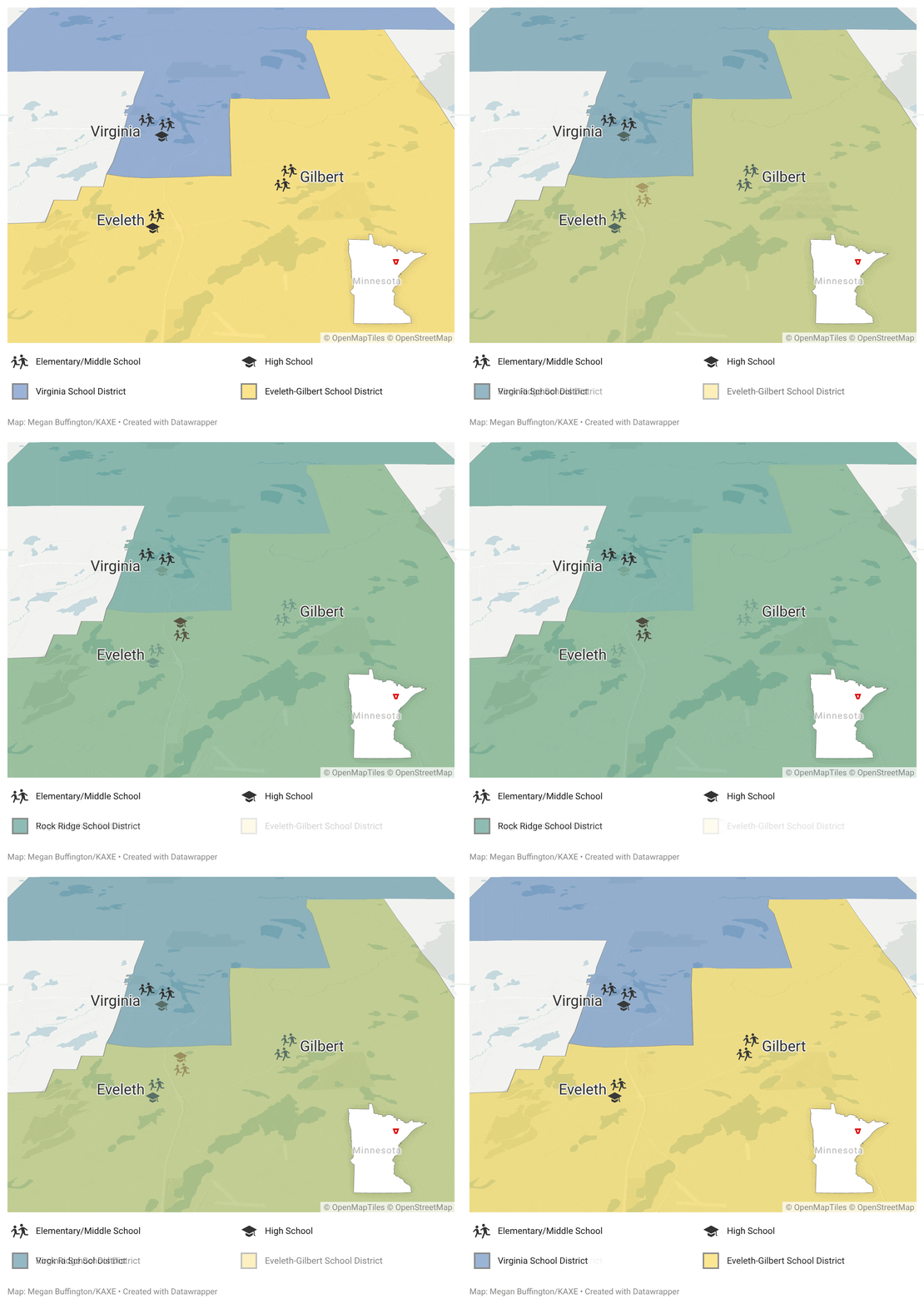
Yet, the trend toward regionalization is undeniable. The most prominent example in Northern Minnesota is Rock Ridge High School. Born from the merger of Virginia and Eveleth-Gilbert, the campus represents a new, modern approach to rural education. Opened four years ago, the facility is a testament to the "academy model"—a state-of-the-art building equipped with everything from a grand piano in the cafeteria to a 3-ton crane in the metal shop.
Supporting Data: The Cost of Small-Scale Education
The economic argument for consolidation rests on the concept of "economies of scale." As Aaron Fischer, executive director of the Minnesota Rural Education Association, explains, there is a minimum threshold of students required to sustain the essential machinery of a district.
"You have to have enough students to pay for the basics," Fischer says. "We always think of teachers and programs, which is the most important thing, but you also need a superintendent, principals, an activities director, custodians, and office support staff. Every small district has these needs, regardless of whether they have 100 students or 1,000."
In Northeast Minnesota, the decline in population means that some districts are effectively running on fumes. In the final year of the Eveleth-Gilbert district, the incoming kindergarten class numbered just 29 students. At the same time, the district faced a "death by a thousand paper cuts"—a phrase used by Rock Ridge Superintendent Noel Schmidt to describe the cumulative impact of failing boilers, leaking roofs, and the inability to offer the diverse elective programs found in larger, more affluent districts.
Data suggests that without such measures, rural schools will eventually face a forced shutdown rather than a managed transition. The state funding formula, which is heavily reliant on headcounts, leaves little room for the operational overhead of multiple aging buildings in declining towns.
Official Responses and the Leadership Dilemma
For administrators, the decision to consolidate is often framed as a "no-brainer" for the sake of the students, even if it is politically toxic. John Uhan, chair of the Rock Ridge School Board, was a board member for Eveleth-Gilbert during the final, dire years.

"The curriculum catalog is way better than what Eveleth-Gilbert was able to offer," Uhan says. "And then athletically, it’s been much more successful. I just think the opportunities in the academy are much more than we would have been able to offer by ourselves."
Uhan acknowledges that the process of tearing down century-old buildings and moving to a consolidated campus is painful. "You lose sleep over it," he admits. "It keeps you up at night. But eventually, you move on."
Superintendent Noel Schmidt, who spearheaded the Rock Ridge consolidation, suggests that leaders from outside the community sometimes have an easier time making these decisions because they aren’t bound by the same local nostalgia. "I had one advantage: I did not grow up here," Schmidt says. "It just took a little different viewpoint on how things are going."
However, the resistance is significant. During a recent visit to Rock Ridge, one parent expressed deep-seated resentment, using explicit language to describe their disdain for the new consolidated system. While Schmidt estimates that "naysayers" represent roughly 20% of the community, others believe the sentiment is closer to a 50/50 split.
The Implications: What Happens to the "Soul" of a Town?
The consequences of school closure extend far beyond the classroom. Mayor Adam Roen of Eveleth notes that the loss of the school district building has left a physical and social void in the town center. The Eveleth Community Center, which occupies the only remaining portion of the old school, is now used for everything from line dancing to bouncy-house birthday parties, but it lacks the daily vibrancy of a functioning K-12 campus.
"When you take the school district out, I think you take a piece of that identity away," Roen says. "You can create your own, and that’s exactly what Eveleth is doing now. But we can’t forget our history."
The concern, as voiced by Steve Giorgi, a former leader of the Range Association of Municipalities and Schools, is that consolidation is a "swear word" because the trade-off is almost always the loss of a unique, localized identity. "Somebody is going to lose an identity," he says.

Looking Toward the Future
As the state of Minnesota faces uncertainty in its budget, rural districts are increasingly turning to creative collaborations to survive. From sharing business services and special education resources to sports co-ops, these districts are attempting to stave off total consolidation as long as possible. Yet, there is a pervasive sense of fatigue.
Peltier, the current RAMS director, warns that the state legislature’s apathy toward rural education may be the final nail in the coffin for some communities. "No one seems to care," he says. "There is a level of apathy at the state level that they don’t even think about us."
For Hibbing, the future remains uncertain. As the school board weighs its options—including the potential for further collaboration or future consolidation with neighboring Chisholm—the community finds itself at a crossroads. The challenge for the coming generation will be to balance the practical necessity of a modern, efficient education system with the human need for the familiar, local, and historical anchors that define a home.
For now, Dave Benz continues to push his granddaughters on the swings at Greenhaven, an island of normalcy in a landscape undergoing profound, irreversible change. The playground is still here, but the clock is ticking.
This reporting is part of a collaboration with the Institute for Nonprofit News’ Rural News Network and Big Local News at Stanford University, with data journalist Cherry Salazar’s analysis helping anchor the reporting. Six nonprofit newsrooms were involved: BenitoLink, KAXE, Mat-Su Sentinel, Mississippi Today, Oxford Free Press, and The Texas Tribune. Support from the Walton Family Foundation made this project possible.