


















































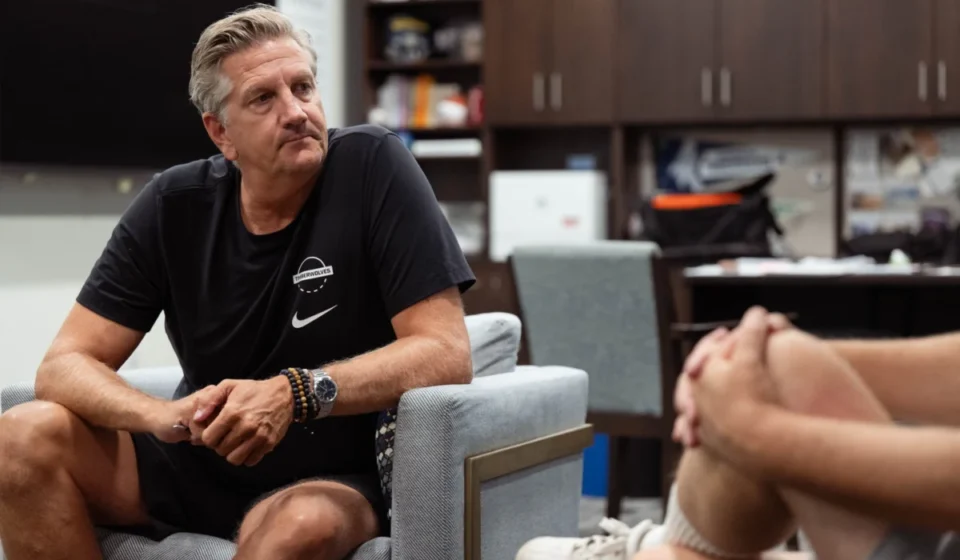

This is the first of a four-part series documenting an exclusive, wide-ranging Q&A between MinnPost’s Britt Robson and Minnesota Timberwolves Head Coach Chris Finch as the team prepares for the 2026-27 season.
The Architect of Adaptation
For Minnesota Timberwolves head coach Chris Finch, the only constant in the NBA is the inevitability of change. Entering his fifth full season at the helm in Minneapolis, Finch has cemented his reputation as one of the league’s most tactically agile coaches. Since taking over for Ryan Saunders mid-way through the 2020-21 season, Finch has steered the franchise from a perennial lottery team to a legitimate championship contender, headlined by consecutive trips to the Western Conference Finals.
However, the 2026-27 preseason presents a starkly different challenge. After a previous campaign where the team’s organizational philosophy was defined by "continuity," this offseason has been characterized by significant roster upheaval under president of basketball operations Tim Connelly. With the departure of key pieces and the arrival of high-impact stars like LaMelo Ball and Jonathan Kuminga, Finch is once again tasked with synthesizing disparate parts into a cohesive, defensive-minded identity.
A Season of Flux: The 2026-27 Outlook
The Timberwolves’ 2025-26 season ended with a sense of "what could have been." Plagued by inconsistency—ranging from an unsettled point guard rotation to questions regarding player dedication—the team fell short of its championship aspirations. As the organization pivots to the upcoming campaign, the objective is to return to the defensive rigor that characterized the team’s rise to prominence.

In an 80-minute conversation held just weeks before the start of training camp, Finch reflected on the shift from the stable roster of last year to the current state of flux.
"The priority this year is kind of re-learning ourselves," Finch noted. "Even though it feels like we only have a few additions, we’ve really had more. We have to bring everyone back to the beginning. We need to impart knowledge, understanding, and expectation. That lifts the accountability piece for everybody."
The Tactical Pivot: Defensive Philosophy
Finch is acutely aware that the team’s defensive identity—the cornerstone of their success—must be recalibrated. With the loss of lead assistant coach Micah Nori to the Portland Trail Blazers and the departure of key rotational players, the coaching staff is currently deep in the "problem-solving" phase.
Returning to Basics
Finch emphasized a "less is more" approach for the early stages of training camp. While the team has established "tentpoles" in Anthony Edwards, Rudy Gobert, and Jaden McDaniels, the integration of new personnel like LaMelo Ball requires a simplified defensive framework.

"We have to be careful not to move too fast," Finch explained. "Continuity allows you to move faster. So, we’ll start at the beginning. We are rethinking how we cover weaknesses, because the weaknesses of this team are going to be different. We are looking at everything: guarding big fours, post defense, and protecting our point-of-attack defenders."
The Gobert Factor and Defensive Chemistry
Rudy Gobert remains the defensive anchor, but the challenge lies in his chemistry with new arrivals. Finch acknowledged that while Gobert’s impact is undeniable, he will have to adjust to teammates who may not be accustomed to playing alongside an elite rim protector.
"LaMelo has never played with a rim protector like that," Finch noted. "He has to learn to play with a rim protector, and Rudy is going to have to guide that process. He’s going to have his own list of requirements for these guys to make it easy for him to help them."
Finch also touched on the potential for more creative defensive schemes, such as a return to more frequent zone looks or "high wall" coverages. "I think in maximizing [the roster], I think we owe it to ourselves to do things; being more aggressive when we can be, even if it is in small doses."

The "Ant" Imperative: A Two-Way MVP Push
Central to the Timberwolves’ success is the continued evolution of superstar Anthony Edwards. For years, Finch has been vocal about his desire for Edwards to develop into a consistent two-way player. As the team shifts its offensive and defensive structures, Finch believes the timing is right for Edwards to elevate his defensive engagement.
"I think we are going to need him to get back to being a high-leverage defender for us," Finch said. "His on-ball handling duties will be reduced, which was probably the most taxing thing for him last year. For him to have an MVP season, he has to have more of a defensive component."
Finch pointed out that when the team has utilized more rotation-based, aggressive defensive schemes in the past, Edwards thrived. The goal is to return to those habits, moving Edwards away from being a "weak link" in rotations and toward utilizing his elite athleticism against larger, more dangerous opposing forwards. "He doesn’t have to take the marquee matchup every night," Finch added, "but he has to re-engage his defensive impact."
Rebounding: The Final Frontier
Beyond individual defensive assignments and tactical schemes, Finch identified a collective shortcoming that must be addressed: rebounding. Historically, the team’s guards have struggled to secure the glass, placing undue pressure on the frontcourt.

"Imperative to our defensive growth is rebounding," Finch stressed. "Our smalls haven’t traditionally rebounded well. The good news is that the two guys we added (Ball and Kuminga) are plus-rebounders for their positions. But given size, given rotations, given all these other things, rebounding needs to go up across the board. These guys have got to become better rebounders—no doubt about it."
Implications: A High-Stakes Balancing Act
The 2026-27 Timberwolves are a team in transition, balancing the championship window of their established core with the necessity of integrating new talent. The implications of Finch’s strategy are clear: if the team can successfully blend their defensive foundation with the creative, versatile skill sets of the new additions, they remain a formidable threat in the Western Conference.
However, the "logical nightmare" of rotations—such as who fills the frontcourt when Gobert rests or faces foul trouble—remains an open question. Whether the answer lies in small-ball lineups featuring Jaden McDaniels at the five, or a more traditional approach using the depth of the roster, Finch is approaching the season with a measured, intentional mindset.
"We have eleven or twelve guys who can help us," Finch concluded. "If we go in too narrow-minded, we might not be able to maximize those other guys. We have to settle on a couple of options early and then be ready to pivot if they don’t work."

As training camp approaches, the Timberwolves find themselves in a position that has become synonymous with the Chris Finch era: embracing the challenge, refining the process, and refusing to settle for anything less than excellence.
Part II of this series will focus on the offensive adjustments and the integration of the team’s newest starting-lineup additions.