
























Beneath the Canopy of Memory: "Meet Me in the Forest" Explores the Duality of Nature at the CAT Museum

At the Cafesjian Art Trust (CAT) Museum in Shoreview, the walls have been physically altered—drilled and prepared—to accommodate a transformation that blurs the lines between the natural world and the internal landscapes of the human psyche. The museum’s latest exhibition, Meet Me in the Forest, which opened in early September 2026 and runs through February 2027, invites visitors to step into a metaphorical woodland. It is a space where the forest is not merely a collection of trees and flora, but a complex stage for memory, trauma, and the search for sanctuary.
Curated by Jill Ahlberg Yohe and Linnea Seidling, the exhibition serves as a multifaceted examination of how we project our history onto the natural world. Through a diverse array of media—including glass, ceramics, textiles, photography, and immersive installations—the show suggests that the forest is the ultimate site of dichotomy: a place that is simultaneously terrifying and beautiful, a site of colonial violence and ancestral healing, and a refuge for the "strange creatures" of our own making.
The Architecture of Reverie: An Installation of "Strange Creatures"
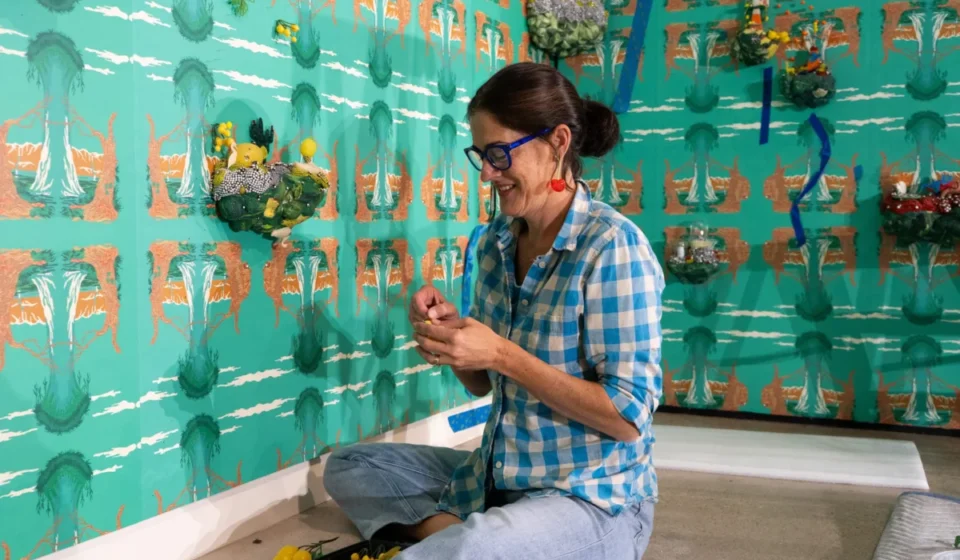
The installation process for Meet Me in the Forest was as meticulous as the artwork itself. Among the most striking contributions is Erica Rosenfeld’s Welcome to Reverie Forest: Sanctuary for Strange Creatures (2026). Rosenfeld spent weeks constructing a delicate habitat for the bizarre, hybrid beings she creates using glass, found objects, and sculpture.
For Rosenfeld, the forest is a sanctuary for misfits—a "safe zone outside of societal constraints." Her work is deeply rooted in a critique of the 1940s and 50s, a period marked by the stifling atmosphere of McCarthyism. During that era, mass-market paint-by-number kits proliferated, offering Americans a "sugar-coated reality" of pastoral landscapes and adorable animals.
"The forest has many dichotomies," Rosenfeld explained. "It can be scary and beautiful." By subverting the kitschy, mass-produced aesthetic of the mid-century kits, she creates something far more surreal—two-headed animals and hybrid beings that exist in a state of perpetual "reverie." Her work serves as an indictment of the unattainable perfection sold to Americans during the Cold War, replacing it with an honest, if slightly unsettling, depiction of identity.
Curatorial Vision: Layered Narratives and Media
The exhibition, which features five recent acquisitions alongside loans and pieces from the museum’s permanent collection, is designed to be a "layered viewing experience." According to co-curator Jill Ahlberg Yohe, the show’s power lies in the dialogue between different artistic mediums.
"They’re just so variable and layered," Ahlberg Yohe noted. "Glass, textiles, painting, and photography bounce off one another to create a space where artists confront pain and joy, tragedy and triumph."
This thematic tension is evident in the work of Kelly Sinnapah Mary. In her 2023 piece, She taught me to listen to the wind, Mary depicts an erotic, lush scene of bodies among forest leaves. Yet, looming above this idyllic tableau is a stark, white claw—a chilling symbol of the colonial violence associated with her family’s history as Tamil laborers in Guadeloupe. The forest, in Mary’s hands, is both a site of trauma and a repository of botanical knowledge, connecting the artist to the land despite the scars left by history.
Historical Echoes: The Forest as a Site of Conflict and Refuge
The exhibition also confronts the geopolitical reality of the forest as a site of displacement. Pao Houa Her’s 3D lenticular print from the series Other Pictures of Paradise (2022–24) provides a haunting example. The work focuses on the jungles along the Thai-Laotian border, where the artist’s family sought refuge during the "Secret War"—the CIA-led military operation that devastated the region in the 1960s and 70s.
When viewed from one angle, the work displays poppies reaching toward the light, evoking a sense of natural beauty. From another angle, the same scene darkens, the beauty replaced by an implied, lingering danger. Her’s work does not attempt to reconcile these two states; instead, it forces the viewer to acknowledge that the same space can hold both "historical terror and moments of children’s delight."

Maximalism and the Aesthetics of Anxiety
The exhibition does not shy away from the sensory overload of nature. Ebony G. Patterson’s …among the blades between the flowers… is a masterclass in maximalism. A hand-cut, jacquard-woven photo tapestry, the work is heavily embellished with glitter, beads, and fabric. Ahlberg Yohe notes that this visual abundance is a strategic choice. By drawing the viewer in with color and texture, Patterson creates a "glittering trap" that leads to an exploration of the legacies of colonization and the performative exuberance of Carnival.
Similarly, Kate Clements’ Stain (2022) utilizes glass to elicit a visceral, almost physical response. Suspended by thin monofilament, the work casts shadows that mimic the texture of scabs and blood. Co-curator Linnea Seidling explains that the piece is a deliberate study in discomfort. "It’s a sparkly, colorful, and really beckoning experience," Seidling said. "But then you look a little bit closer, and all of a sudden it becomes kind of terrifying." This juxtaposition of "beckoning" and "terrifying" is the emotional anchor of the entire exhibit.
Healing and the "Outsider" Perspective
Beyond the political and the traumatic, Meet Me in the Forest also explores the role of nature in personal healing and spiritual transition. Ceramicist Amanda Michelle Smith uses the forest to unpack her experiences of leaving the Church of Jesus Christ of Latter-day Saints. In works like Trust Issues and Trauma, the forest is not a passive backdrop but an active participant in the artist’s process of "repair."
Smith’s style has been compared to the "outsider" art of Henry Darger. Her intricate, often spellbinding work captures the disorientation of exiting a high-control community. In this context, the forest represents the liminal space between the known—however restrictive—and the unknown, where the artist must learn to define her own belonging and fear.
Implications: A New Way of Seeing the Woods
The curators’ ultimate goal was to move away from the traditional view of nature as a site of mere loss or conservation. Instead, they present the forest as a realm where "human creativity, activity, and memory happen."
By centering the exhibition on the concept of the forest as an "abundance of stories," Ahlberg Yohe and Seidling have created a space that holds contradiction in high regard. The exhibition suggests that to truly understand our connection to the land, we must be willing to hold the "violence and beauty" together, rather than separating them.
Logistics and Related Programming
Meet Me in the Forest will remain on display at the Cafesjian Art Trust Museum through February 27, 2027. The museum, located at 4600 Churchill Street in Shoreview, has curated the exhibition as a cornerstone of its 2026-2027 season.
For those whose interest in the natural landscape extends beyond the gallery walls, the Mississippi Park Connection is presenting a screening of the documentary Out There: A National Parks Story. Directed by Brenden Hall, the film explores the American national park system through the eyes of those who interact with it most intimately—rangers, hikers, and photographers. The screening is scheduled for Monday, September 14, at the Parkway Theater in Minneapolis.
In a time when national landscapes face increasing threats, the film serves as a companion piece to the museum exhibition, highlighting the necessity of protecting the spaces that provide us with both physical refuge and imaginative possibility. As the CAT Museum exhibition proves, the forest is not just a place we visit; it is a repository of our collective memory, a mirror for our fears, and a fertile ground for the resilience of the human spirit.