
























































In a seismic shift for the high-performance computing landscape, AMD has unveiled a comprehensive, end-to-end AI infrastructure strategy designed to directly challenge Nvidia’s dominance. At the "Advancing AI 2026" event in San Francisco, AMD executives detailed a new generation of hardware and software solutions, anchored by the Helios rack-scale platform, 6th Gen EPYC "Venice" CPUs, and the powerful Instinct MI455X GPU. This move marks the culmination of years of internal development and strategic acquisitions—most notably the integration of ZT Systems—as AMD positions itself as the primary alternative for hyperscalers and enterprise entities grappling with the insatiable demands of large reasoning models and agentic AI.
The Core Infrastructure: The Helios Platform
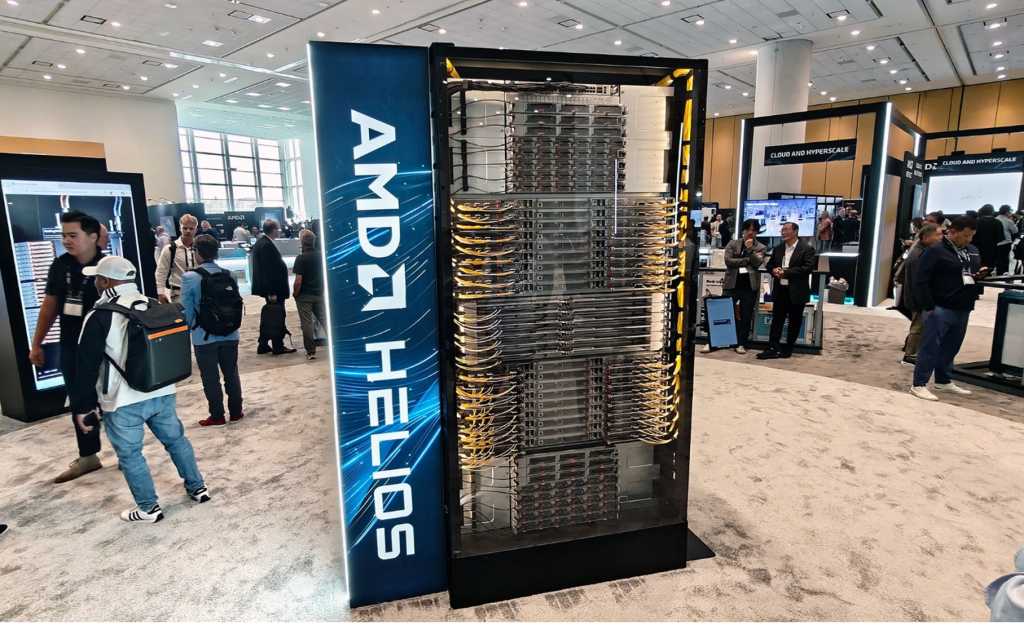
At the heart of AMD’s strategy is Helios, a rack-scale AI platform designed to compete head-to-head with Nvidia’s upcoming "Vera Rubin" architecture. Helios is not merely a collection of components; it is a vertically integrated, liquid-cooled system that represents AMD’s most sophisticated engineering effort to date.
Each Helios rack houses 72 Instinct MI455X GPUs, 18 single-socket "Venice" EPYC CPUs, and an advanced networking fabric powered by Pensando technology. By shifting from the traditional, smaller eight-GPU server nodes to a unified 72-GPU shared-memory domain, AMD aims to eliminate the performance bottlenecks inherent in scale-out networking. This architecture allows models that are too massive for a single node to operate across the entire rack, significantly reducing latency and boosting throughput for large-scale model inference and training.
Chronology of Innovation: From Acquisition to Deployment
AMD’s journey toward rack-scale dominance has been deliberate. For years, the company operated primarily as a component supplier, but the acquisition of ZT Systems last year served as the catalyst for its current platform-level ambitions. By bringing ZT’s engineering prowess in-house, AMD gained the intellectual property necessary to design, build, and deploy entire server racks.
- Late 2025: AMD begins integrating ZT Systems’ engineering teams to focus on rack-scale thermal management and high-density packaging.
- June 2026: Initial sampling of the Ryzen AI Embedded X100 begins, laying the groundwork for edge-AI expansion.
- July 2026 (Advancing AI Event): Official unveiling of the MI455X, Venice CPUs, and the Helios platform.
- H2 2026 (Ongoing): Shipments of the Helios platform commence, with initial 1GW deployments planned by major partners.
- H1 2027: Anticipated activation of large-scale partnerships, including the Anthropic deployment.
Technical Specifications and Performance Metrics
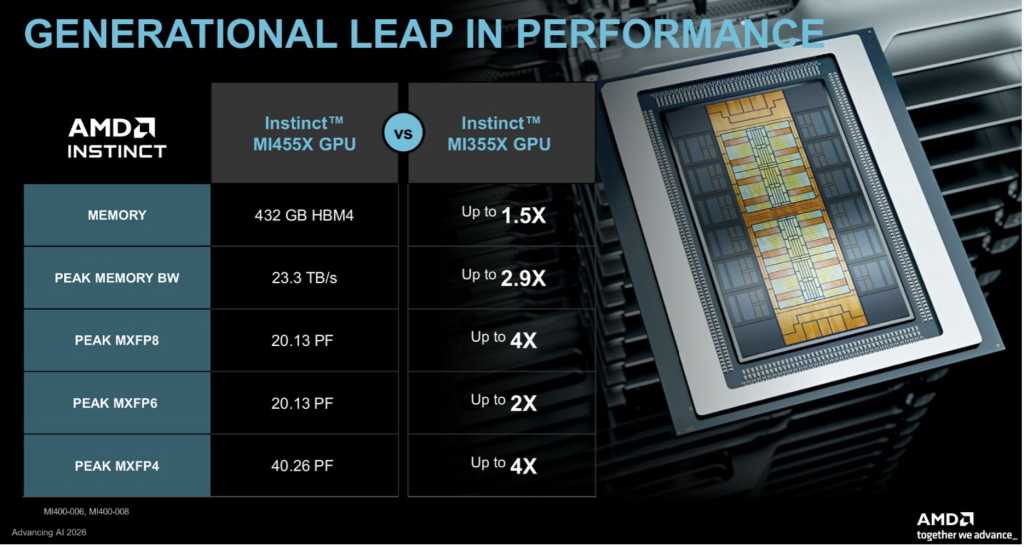
The Instinct MI455X serves as the engine of the Helios rack. As the first GPU built on the CDNA 5 architecture, it utilizes a sophisticated mix of 2nm and 3nm chiplets. The specifications are aggressive: 432GB of HBM4 memory and a staggering 23.3TB/s of peak memory bandwidth.

Comparative Gains (vs. MI355X)
AMD’s internal testing paints a picture of a generational leap:
- Memory Capacity: 1.5x increase.
- Memory Bandwidth: Up to 2.9x increase.
- Matrix Performance: Up to 4x peak performance using MXFP4/MXFP8 data types.
- Networking Bandwidth: 2.5x to 3.5x improvement.
The shift toward lower-precision formats like MXFP4 and MXFP6 is a strategic play to manage the "memory wall." By reducing the memory footprint of AI models without sacrificing accuracy, AMD allows more of a model’s activation states and KV caches to reside locally on the GPU, minimizing the need for costly data transfers.
The Role of Venice CPUs in Agentic Workflows
While the GPU takes center stage, AMD is placing a newfound emphasis on the CPU’s role in "agentic" AI—systems that autonomously invoke tools, databases, and security checks before responding. The upcoming "Venice" EPYC processors are designed to handle these auxiliary compute requirements.
Venice supports up to 256 Zen 6 cores, 512 threads, and 16 memory channels. With PCIe 6.0 and CXL 3.1 connectivity, these processors act as the orchestrators of the rack. AMD’s data suggests that Venice provides a 1.7x performance lift over the current EPYC "Turin" 9965 CPUs in agentic workflows, specifically in areas such as gateway processing, vector search, and short-lived code execution.
Official Responses and Strategic Partnerships
The market’s reception to AMD’s new direction has been swift and substantial. Several major players have committed to multi-generation partnerships, validating the shift toward AMD’s open-architecture approach.
- Meta and OpenAI: Have entered into multi-generation agreements totaling up to 6GW of compute capacity.
- Microsoft: Confirmed it will deploy Helios for Azure AI inference workloads.
- Oracle: Plans to launch a 50,000-GPU public cloud cluster by Q3.
- Anthropic: Announced a strategic partnership to deploy 2 Gigawatts of AMD-fueled compute, with the first gigawatt expected by early 2027.
To solidify these relationships, AMD has employed both technological and financial levers, including issuing performance-based warrants to OpenAI and investing up to $5 billion into Anthropic. These deals represent a massive vote of confidence in AMD’s ability to move beyond being a "second-source" vendor to becoming a primary architectural partner.
Implications for the AI Industry
AMD’s pivot to a "total system" approach carries significant implications for the industry.
The Open vs. Closed Debate
AMD is leaning heavily into open standards like UALoE (UALink over Ethernet). This offers hyperscalers more flexibility, preventing vendor lock-in—a common criticism leveled against Nvidia’s closed CUDA ecosystem. However, openness comes with a challenge: consistency. While Nvidia provides a highly curated, "it just works" experience, AMD must prove that its open-standards platform can deliver the same level of reliability and predictability at the scale of thousands of GPUs.
Software as the Final Frontier
The introduction of ROCm.AI, an AI-assisted development layer, marks an attempt to bridge the software gap. By automating kernel tuning and workload profiling through the new "Hyperloom" tool, AMD aims to reduce the barrier to entry for developers who are currently accustomed to the maturity of Nvidia’s CUDA. Whether these automated optimizations can match the years of manual, expert-level tuning available in the Nvidia ecosystem remains the defining question for 2027.
The Economics of Rack-Scale AI
The "big iron" approach—selling entire, pre-validated racks—is designed to improve GPU utilization. Currently, many providers suffer from poor utilization rates due to data-movement bottlenecks. By optimizing the networking via Pensando DPUs and ensuring high-speed interconnects throughout the rack, AMD hopes to lower the Total Cost of Ownership (TCO) for its clients. If AMD can demonstrate that a Helios rack provides more "effective" compute per dollar than a competing cluster, the shift in market share could be rapid.
Conclusion: The Execution Test
AMD has successfully assembled the pieces of a formidable AI puzzle. The MI455X GPU, Venice CPU, Pensando networking, and the Helios platform represent a high-water mark for the company’s engineering capabilities. However, the hardware is only half the battle.
The success of this mission now rests on execution. Can AMD deliver these systems on schedule? Can it provide the software tooling necessary for developers to migrate without significant disruption? And perhaps most importantly, can it maintain the performance, reliability, and cooling efficiency required to operate 72-GPU domains in production environments?
As the industry faces an insatiable demand for AI services, the market is currently an environment where "big iron" success is possible. AMD has provided the architecture; now, it must prove that it can scale its operations to meet the world’s most demanding AI workloads. The race for the AI crown is no longer just about the chip—it is about the entire rack, and for the first time in a decade, Nvidia has a legitimate, system-level challenger in the ring.