





















































DULUTH, Minn. – In a pivotal moment for Minnesota’s Republican Party, Michele Tafoya, the prominent former sports broadcaster, has ignited a fierce primary battle by vowing to continue her quest for retiring Senator Tina Smith’s seat despite failing to secure the party’s official endorsement. This decision directly challenges a long-standing, unofficial rule within the Minnesota GOP: a candidate who loses the party endorsement at the state convention almost invariably fails to win the subsequent primary nomination. Tafoya’s defiance sets the stage for a high-stakes intra-party contest, testing the power of convention delegates against the appeal of name recognition, national party backing, and perceived general election electability.
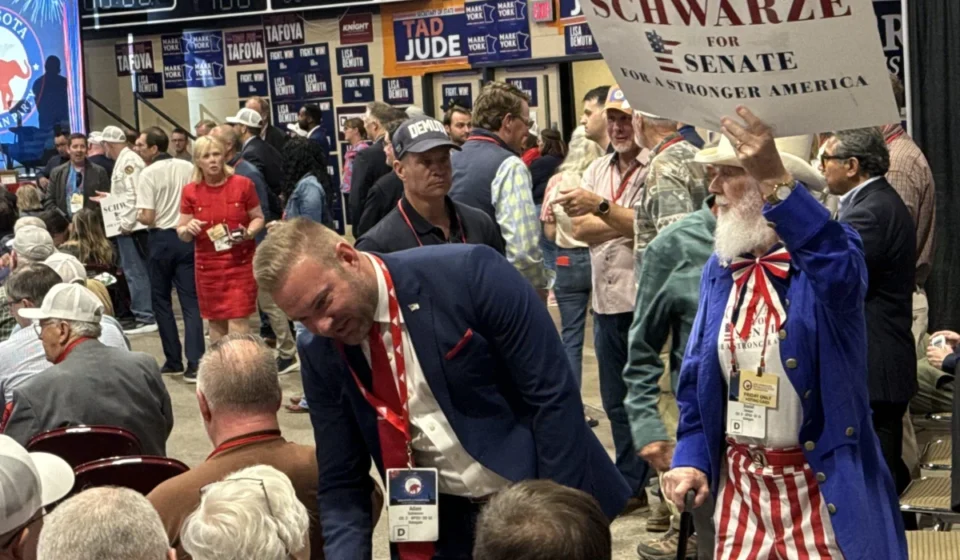
The dramatic conclusion of the state Republican convention in Duluth saw former Navy SEAL Adam Schwarze emerge as the endorsed candidate, securing the support of nearly 63% of GOP delegates after six rounds of intense balloting. His victory represents a clear preference by the party’s activist base for a candidate whose platform aligns uncompromisingly with conservative values. Tafoya, who had campaigned on her broader appeal and electability, now faces an uphill climb to convince primary voters that her path, rather than the party-endorsed one, is the true route to victory in a state that has not elected a Republican to statewide office in two decades.
The Duluth Convention: A Battle for the Party’s Soul
The Minnesota Republican Party convention, held in Duluth, unfolded as a strategic battleground where candidates sought to sway the committed delegates who represent the party’s most active and ideologically driven segment. The stakes were particularly high for the U.S. Senate race, widely seen as a critical opportunity for the GOP to regain a statewide foothold.
Six Rounds of Intense Balloting
The endorsement process was a grueling affair, stretching over six rounds of balloting as delegates meticulously weighed their options. A multitude of candidates initially vied for the party’s imprimatur, each presenting their vision for the state and the nation. Among those eliminated in earlier rounds was former NBA player Royce White, whose populist appeal failed to consolidate sufficient support. The protracted voting underscored the delegates’ determination to coalesce around a candidate who best embodied their collective principles and strategic aspirations. Ultimately, the momentum decisively shifted towards Adam Schwarze, whose consistent conservative message resonated deeply within the convention hall.
Schwarze’s ascent culminated in a commanding victory, where he garnered the backing of nearly 63% of the GOP delegates. This substantial margin reflected a clear mandate from the party faithful, signaling their strong preference for a candidate unburdened by past perceived ideological compromises. Tafoya, despite her well-articulated pitch emphasizing her "electability" and broad appeal, could not muster more than 37% of the votes, falling significantly short of the threshold required for endorsement. Her inability to sway a majority of delegates highlighted a fundamental disconnect between her campaign’s strategy and the prevailing sentiment of the party’s base.
Schwarze’s Resounding Victory Speech
In his victory speech delivered from the convention floor, Adam Schwarze wasted no time in articulating the core tenets of his campaign. He directly addressed Tafoya’s electability argument, urging delegates to reject the notion that ideological purity must be sacrificed for broader appeal. "We can win this Senate race," Schwarze declared emphatically, "without compromising our values." His words were met with enthusiastic applause, affirming the delegates’ desire for a candidate who would champion conservative principles without equivocation.
Schwarze doubled down on this promise in his acceptance remarks, stating simply, "I will not compromise." This pledge, delivered with conviction, served as a rallying cry for the conservative wing of the party, signaling his intention to be a steadfast voice for their beliefs in Washington, D.C. He further energized the crowd by invoking a broader collective effort: "I will fight in D.C. and we will fight to take back our state together." His rhetoric painted a picture of a united front, appealing to delegates’ aspirations for not only a Senate victory but also a resurgence of Republican influence across Minnesota. His background as a former Navy SEAL also undoubtedly contributed to an image of strength and unwavering commitment, resonating with a base that values principled leadership.
Tafoya’s Electability Pitch Falls Short
Michele Tafoya’s campaign strategy at the convention hinged significantly on presenting herself as the most "electable" candidate capable of defeating a Democrat in the general election. Her appeals to delegates Friday focused on her widespread name recognition, her media savvy, and her ability to attract diverse voters, arguing these attributes were crucial for breaking the GOP’s long statewide losing streak. However, this pragmatic approach, while potentially appealing to independent voters in a general election, proved to be a miscalculation with the convention delegates.
Even before the convention vote, Tafoya had publicly stated her intention to "buck the state party" by not abiding by the convention’s choice if she failed to secure the endorsement. This pre-emptive declaration, while demonstrating her resolve, likely solidified the perception among some delegates that she was not fully committed to the party’s traditional endorsement process. Her campaign’s emphasis on electability, rather than strict ideological alignment, was perceived by many as a compromise of core conservative principles. This fundamental divergence in approach ultimately prevented her from gaining the necessary support to win the endorsement, setting the stage for the primary showdown she had already anticipated.
The Weight of History: A Risky Path for Tafoya
Tafoya’s decision to bypass the party endorsement and continue to the primary carries significant historical weight in Minnesota, where defying the convention has proven to be a treacherous path for Republican candidates.
The "unofficial rule" within the Minnesota GOP is a potent one: a candidate who fails to get the party’s endorsement nearly always loses the primary nomination. This tradition reflects the powerful influence of the party’s activist base, who are typically more conservative and dedicated to the endorsement process. Their collective decision at the convention is often seen as a litmus test for a candidate’s viability within the party.
The last time a non-endorsed GOP candidate successfully won a Republican primary in Minnesota was in 1994, with Arne Carlson. Carlson, an incumbent governor at the time, was considered too moderate for the delegates at that year’s Republican Party convention. Despite losing the endorsement, his incumbency, widespread name recognition, and established political infrastructure allowed him to win the primary and subsequently secure reelection to the governor’s office.
However, political science professor David Schultz of Hamline University highlights the distinct challenges Tafoya faces compared to Carlson. "Unlike the Democrats, the Republican track record in Minnesota of bucking the convention in recent history has not worked out well," Schultz observes. He points out that Carlson’s incumbent status provided a crucial advantage that Tafoya, as a first-time candidate for this office, does not possess. Carlson had a proven track record, a built-in campaign structure, and direct access to voters as the sitting governor. Tafoya, while having name recognition from her broadcasting career, lacks this foundational political leverage. Her fight against an endorsed candidate, especially one backed by the enthusiastic conservative base, is therefore arguably more challenging than Carlson’s two decades prior. The historical precedent serves as a stark warning, underscoring the formidable task ahead for Tafoya’s campaign as it navigates the August primary without the official blessing of the state party.
Tafoya’s Unique Campaign: Strengths and Stumbling Blocks
Michele Tafoya’s campaign is characterized by a unique blend of significant advantages and distinct vulnerabilities, particularly evident in her struggle to secure the GOP endorsement. Her profile as a former national sports broadcaster grants her a level of public recognition and media savviness few political newcomers possess, yet her past statements on key issues have proven to be significant hurdles with the party’s conservative base.
Assets for a Statewide Race
Despite the setback at the state convention, Tafoya’s campaign enters the primary with several formidable assets that distinguish her from typical non-endorsed candidates. Chief among these is the full support of the National Republican Senatorial Committee (NRSC). This national backing is a critical lifeline, particularly given Professor Schultz’s observation that "The Republican Party in Minnesota is still in the most part broke." The NRSC’s commitment signals that if Tafoya can win the August 11 primary and is deemed competitive in the general election, they are prepared to "pour millions of dollars" into the race. This financial muscle and strategic guidance from the national party can significantly offset the loss of state party resources and infrastructure.
Beyond national financial support, Tafoya brings considerable name recognition to the race, a direct benefit of her long and visible career as a sports broadcaster. This widespread familiarity gives her an immediate advantage in a crowded primary field, allowing her to bypass the initial hurdle of introducing herself to a broad electorate. Her media savvy, honed over decades in front of cameras, also equips her with the ability to effectively communicate her message, navigate interviews, and leverage various media platforms to reach voters directly. John Kline, a former Minnesota Republican congressman who introduced Tafoya at the convention, unequivocally stated his belief in her general election viability, calling her the "only candidate here who can and will win in November." This public vote of confidence from a respected party figure underscores the strategic thinking behind supporting Tafoya, despite her ideological differences with the base.
The Moderation Conundrum: Alienating the Base
Tafoya’s primary challenge stems from what can be termed her "moderation conundrum"—her past and present stances on certain issues, which, while potentially appealing to a broader general election electorate, have alienated the ideologically conservative core of the Republican Party. This dynamic is illustrative of an increasingly strong trend in national politics, where candidates are often compelled to appeal to their party’s base voters—strongly conservative for the GOP and progressive for Democrats—to win endorsements and primaries.
Tafoya’s record includes several positions that diverge from the strict conservative orthodoxy expected by convention delegates. She previously identified as a "pro-choice Republican," a label anathema to a significant portion of the GOP base, especially given the party’s staunch anti-abortion platform. While she has more recently clarified her position, stating that states should outlaw abortions after 12 weeks of pregnancy, this evolution did little to assuage the concerns of delegates who prioritize a fully pro-life stance.
Furthermore, Tafoya once penned an "open letter" to President Donald Trump, explicitly asking him not to seek re-election. In a party where loyalty to Trump remains a powerful litmus test, such a public critique is a significant liability. Her support for "red flag" laws, or Extreme Risk Protection Orders—which allow courts to temporarily remove weapons from individuals deemed a danger to themselves or others—also drew criticism. Tafoya described these as the "most sensible" ways to combat mass shootings, a view that "raised the hackles of 2nd Amendment enthusiasts" who often view such measures as infringements on constitutional rights.
At the convention, Tafoya attempted to mitigate these concerns, declaring, "I will never compromise my conservative values." However, these attempts to pivot proved insufficient to overcome the delegates’ memories of her past statements. Curtis Rethwisch, a Lincoln County delegate who supported Schwarze, articulated the sentiment of many: "If it was just word of mouth and campaign smears I wouldn’t give it any credibility, but I watched the videos. The words came right out of her mouth." This direct observation highlights the difficulty of disavowing publicly documented positions, particularly in an era of readily accessible digital archives. The impact of these stances was even felt in 2022 when Kendall Qualls, then running for governor, rejected Tafoya as his choice for lieutenant governor, explicitly citing her pro-choice views as out of line with GOP values. These incidents collectively illustrate the formidable challenge Tafoya faces in convincing the conservative primary electorate of her ideological bona fides.

Schwarze: The Uncompromising Conservative Standard-Bearer
Adam Schwarze’s decisive victory at the Minnesota Republican Party convention solidified his position as the standard-bearer for the party’s conservative wing. His appeal lay precisely in his unwavering commitment to principles that resonated deeply with the delegates, offering a stark contrast to Tafoya’s more pragmatic approach.
Schwarze’s background as a former Navy SEAL contributes to an image of disciplined leadership and steadfast resolve, qualities highly valued by the party base. His messaging throughout the convention was consistent and clear, focusing on core conservative tenets without apparent deviation. This resonated powerfully with delegates like Chisago County’s Tony Kaufman, who championed the endorsement process itself as a mechanism for informed decision-making. Kaufman stated, "When you support the endorsement process, you’re supporting an informed base, an informed constituent, and that’s why we’re excited about it, and that’s why we choose to abide by the endorsement." For Kaufman and many others, Schwarze represented the outcome of this informed process, a candidate thoroughly vetted and found aligned with fundamental Republican principles.
Curtis Rethwisch, the Lincoln County delegate who expressed skepticism about Tafoya’s past statements, found in Schwarze a candidate who "checked all the boxes." Rethwisch explicitly articulated his reasoning: "I don’t have to give up anything on my principles and my morals with him. He’s pro life, he’s pro build a wall, he backs Trump." This statement encapsulates the ideological alignment that secured Schwarze the endorsement. He embodied the uncompromised conservative platform: a strong stance against abortion, a commitment to border security, and unequivocal support for former President Donald Trump. These positions are foundational for the most active and engaged segments of the Republican Party, particularly those who participate in conventions.
While Schwarze’s strong conservative stance proved to be his greatest asset at the convention, his campaign is not without potential vulnerabilities in a broader election. The article notes that there will be "more scrutiny of Schwarze, who has made controversial remarks about birth control." While such remarks might appeal to the most conservative elements of the party, they could become a liability in a general election, especially when trying to appeal to independent and more moderate voters. However, for the convention delegates, his alignment with Trump and his perceived ideological purity were paramount, securing him the firm support of the conservative wing of the GOP and those most supportive of the former president. His challenge, like Tafoya’s, will be to broaden his appeal beyond this core base if he is to become a truly competitive general election candidate.
The Primary Battle Ahead: August 11th Showdown
With the convention endorsement settled, the focus now squarely shifts to the August 11 primary election, where Michele Tafoya and Adam Schwarze will face off in a direct contest for the Republican nomination. Tafoya has unequivocally stated her campaign will continue "moving full speed" toward this crucial date, embracing the challenge of an unendorsed candidate.
Professor David Schultz, while acknowledging the historical hurdles for non-endorsed GOP candidates in Minnesota, suggests that Tafoya "has a chance to squeak through" the primary. This assessment, while cautious, indicates that her unique strengths could potentially overcome the ideological leanings of the primary electorate, which tends to be more conservative and overrepresented by party activists compared to the general population. Tafoya’s substantial name recognition, cultivated over decades in broadcasting, will be a significant asset in reaching primary voters who may not be as engaged in party politics as convention delegates.
A key component of Tafoya’s strategy for the primary is an anticipated "advertising blitz, both on television and the internet." With the backing of the NRSC and her demonstrated ability to raise campaign cash, she possesses the financial resources to saturate the airwaves and digital platforms with her message. This aggressive advertising campaign will be crucial for defining her candidacy, countering any narratives from the Schwarze campaign, and directly appealing to the broader swath of Republican primary voters who did not participate in the convention.
Conversely, the primary will bring increased scrutiny to Schwarze. As a less publicly known figure than Tafoya, his past statements and positions will be subjected to greater examination by the media and his opponent’s campaign. The article specifically mentions "controversial remarks about birth control," which could become a point of attack, potentially alienating some moderate Republican women voters or those less aligned with the party’s extreme conservative wing. While these remarks may have resonated with convention delegates, their impact in a broader primary electorate remains to be seen.
The challenge for Tafoya will be to mobilize a sufficient number of primary voters who value electability and her particular brand of conservatism over the party’s official endorsement. She must convince enough Republicans that her pathway is the most viable for ultimately winning the general election, even if it means bypassing the traditional party structure. For Schwarze, the task is to translate his strong base support into a wider primary victory, leveraging the endorsement to consolidate conservative votes while fending off attacks on his more extreme positions. The August 11 primary promises to be a compelling test of conventional party power versus the influence of personality, national backing, and perceived electability.
Eyeing the General Election: A Purple State Challenge
While the immediate focus remains on the Republican primary, both Tafoya and Schwarze have their sights firmly set on the November general election, where the winner will face a formidable Democratic opponent in a state that has proven challenging for Republicans. Minnesota has not elected a Republican to statewide office in 20 years, underscoring the high stakes and the difficulty of the political landscape.
The likely Democratic contenders are either Lieutenant Governor Peggy Flanagan or U.S. Representative Angie Craig, D-2nd District. Both are established figures with strong ties to the Democratic base and proven campaign capabilities. Interestingly, Rep. Craig shares a notable characteristic with Tafoya: she also "rebelled against the party convention process" in her own political career, demonstrating that defying party endorsements is not exclusive to the GOP and can, in certain circumstances, lead to success. This parallel might offer a glimmer of hope for Tafoya’s general election prospects, suggesting that general election voters can be swayed beyond party dictates.
An Emerson College poll conducted in February, roughly a month after Tafoya entered the race, offered an early glimpse into potential general election matchups. The poll showed Flanagan receiving 47% support to Tafoya’s 41%. Against Craig, Tafoya polled slightly lower, with Craig leading 47% to 40%. While these figures do not place Tafoya in a winning position, Professor Schultz notes, "That doesn’t put her in the winning category, but at this point that’s not bad." He emphasizes that in a general election, Tafoya’s positions are "where she should be on the issues," suggesting her moderation could become an asset rather than a liability.
Schultz further elaborates on Tafoya’s potential general election strengths, particularly her ability to attract crucial swing voters. "At that point, she has a shot at attracting independents," he explains, "She picks up a different group of Republicans. People at the conventions are the most extreme." This analysis highlights the fundamental tension in modern politics: the need to energize the base for a primary while simultaneously broadening appeal for a general election. Tafoya’s perceived moderation, which alienated convention delegates, could ironically become her strength in a statewide contest in Minnesota, a state often described as purple rather than deep red or blue.
Beyond policy positions, Schultz also points to other demographic factors that could boost Tafoya’s general election chances. Her gender, he argues, "would be a boost when it came to the crucial votes of suburban women," a demographic segment that often decides close elections. Additionally, her diverse background—her father was Hispanic—may also help her appeal to a broader cross-section of Minnesota voters. However, all these general election advantages remain theoretical unless Tafoya first successfully navigates the August 11 primary, overcoming the party’s endorsed candidate and the weight of historical precedent.
Broader Implications for Minnesota and National GOP Strategy
Michele Tafoya’s unconventional campaign and the outcome of the Minnesota GOP convention carry significant implications, not just for the immediate Senate race but also for the future trajectory of the Republican Party in Minnesota and potentially for national GOP strategy.
The most immediate implication is the challenge to the sanctity of the party endorsement process in Minnesota. If Tafoya were to win the primary, it would significantly weaken the power of convention delegates and the traditional mechanism for selecting the party’s preferred candidate. This could lead to internal friction within the state party, potentially fostering disunity heading into a critical general election. Conversely, if Schwarze wins, it would reaffirm the power of the base and the endorsement, potentially pushing the state party further to the right in its candidate selections.
For the Minnesota GOP, the race highlights its ongoing struggle to win statewide office. The party has faced a two-decade drought, and this internal battle raises questions about its capacity to present a united front against well-organized and well-funded Democratic opposition. The tension between ideological purity, represented by Schwarze, and perceived electability, embodied by Tafoya, is a microcosm of the national debate within the Republican Party. Can the party win by exclusively appealing to its conservative base, or must it embrace a broader, more moderate appeal to capture swing voters in purple states?
The involvement of the National Republican Senatorial Committee (NRSC) in backing Tafoya, despite her lack of state party endorsement, also signals a shift in national party strategy. It suggests a willingness by national committees to prioritize a candidate’s perceived general election viability and fundraising prowess over strict adherence to state party processes and ideological alignment. This could set a precedent for future races, where national party organizations might increasingly bypass state party endorsements if they believe a different candidate has a stronger chance of winning. This dynamic underscores the evolving relationship between national and state party structures, particularly in financially struggling state parties like Minnesota’s GOP.
Finally, the potential for a fractured and bruising primary battle poses a risk to the eventual Republican nominee. A prolonged and contentious primary could exhaust resources, create lingering animosity, and provide Democrats with ample material to use against the Republican candidate in the general election. The outcome of this primary will not only determine who faces a Democrat in November but also offer a crucial insight into the balance of power within the Minnesota Republican Party and its strategic approach to reclaiming statewide relevance.