






















































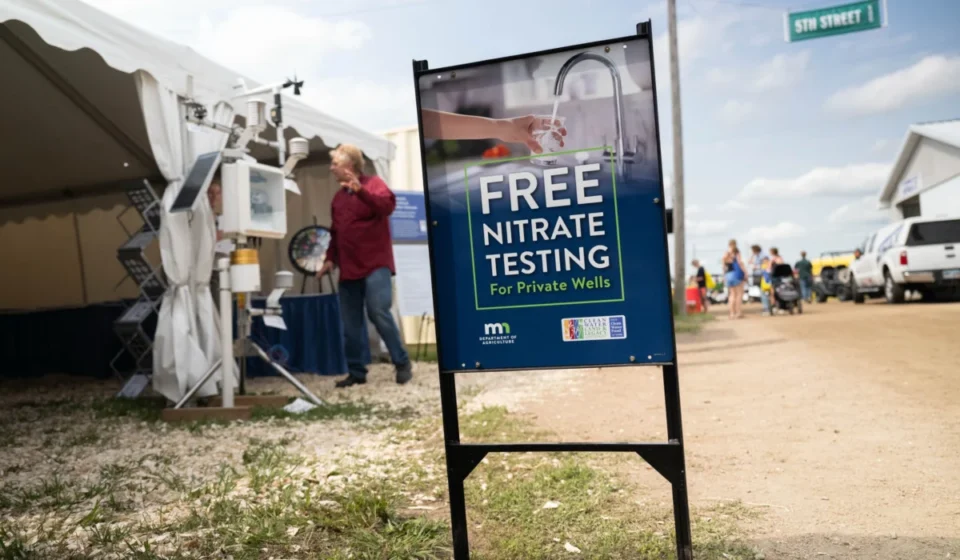

At the heart of Farmfest, Minnesota’s premier agricultural showcase, the atmosphere is typically one of celebration. Beneath the hum of tractors, the scent of deep-fried corn dogs, and the constant maneuvering of politicians vying for rural votes, a quieter, more urgent scene unfolds at a small, unassuming booth.
Here, Denton Bruening, an official with the Minnesota Department of Agriculture, operates a machine that looks more like a relic of a 1990s office than a cutting-edge scientific instrument. It is a clunky, briefcase-sized gray plastic box known as a spectrophotometer.
Visitors approach the booth with Ziploc bags, mason jars, and plastic water bottles filled with water drawn from their private home wells. Bruening carefully transfers the water into a small vial, where clear tubes pump the liquid into the machine. An ultraviolet ray shoots through the sample, measuring its light-absorption wavelengths. Thirty seconds later, the screen flickers to life: 7.3.
This number, while seemingly small, represents a growing anxiety for rural Minnesotans. In this instance, it indicates a high concentration of nitrates—a silent, invisible, and potentially dangerous contaminant that has plagued the state’s groundwater for decades.
The Scope of the Problem: A Persistent Environmental Challenge
Nitrate contamination is a direct byproduct of modern agricultural practices. When fertilizer and manure are applied to fields, nitrogen that isn’t absorbed by crops can leach through the soil, particularly in areas with porous geography or shallow well infrastructure. In regions like southwestern, southeastern, and central Minnesota, this runoff enters the shallow aquifers that thousands of families rely on for their daily drinking, bathing, and cooking water.
The Department of Agriculture’s presence at Farmfest is a critical outreach effort funded by the Clean Water, Land and Legacy Amendment. It serves as a stark reminder that for the estimated 93,000 Minnesotans relying on private wells, the safety of their tap water is not guaranteed. Unlike public municipal water systems, which are strictly regulated under the federal Safe Drinking Water Act, private wells fall into a regulatory blind spot. If a private well becomes contaminated, the burden of discovery, testing, and remediation falls entirely on the homeowner.
Chronology of a Chronic Issue
The struggle with nitrates is not a recent development. The Minnesota Department of Agriculture began offering free nitrate testing in the 1990s, acknowledging that rural residents were at the highest risk of exposure. Over the last thirty years, the issue has shifted from a niche concern to a major public health conversation.
- 1990s: The state initiates the first mobile "water clinics" to assist rural well owners in assessing nitrate levels.
- Early 2000s–2010s: Increased industrialization of farming and more intensive nitrogen application correlate with rising nitrate levels in groundwater, particularly in the karst landscapes of southeastern Minnesota.
- 2020s: Advocacy groups gain traction in calling for stricter standards, arguing that the federal limit of 10 milligrams per liter (mg/L) is outdated and insufficiently protective of human health.
- Present Day: Agencies continue to provide testing, yet the gap between identifying contamination and financing a solution remains a primary obstacle for families.
Supporting Data and Health Implications
The federal government sets the maximum safe limit for nitrates in drinking water at 10 mg/L. However, scientific consensus is increasingly pointing toward risks at much lower thresholds. Research suggests that exposure to nitrate levels as low as 3.5 mg/L can be linked to adverse health outcomes, including increased cancer rates and pregnancy complications, such as miscarriages.
When Bruening logs a result of 7.2 or 7.3, he isn’t just delivering a data point; he is delivering a warning. For the homeowner, this often necessitates a difficult decision. Mitigation is rarely cheap. A standard reverse osmosis system, which can effectively filter out nitrates, typically costs between $500 and $5,000 depending on the model and installation complexity. For many rural families, this is a significant, unplanned household expense.
While some counties in southeastern Minnesota have implemented programs to provide free reverse osmosis systems to households with high nitrate levels, these programs are the exception, not the rule. Most regions lack the tax base or the allocated funding to provide such infrastructure, leaving the majority of affected families to choose between expensive home filtration, drilling a new well—which can cost upwards of $10,000 to $30,000—or switching entirely to bottled water.

Official Responses and the Political Divide
The tension surrounding nitrate regulation is exacerbated by Minnesota’s status as an agricultural powerhouse. With $9.3 billion in annual agricultural exports, the state’s farming industry wields significant economic and political influence.
At the Department of Agriculture, officials are caught in a delicate balance. They provide the science and the testing, but they lack the mandate to regulate the source of the pollution. Tony Runkle, lead geologist of the University of Minnesota’s geological survey, notes that lowering the state’s nitrate standard to 3.5 mg/L—a move pushed by environmental groups—would be a "huge heavy lift."
"There’d be a ton of opposition from ag," Runkle explains. This political reality creates a stagnation in policy. While the Department of Agriculture has developed nitrogen and fertilizer management plans that encourage farmers to adopt "cover crops" to absorb excess nitrogen, these measures remain voluntary. Without a state-mandated requirement, the cost of implementing these environmentally friendly practices is borne by the farmer, leading to inconsistent adoption rates.
Implications for the Future: A Question of Responsibility
The current system relies on the initiative of the individual. "We want to make sure that people feel comfortable coming in and having their sample tested, and then we also want to make sure that they’re understanding why they may have high nitrates," says Bruening.
However, the "education-first" approach has its limits. When a farmer visits a water clinic, they are often confronted with the reality that their own well might be affected by their own farming practices. It is a moment of personal reckoning, but it does little to address the systemic nature of groundwater contamination.
As the Department of Agriculture continues to urge well owners to test their water annually, the broader question remains: who is responsible for the health of the state’s groundwater?
For now, the responsibility rests on the shoulders of people like those seen at Farmfest—the families who walk up to the booth with plastic bags of water, hoping for a clean reading. For those who receive a high result, the "solution" is often a patchwork of bottled water and expensive, privately funded filtration systems.
As long as the state’s agricultural success is prioritized over stricter environmental regulation, the "invisible crisis" in Minnesota’s wells is likely to persist. The gray, clunky spectrophotometer will continue to flash numbers, and for thousands of Minnesotans, the anxiety of what is flowing from their tap will remain a permanent fixture of rural life.
Recommendations for Well Owners
The Minnesota Department of Agriculture suggests the following steps for those concerned about their water quality:
- Annual Testing: Test your well water for nitrates at least once a year, even if previous tests were clear.
- Utilize Local Resources: Reach out to your local Soil and Water Conservation District to find free or low-cost water testing clinics.
- Seek Professional Consultation: If your test exceeds 10 mg/L, consult with a licensed well contractor to discuss filtration or, if necessary, well rehabilitation or relocation.
- Stay Informed: Stay updated on state-level policy discussions regarding groundwater protection and nitrate mitigation, as these policies may eventually offer more financial or regulatory support for private well owners.