























































Bridging the Strategy Gap: Smartsheet Unveils ‘vsActual’ to Revolutionize C-Suite Oversight

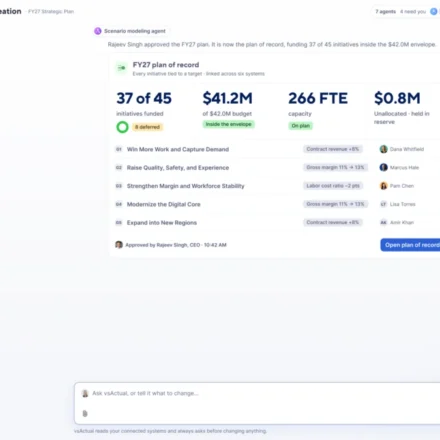
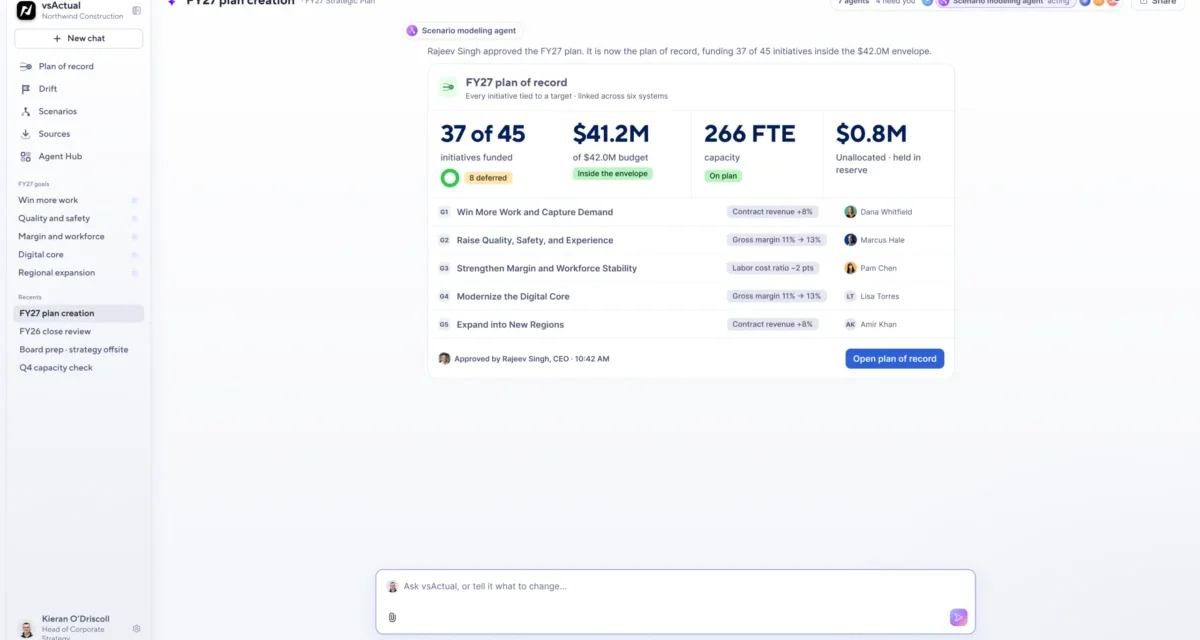
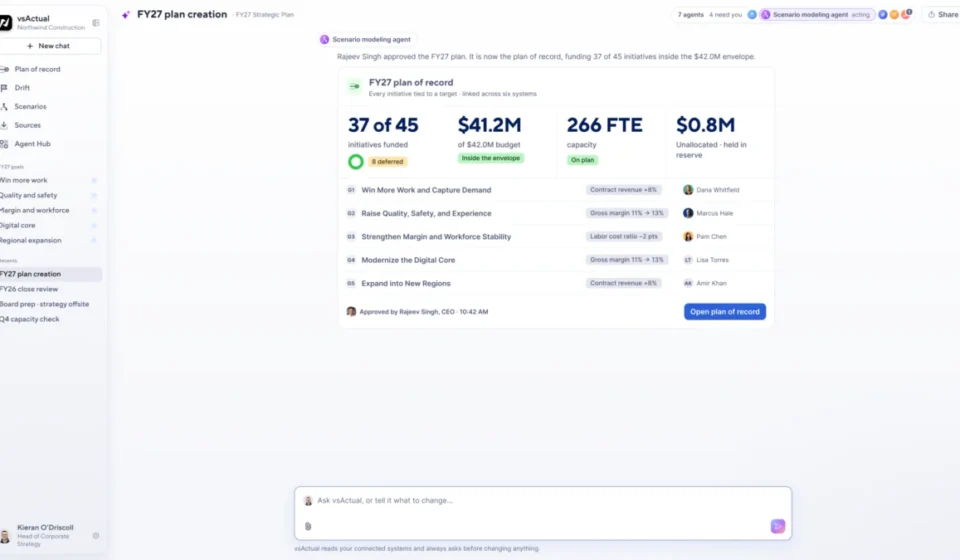
In a bold departure from its traditional roots in task and project management, Smartsheet has officially entered the strategic governance arena with the unveiling of vsActual. Introduced this week at the company’s annual Engage conference, vsActual is an AI-native, standalone application designed to act as a high-level command center for CEOs, CFOs, and COOs.
By integrating disparate data streams from enterprise powerhouses like Oracle, SAP, Salesforce, and Workday, vsActual promises to solve the "execution drift" that plagues modern organizations—the persistent, often invisible gap between a company’s strategic goals and its actual, day-to-day operational performance.
The Core Challenge: Closing the "Execution Drift"
For decades, executive leadership has relied on a fragmented, retrospective view of organizational health. Quarterly planning sessions are often dominated by static PowerPoint presentations and outdated Excel spreadsheets, providing a rearview mirror look at budget overruns, timeline delays, and resource conflicts. By the time these discrepancies are identified, the window for effective correction has often closed.
"vsActual is aimed at the C-Suite, specifically the CFO and COO, who are often battling the issue of budget creep and timeline drift," explains Liz Miller, vice president and principal analyst at Constellation Research.
The application functions as an intelligent layer that sits above the operational noise. Using a sophisticated network of AI agents, it monitors the pulse of the business in real time, comparing actual outcomes against the "plan of record." When the system detects a deviation—or "drift"—it does not merely flag the issue; it proactively suggests data-driven corrective actions, such as reallocating staff to a bottlenecked project or adjusting project timelines based on real-time capacity data.
Chronology of Development and Launch
Smartsheet’s journey to vsActual represents a multi-year evolution in the company’s product roadmap:
- Pre-2025 (The Foundation): Smartsheet established its reputation as a leader in collaborative work management, focusing on bottom-up adoption among project managers and operational teams.
- 2025 (Strategic Pivot): During the previous Engage conference, Smartsheet began signaling a shift toward higher-level strategic planning, introducing preliminary portfolio tracking and scenario modeling tools within its core platform.
- November 2026 (The Reveal): Smartsheet officially announces vsActual at the Engage conference. Unlike previous iterations, this is launched as a standalone "AI-native" application, signaling that the company is no longer just managing tasks—it is governing strategy.
- 2026–2027 (The Road Ahead): The product enters an early-access phase, with a roadmap focused on refining the AI agent autonomy and building out the integration ecosystem.
- Early 2027 (Projected Milestone): General availability for the platform is scheduled, with a pricing model structured around usage-based billing.
The AI Ecosystem: How vsActual Operates
The intelligence behind vsActual is anchored in what Smartsheet calls the Execution Graph. This is a knowledge graph that maps the intricate, often invisible relationships between an organization’s tasks, human resources, financial budgets, and long-term strategic objectives.
The application deploys a specialized fleet of AI agents to perform distinct functions:
1. The Intake Agent
This agent acts as the ingestion engine. It parses existing corporate documentation—presentation decks, project charters, and spreadsheets—to synthesize a "plan of record." This establishes the baseline for goals, timelines, and budget caps.
2. The Planning and Scenario Agent
When external conditions change—such as a market shift or a sudden reduction in budget—this agent allows leadership to model "what-if" scenarios. It provides capacity planning insights, showing exactly how a change in strategy will ripple through the organization’s operational capacity.
3. The Drift Agent
The "watchdog" of the system, this agent monitors data flows across connected enterprise applications. Crucially, it extends its reach into informal communication channels, including Slack, to identify potential delays or resource conflicts before they manifest in formal reports.
4. The Data Quality and Reporting Agent
These agents ensure the integrity of the information feeding the system. By maintaining "data hygiene," they ensure that the recommendations provided by the AI are grounded in accurate, real-time insights rather than stale information.

Expert Analysis and Official Responses
Industry analysts have been quick to weigh in on the implications of this launch. Keith Kirkpatrick, vice president and research director at The Futurum Group, notes that while the concept is sound, it represents a significant hurdle for Smartsheet’s sales and product teams.
"The [vsActual] concept is sound, but the launch asks Smartsheet to sell to a new buyer and to sell a product unlike the one it is known for," Kirkpatrick stated in a recent analysis. He adds that the move is Smartsheet’s "clearest move yet from managing tasks to governing strategy," potentially disrupting the market for traditional OKR (Objective and Key Results) tracking and financial operations software.
Liz Miller highlights a critical caveat: the "Garbage In, Garbage Out" rule of AI. "The tenet that AI is only as good or as accurate as the data, prompts, and guardrails in which it operates is certainly true here," she emphasizes. She suggests that the effectiveness of vsActual will hinge on an organization’s internal processes for data governance.
Smartsheet has addressed these concerns by emphasizing that while the AI agents are capable of autonomous action—such as updating third-party application fields—they are designed to operate under a "human-in-the-loop" framework. By default, major corrective actions require human approval, ensuring that executives remain the ultimate arbiters of strategy.
Implications: A New Era of Autonomous Governance?
The introduction of vsActual suggests a fundamental shift in the enterprise software landscape. Most existing strategic planning tools are "tethered" to specific ERP or HCM platforms. These tools are often excellent at storing data but frequently fall short when it comes to closing the loop between insight and action.
Moving Beyond Bottom-Up Adoption
For Smartsheet, vsActual is an attempt to capture the C-suite. By moving beyond project management, the company is positioning itself as an essential partner for the Chief Strategy Officer and the CFO. This is a departure from the traditional "bottom-up" adoption model that characterized the company’s early success.
The Rise of Autonomous Business
The ability for an AI to not just report on a budget overrun, but to proactively suggest moving resources from a secondary project to a primary one, represents the next frontier of "autonomous business." If successful, vsActual could reduce the time between a strategic decision and its execution by weeks or even months.
Market Competition
vsActual enters a crowded field. It competes with specialized OKR software, sophisticated financial planning and analysis (FP&A) suites, and legacy project portfolio management (PPM) tools. Its primary differentiator is its "AI-native" architecture, which treats the Execution Graph as the source of truth, rather than relying on disparate, manually updated spreadsheets.
Conclusion: The Path to 2027
As vsActual moves through its early access phase, the industry will be watching closely to see if Smartsheet can successfully transition from a task-management tool to a strategic governing platform.
The success of the application will likely be measured by its ability to integrate seamlessly with the complex, heterogeneous technology stacks that define modern enterprise architecture. If Smartsheet can prove that its AI agents can reliably "connect the dots" across Salesforce, Oracle, and SAP, vsActual could become a mandatory fixture for the modern executive.
However, the challenge remains organizational. As Liz Miller noted, the most important "guardrail" is not in the software, but in the culture. Organizations must be prepared to "test, train, and ground" their AI agents before empowering them to make decisions that influence the bottom line.
For now, vsActual stands as a high-stakes, high-reward experiment in the future of work—a future where the gap between strategy and execution is not just narrowed, but actively bridged by the machines themselves.