




















































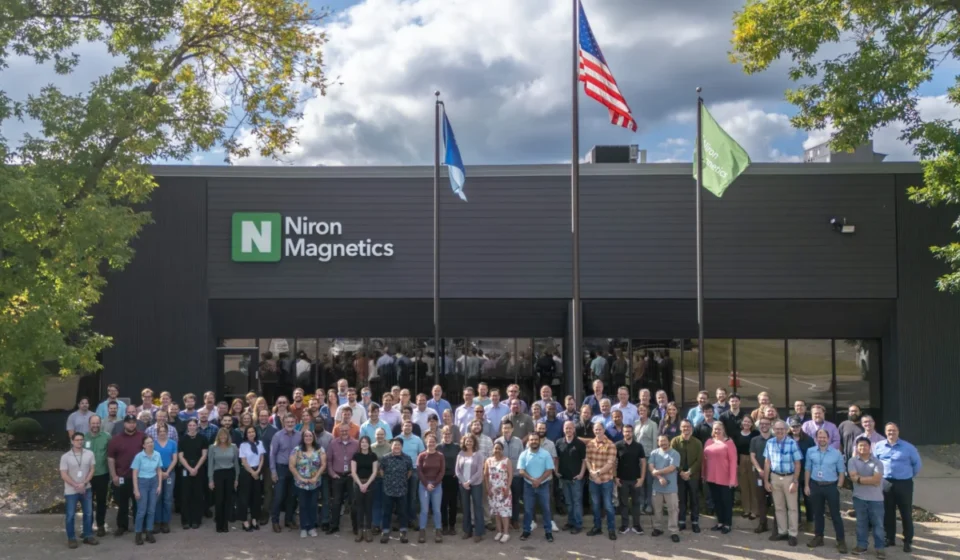

While the contentious debate over the Twin Metals copper-nickel mine near the Boundary Waters Canoe Area (BWCA) has dominated national headlines and environmental discourse, a quieter, potentially more transformative industrial evolution is taking root in Minnesota. Minneapolis-based Niron Magnetics is currently evaluating the state’s historic Iron Range for the construction of its third and most ambitious manufacturing facility—a project that promises to replace hundreds of legacy mining jobs with a foothold in the high-tech, green-energy economy.
Niron’s mission is as strategic as it is industrial: to break the global stranglehold held by China over the production of “rare-earth” minerals. These minerals are the essential components in the high-performance permanent magnets that power everything from electric vehicle (EV) motors and wind turbines to critical defense systems and consumer electronics. By leveraging Minnesota’s deep-rooted history in iron ore, Niron aims to prove that the future of American manufacturing does not need to rely on foreign supply chains, but rather on domestic innovation and abundant raw materials.
The Technological Pivot: Iron and Nitrogen
The core of Niron’s innovation lies in a patented technology developed by University of Minnesota Professor Jian Ping Wang. While traditional high-power magnets rely on rare-earth elements—a process often associated with significant environmental degradation and complex chemical separation—Niron has developed a "cleaner" alternative.
Niron’s secret-sauce involves processing iron powder or recycled steel with a chemical compound that induces magnetism without the need for extreme, energy-intensive heat. By utilizing iron and nitrogen—both of which are abundant and environmentally benign compared to rare-earth elements—the company has created a product that is not only more economical but also aligns with modern environmental, social, and governance (ESG) standards.
"Minnesota has an opportunity to address this crisis and offer a transformative solution to U.S. commercial and defense manufacturers," the company stated recently. "An alternative to rare-earth permanent magnets has been invented in Minnesota… using domestically sourced raw materials, iron, and nitrogen."
Chronology of a Growing Enterprise
Niron’s journey from a laboratory concept to a $1.8 billion industrial player has been rapid and deliberate:
- Foundational Years: The company began by commercializing Professor Wang’s research, establishing a headquarters and a pilot plant in Northeast Minneapolis.
- The Sartell Breakthrough: Niron secured $10 million in state support to begin construction on its first major production plant near St. Cloud. This facility, which is currently underway, is expected to employ 175 people and produce 1,500 tons of magnets annually.
- Site Selection (2024–Present): Earlier this year, Niron engaged global commercial real estate advisor Savills to identify a location for a massive, 1.6 million-square-foot facility.
- The 2029 Vision: The proposed Iron Range facility, projected to cost $1.8 billion, is slated to begin construction in 2028. Once operational, it is expected to employ over 700 workers and ramp up production to 10,000 tons of magnets annually.
Economic Implications for the Iron Range
For the Iron Range, a region that has spent decades grappling with the decline of traditional taconite mining due to global steel competition and the rise of recycled steel, Niron’s interest is a beacon of hope. The region remains a "job-hungry" landscape, and the prospect of a high-tech manufacturing hub that honors the area’s industrial heritage while pivoting toward the future is being met with significant enthusiasm from local leaders.
"It’s a massive opportunity that fits agency priorities," said Ryan Malich, executive director of the Minnesota Department of Iron Range Redevelopment and Resources (IRRR). "These are the types of jobs that we’re trying to add to the area in evolving, innovative technologies. We want to be on the frontside of technological development. We have a highly skilled, available workforce. All the elements seem to line up well for this potential development."
Speculation is currently centered on the potential for Niron to revitalize a shuttered taconite plant, repurposing existing infrastructure to house its high-tech operations. While Niron officials and state agencies have remained tight-lipped regarding specific site locations—likely due to ongoing negotiations regarding government participation, tax incentives, and infrastructure investment—the momentum is palpable.
Strategic National Security and Global Competition
The urgency behind Niron’s expansion is driven by cold, hard data. According to the Center for Strategic and International Studies, China currently controls up to 90% of the manufacturing and processing of rare-earth minerals. This dominance has created a single point of failure for Western economies, particularly as the demand for electric powertrains in the automotive industry surges.
Niron CEO Jonathan Rowntree has been clear about the geopolitical necessity of the project. "The Chinese put export controls in place around rare earths, and that’s been a great benefit to us," Rowntree noted in a recent interview. By providing a domestic, reliable supply chain, Niron positions itself as a critical partner for major automotive and tech players, including GM Ventures, Volvo, Samsung Ventures, Stellantis, and Western Digital.
"Permanent magnets are foundational to everything from electric motors to defense," Rowntree said. "Expanding domestic production with the right partner who shares this vision will be critical to strengthening supply chain resilience."
The "Twin Metals" Contrast
The Niron project is frequently discussed in the context of the Twin Metals Minnesota proposal. While both projects seek to extract materials from the earth, they represent fundamentally different approaches to resource management. Twin Metals, a Chilean-owned firm, aims to build a hard-metals mine near the BWCA, a project that has sparked a decade-long legal and environmental battle over the potential for watershed pollution.
In contrast, Niron’s proposed facility would be located outside the sensitive BWCA watershed. Furthermore, Niron enjoys a rare level of bipartisan support. Gov. Tim Walz’s administration, which has actively opposed the Twin Metals project on environmental grounds, has been aggressively courting Niron’s expansion. Similarly, U.S. Rep. Pete Stauber (R-MN), a champion of the bill to lift mining bans near the BWCA, has also voiced strong support for Niron, viewing it as a way to bolster the Range’s economy without the controversy associated with hard-rock mining in protected areas.
Supporting Data and Financial Trajectory
Niron’s rapid growth is backed by a combination of public and private capital. To date, the company has raised approximately $300 million. However, to meet the $1.8 billion requirement for the Iron Range facility, Niron will likely need to secure hundreds of millions in additional capital.
Market analysts point to a potential public offering of stock within the next two years as a viable path for the company to achieve its goal of reaching $1 billion in annual revenue. The scale of the proposed plant—1.6 million square feet—would dwarf the company’s current operations, signaling a transition from a research-heavy startup to a cornerstone of the North American manufacturing sector.
Official Responses and Future Outlook
State officials are framing the Niron potential as a "fabulous story" of homegrown innovation. Kevin McKinnon, Deputy Commissioner of the Department of Employment and Economic Development (DEED), highlighted the importance of the University of Minnesota connection. "The promise, the trajectory of where they are going is very exciting. We continue to work with them in Sartell. And the third project would dwarf Sartell. The scale is exciting. We believe Minnesota is a compelling location for such a project."
As Niron moves forward, the company is not looking at Minnesota alone; it is simultaneously planning manufacturing footprints in Europe and Asia to meet global demand. However, the Iron Range remains a prime candidate for its flagship production hub. For the people of northern Minnesota, this represents a unique bridge between the past and the future: taking the iron that built the 20th century and refining it into the high-tech magnets that will power the 21st.
Ultimately, Niron Magnetics is attempting to solve a problem that the U.S. largely abandoned decades ago: the cost and environmental difficulty of rare-earth mining. By creating a "secret-sauce" that simplifies the metallurgical process, Niron is not just building a factory; it is building a new, more resilient economic model for the American Midwest. As the site selection process nears its conclusion, the eyes of the global manufacturing community—and the hopeful residents of the Iron Range—remain fixed on Minnesota.