










































The 2025-26 Minnesota Timberwolves season has officially drawn to a close, ending not with the triumphant roar of a championship run, but with the sobering, clarifying realization that the franchise, in its current iteration, lacks the fundamental cohesion required to hoist the Larry O’Brien Trophy. Following a decisive 139-109 elimination at the hands of the San Antonio Spurs—a team that dismantled them in four of their six second-round meetings—the organization finds itself staring into an uncertain offseason defined by strategic missteps, roster imbalances, and a desperate need for a new identity.
The Anatomy of an Exit: A Series of Strategic Gambles
The Timberwolves’ postseason exit was, in many ways, a microcosm of their entire season: a series of high-stakes gambles that backfired. In the deciding Game 6 against the Spurs, head coach Chris Finch attempted a radical defensive shift, tasking Julius Randle with primary coverage on Victor Wembanyama. The objective was to free up Rudy Gobert to roam as a help defender, effectively double-teaming the French phenom while ostensibly matching up with Spurs guard Stephon Castle.
While the strategy succeeded in neutralizing Wembanyama early—holding him to just four points in the first quarter—it left the perimeter dangerously exposed. Castle, the reigning Rookie of the Year and a battle-tested NCAA champion, exploited the gap with clinical precision, hitting three early triples and attacking the rim to catalyze a 30-point blowout.
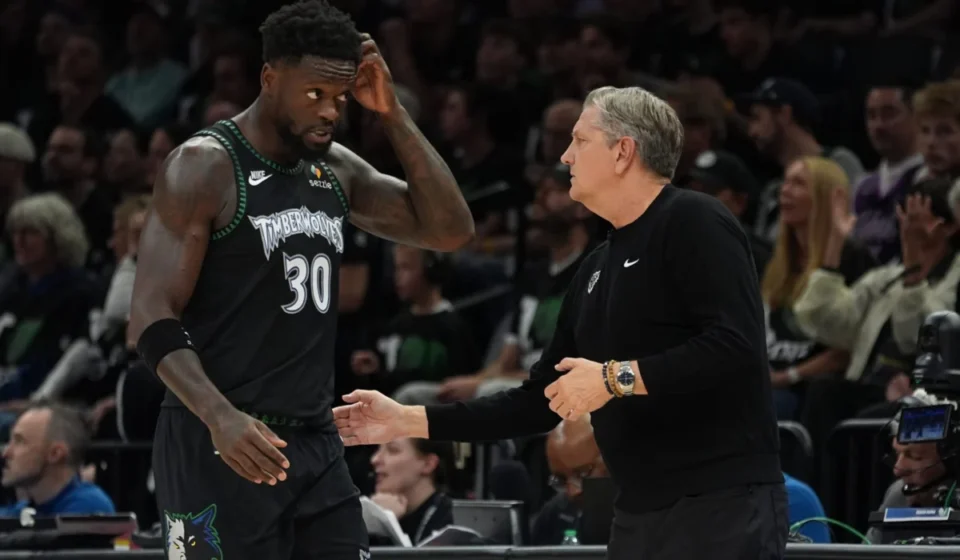
Finch, known for his transparent approach to coaching, did not shy away from the fallout. "We lost some of our aggression," Finch admitted during his post-game press conference. "We needed to come out more aggressive. That’s on me."
A Chronology of Conflict: The "Original Sin"
If the loss to the Spurs was the final act, the story of the Timberwolves’ season began long before the playoffs. In a candid 19-minute session during exit interviews, Coach Finch pinpointed what he described as an "original sin": the abrupt, unilateral decision to alter the starting lineup just before the season opener.
By inserting Donte "Ragu" DiVincenzo into the starting backcourt alongside Anthony Edwards and relegating 19-year veteran Mike Conley to a bench role, the coaching staff sought to prioritize DiVincenzo’s development. However, the move caused a ripple effect that undermined the team’s continuity.
"Putting Ant at the point guard spot on the eve of the season certainly helped with Donte, but it hurt putting everyone else in their best position," Finch explained. The move stripped the team of its primary floor general, forcing Edwards to expend precious energy initiating the offense rather than acting as the primary scoring engine. For Mike Conley, the shift was fatal to his rhythm. A player whose value is built on stability and veteran leadership, Conley spent the year struggling to find consistency, a byproduct of a role that fluctuated throughout the campaign.
Supporting Data: The Randle-Gobert Conundrum
The roster composition, specifically the acquisition of Julius Randle in the trade for Karl-Anthony Towns, has proven to be a strategic quagmire. The data suggests a team at war with its own architecture.
During his 23:42 of court time in the elimination loss to San Antonio, the Timberwolves were a staggering -34. Conversely, the team was +4 during the 24:18 he sat on the bench. Randle’s fit as a secondary, ball-dominant playmaker alongside Edwards has effectively cannibalized the team’s offensive flow. With Gobert already occupying the paint and providing zero floor spacing, Randle’s struggles from deep (shooting 32.9% during his Wolves tenure) have clogged the lane, stifling the movement required to beat elite defenses.
Moreover, while Randle is capable of high-level defense, his inconsistent intensity—often described as a "matador" approach rather than a disruptive one—has eroded the team’s defensive culture. In a league where resilience and quality control are paramount, the gap between the team’s potential and its output has become an impossible hurdle to clear.
Official Responses and Internal Tensions
The atmosphere at the post-elimination pressers was heavy. While stars like Naz Reid and Jaden McDaniels—the bedrock of the "second timeline" alongside Edwards—spoke openly about the need for a traditional, organizing point guard, the silence from Julius Randle was deafening. He did not address the media following the loss, nor the morning after, leaving a vacuum in the locker room narrative.
Coach Finch’s admission that he "went with his gut" and failed to reconcile the conflicting goals of developing young players while chasing a title speaks to a broader failure in the team’s championship-caliber mindset. The players often spoke of grit and focus, yet, as seen in the Game 1 loss to Denver, they often failed to internalize these habits until they were pushed to the brink.
Implications: The Path Toward 2026-27
As the front office, led by President of Basketball Operations Tim Connelly, prepares for the offseason, the Timberwolves face a series of difficult, interconnected decisions.
1. The Search for a Floor General
The team must prioritize acquiring a "Conley-like" point guard—someone who can manage the offense, reduce the physical toll on Edwards, and distribute shots to secondary scorers. With Ayo Dosunmu entering unrestricted free agency and DiVincenzo facing a long road of rehabilitation from an Achilles injury, the internal options are limited. The draft, holding only the 28th and 59th picks, offers little immediate relief.
2. The Randle Dilemma
Trading Julius Randle appears to be the most logical, albeit difficult, step. Moving him could clear the path for a more synergistic offensive structure and provide the flexibility to acquire a player who fits the modern, spacing-heavy NBA. However, the Wolves’ limited draft capital and the nature of the market make this a complex transaction.
3. The Giannis Speculation
The rumors regarding Giannis Antetokounmpo will undoubtedly dominate the news cycle. While Connelly has shown a willingness to swing for the fences, the history of "super-team" construction suggests that depth is often the casualty of such moves. The modern NBA, characterized by athletic wings who can space the floor and switch defensively, favors collective synergy over top-heavy talent. Relying on the continued maturation of the Edwards-Reid-McDaniels core may be a safer, more sustainable route to contention.
Conclusion: Lessons from a Glorious Game
Despite the frustrations, it is essential to contextualize the season. The Timberwolves showcased moments of brilliant, high-quality basketball, most notably their hard-fought series against the Denver Nuggets. They have a core that is approaching its collective prime, and the emergence of players like Ayo Dosunmu and TJ Shannon provides a template for the wings of the future.
The Timberwolves were taught a lesson by the San Antonio Spurs and the OKC Thunder: talent without discipline and synergy is merely a suggestion of success, not a guarantee. Whether this lesson leads to a fundamental roster overhaul or a shift in coaching philosophy remains to be seen. For now, the organization sits at a crossroads, forced to decide whether to double down on the current vision or admit that, to reach the promised land, they must first burn down the structure that kept them from arriving.