



















































The Paraquat Papers: Inside the Decades-Long Corporate Strategy to Shield a Controversial Pesticide

This investigation into Syngenta and the systemic failures surrounding the herbicide paraquat is based on reporting originally published by The New Lede.
For over four decades, a global consensus has been building against the use of paraquat, a highly toxic herbicide known for its efficacy in killing weeds but increasingly linked to devastating human health outcomes. While Sweden pioneered the movement to ban the chemical in 1983, and more than 70 nations—including China, the home of paraquat manufacturer Syngenta—have since followed suit, the United States remains a massive outlier.
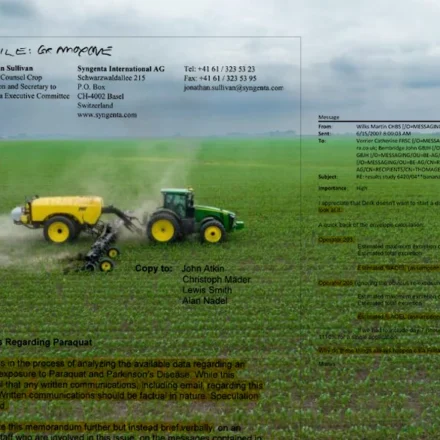
New, explosive evidence extracted from roughly 3,700 pages of internal corporate records, depositions, and confidential communications reveals a calculated, multi-decade campaign by Syngenta to maintain its foothold in the U.S. market. The documents suggest that the company systematically withheld critical safety data from the U.S. Environmental Protection Agency (EPA), actively worked to discredit independent science, and prioritized corporate profits over public health while the U.S. usage of the chemical nearly tripled between 2000 and 2018.
The Science of Silence: What Was Withheld
Under the Federal Insecticide, Fungicide, and Rodenticide Act (FIFRA), manufacturers are legally mandated to report "unreasonable adverse effects" to the EPA. However, court-mandated disclosures indicate that Syngenta failed to share a wealth of information that might have fundamentally altered the regulatory landscape.

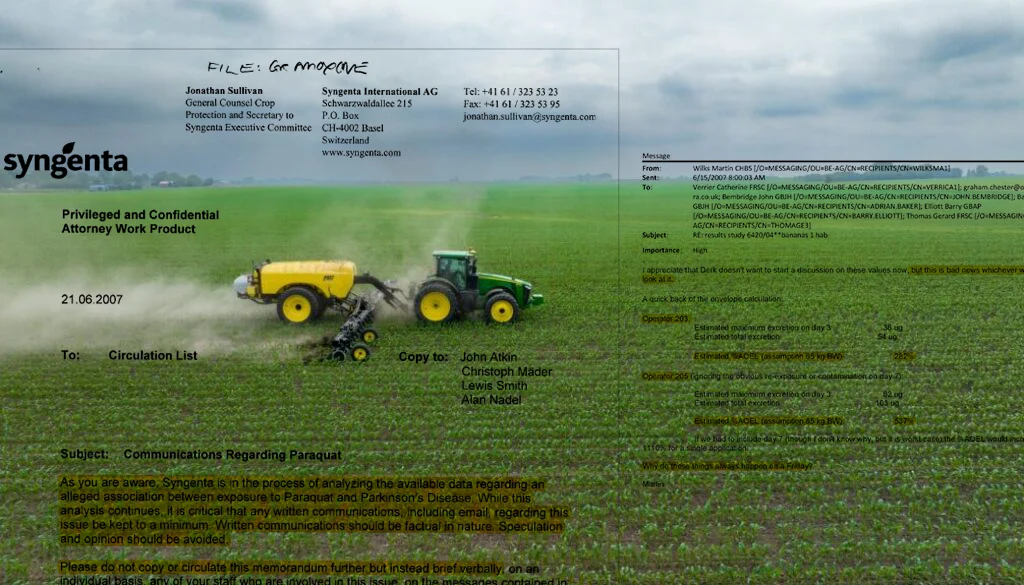
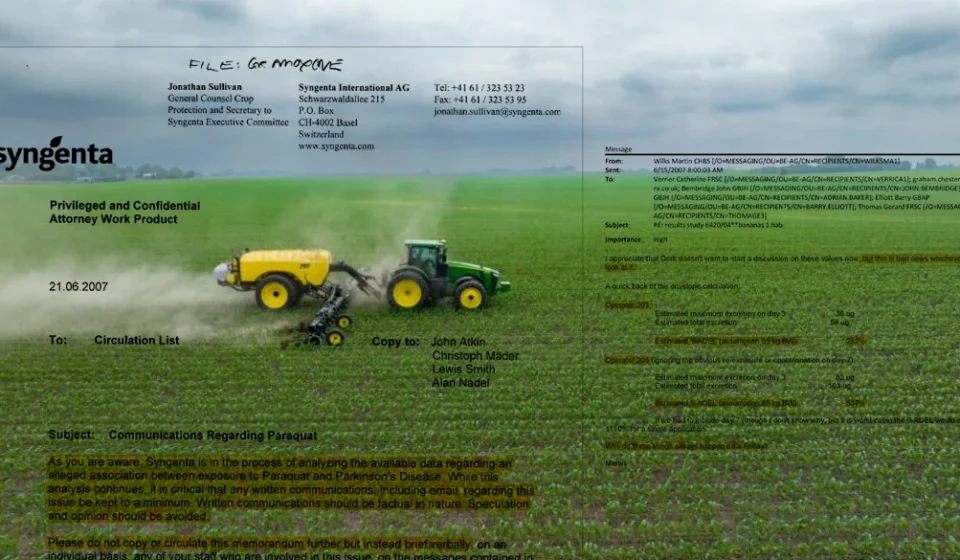
Internal documents reveal that the company possessed, yet did not disclose, detailed analyses on how quickly paraquat could permeate clothing, its rapid absorption rates into the human bloodstream, and the alarming way in which common agricultural practices—such as mixing paraquat with surfactants—dramatically increased its toxicity. While the company publicly maintained the safety of its “blockbuster” product, internal emails explicitly discussed the "bad news" associated with these findings.
One of the most damning revelations involves the company’s internal strategy to combat growing scientific evidence linking paraquat to Parkinson’s disease, an incurable neurodegenerative disorder. While outside researchers were publishing studies suggesting a causal link, Syngenta officials were privately orchestrating a plan to "brush aside" a decade of peer-reviewed science, replacing it with their own, company-funded research designed to be "dead solid airtight" for the benefit of regulators and jurors.
Chronology of a Regulatory Failure
The history of paraquat is a case study in how corporate influence can stall public health interventions:
- 1983: Sweden becomes the first nation to ban paraquat, citing significant human health risks.
- 2000–2018: Despite growing global bans, U.S. consumption of paraquat nearly triples, cementing the U.S. as one of the world’s largest markets for the chemical.
- 2007: The European Union bans paraquat across all member states, citing neurotoxicity and links to Parkinson’s.
- 2012–2016: China, after conducting its own independent toxicity studies—the existence of which Syngenta sought to keep from the EPA—phases out and ultimately bans the chemical.
- 2021: Syngenta pays at least $187 million to settle initial litigation, though the company admits no liability.
- 2026: Following years of intense litigation and the emergence of the "Paraquat Papers," Syngenta announces it will cease all global production of the chemical, citing "market factors" rather than health concerns.
Supporting Data and the "Independent" Science Strategy
The documents reveal a sophisticated mechanism for manufacturing doubt. In one instance, a 2011 email thread between Syngenta scientists discussed the development of a "PD Risk Factors Paper" to be published under the name of an outside academic, Jack Mandel. The goal, according to the emails, was to make the paper appear independent: "We cannot be seen to try to influence," the writers noted, advising that communication should occur only verbally to avoid a paper trail.

This paper, along with others funded by Syngenta grants, concluded that evidence linking paraquat to Parkinson’s was "limited." Furthermore, when a government-funded study, the Farming and Movement Evaluation (FAME), reported a significant association between the chemical and the disease, Syngenta commissioned its own secret analysis. That analysis, marked as "Attorney-Client Work Product" and withheld from the EPA, effectively confirmed the FAME study’s findings, yet the company continued to publicly disparage the government’s work.
Official Responses: The EPA’s Stance
The role of the EPA in this saga has come under intense scrutiny. Critics argue that the agency is far too reliant on industry-provided data, creating a feedback loop where the companies being regulated effectively dictate the terms of their own safety assessments.
When confronted with the revelations of omitted data, the EPA issued a statement claiming it "cannot speculate on how this additional information would impact EPA’s assessment." The agency insisted that its review is based on an "extensive database" and reminded registrants that failing to submit information regarding "unexpected or unreasonable adverse effects" is a "direct violation of federal law."
Syngenta, for its part, vehemently denies any wrongdoing. In court filings, the company asserts that it has "never knowingly failed to provide regulators with relevant and required information." They argue that the omitted data was either irrelevant to the U.S. market or that the significance of the findings was negated by other factors. A spokesperson stated that the company "takes the safety of its products very seriously" and that the claims of withholding information are "inaccurate and misleading."

The Human Cost and Legal Implications
The human toll is represented by over 10,000 lawsuits filed by individuals suffering from Parkinson’s disease who claim their condition resulted from exposure to paraquat. The legal discovery process has been the primary vehicle for bringing these internal documents to light, stripping away the corporate veil that shielded Syngenta for decades.
The implications of this case extend far beyond a single company or a single chemical. Legal experts, such as Wendy Wagner of the University of Texas, suggest that these findings expose "holes in our regulatory system" that allow corporations to bypass safety protocols. The reliance on industry-funded studies creates a dangerous information asymmetry that puts public health in a state of perpetual risk.
Tracey Woodruff, a professor of epidemiology at Stanford University, offered a stark assessment of the behavior: "When the pesticide companies know from their own studies that their pesticides are harmful and don’t tell the public or regulators, then they are knowingly contributing to people getting sick and dying."
The Future of Pesticide Regulation
The recent U.S. Supreme Court ruling, which solidified the EPA’s role as the preeminent authority on pesticide labeling, adds a layer of complexity to this debate. If the agency is the sole arbiter of what constitutes a "harmful" label, but is simultaneously starved of the resources to conduct independent research, it remains vulnerable to the very strategies Syngenta used to protect paraquat.

While Vermont has banned the chemical and California regulators have moved toward voluntary cancellation, the EPA continues to permit paraquat use on millions of acres, including aerial spraying. As Ted Schettler of the Science and Environmental Health Network noted, "Untold numbers of people could have been prevented from developing Parkinson’s disease if the agency had done its job of protecting public health."
The story of paraquat is not merely a tale of one company’s greed; it is a critical examination of a regulatory system that has, for too long, prioritized the "blockbuster" potential of agricultural chemicals over the neurological health of the citizens it is meant to protect. As the litigation continues, the thousands of pages of internal documents serve as a grim reminder that in the absence of transparency, scientific truth is often the first casualty of corporate strategy.
Readers interested in the source material for this report can consult the full database of the "Paraquat Papers," which provides an unprecedented look into the internal decision-making processes of one of the world’s largest agribusiness corporations.