

















































DULUTH, Minn. – In a significant shake-up of Minnesota’s Republican political landscape, former sports broadcaster Michele Tafoya has declared her intent to continue her campaign for retiring Senator Tina Smith’s seat, despite failing to secure the official party endorsement. This audacious move defies a long-standing, albeit unofficial, rule within the Minnesota GOP: candidates who miss out on the party’s endorsement almost invariably lose the subsequent primary election. Tafoya’s decision sets the stage for a high-stakes August primary, pitting her considerable name recognition and national backing against the conservative fervor that propelled former Navy SEAL Adam Schwarze to victory at the state convention.
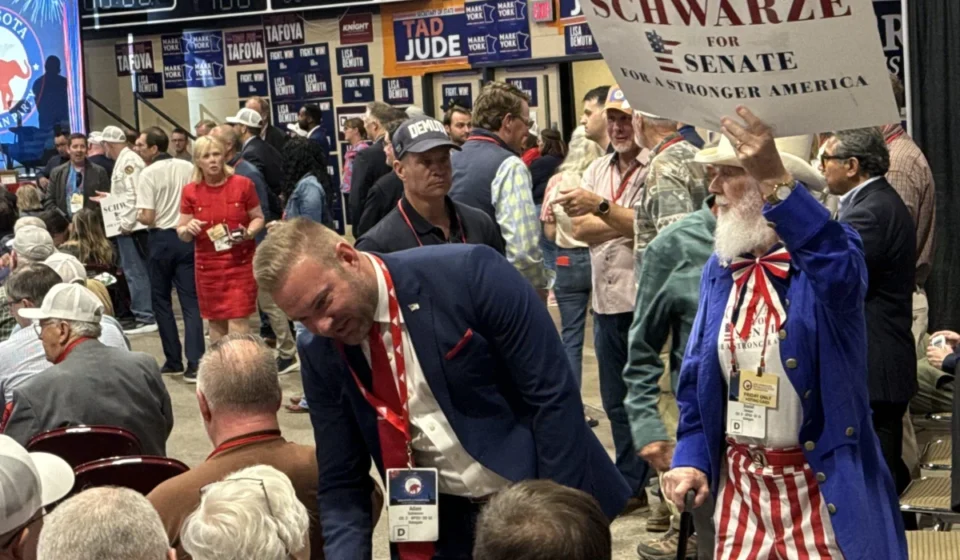
The Republican Party’s state convention, held in Duluth, became the epicenter of this intra-party struggle. After six grueling rounds of balloting, which saw other contenders, including former NBA player Royce White, fall by the wayside, the endorsement was ultimately bestowed upon Schwarze. He garnered the support of nearly 63% of the GOP delegates, a decisive margin that reflected the conservative base’s preference for a candidate perceived as uncompromising on core Republican values.
The Convention Showdown: Values Versus Electability
The atmosphere on the convention floor Friday in Duluth was charged with anticipation as candidates made their final pitches. Schwarze, in a series of impassioned speeches, directly challenged Tafoya’s central argument that she was the most “electable” candidate capable of flipping a statewide seat in Minnesota. He implored delegates to reject the notion that electability required ideological concessions, asserting that Republicans could win the Senate race “without compromising our values.” His message resonated deeply with a delegate pool eager for a candidate who would stand firm against what they perceive as progressive encroachment.
Upon securing the endorsement, Schwarze delivered a victory speech punctuated by promises of unwavering commitment. “I will not compromise,” he declared, his words met with enthusiastic applause. He further rallied the base, stating, “I will fight in D.C. and we will fight to take back our state together.” His rhetoric clearly aimed at mobilizing the party’s conservative wing, emphasizing a return to foundational principles.
Despite her defeat at the convention, Tafoya, who had previously signaled her intention to disregard the convention’s choice, remained resolute. Her campaign promptly announced its full-speed continuation toward the August primary election. This defiance, however, comes with substantial historical baggage and carries considerable political risk.
A Risky Precedent: The Shadow of Minnesota GOP History
The path Tafoya has chosen is fraught with peril, as Minnesota Republican history offers a stark warning. A non-endorsed GOP candidate has not won a Republican primary since 1994, a singular exception provided by Arne Carlson. Carlson, then the incumbent governor, was deemed too moderate by delegates at that year’s Republican Party convention but defied the party to win the primary and subsequently secure re-election to the governor’s office. His victory remains a rare anomaly, often cited as the ultimate example of a candidate successfully bucking the party establishment.
David Schultz, a political science professor at Hamline University, underscored the historical challenge facing Tafoya. “Unlike the Democrats, the Republican track record in Minnesota of bucking the convention in recent history has not worked out well,” Schultz observed. This sentiment reflects a general understanding within Minnesota political circles that the GOP base, particularly those active enough to participate in conventions and primaries, holds a strong preference for endorsed candidates. The party infrastructure, including volunteers and local organizers, traditionally aligns itself with the endorsed candidate, making an uphill battle even steeper for those who choose to run independently.
Tafoya, a recognizable figure from her decades as a prominent sports broadcaster, lacks the critical advantage of incumbency that Arne Carlson enjoyed. However, she brings other formidable assets to the fight. She boasts the full support of the National Republican Senatorial Committee (NRSC), a powerful national entity dedicated to electing Republicans to the U.S. Senate. This national backing is crucial, providing her with significant financial and strategic resources. Coupled with her inherent name recognition, a proven ability to raise substantial campaign cash, and considerable media savvy, Tafoya presents a unique challenge to the traditional endorsement process. She leveraged these strengths in her appeals to delegates on Friday, but ultimately failed to secure more than 37% of the votes, indicating a significant disconnect with the party’s most active members.

The National-Local Divide and Financial Realities
Losing the state endorsement means Tafoya foregoes the official support of the Minnesota Republican Party. However, Professor Schultz minimized the impact of this loss, particularly given her NRSC backing. “The Republican Party in Minnesota is still in the most part broke,” Schultz stated, highlighting the state party’s perennial financial struggles. This financial weakness means the state party’s organizational support, while valuable, might not be as decisive as the multi-million dollar investment the NRSC is prepared to pour into the race if Tafoya wins the August 11 primary and is deemed competitive in the general election.
This dynamic illustrates a growing trend in modern American politics where national party committees can sometimes overshadow struggling state parties, particularly when a candidate brings national appeal and fundraising prowess. For Tafoya, the NRSC’s financial muscle could mitigate the lack of local party infrastructure support, allowing her to fund a robust advertising campaign and grassroots efforts independently.
In the November general election, should she prevail in the primary, Tafoya would likely face a formidable Democratic opponent, either Democratic Lt. Gov. Peggy Flanagan or U.S. Rep. Angie Craig, D-2nd District. Interestingly, Craig shares a notable characteristic with Tafoya: she too successfully rebelled against her party’s convention process, winning her primary without the official DFL endorsement in the past. This precedent, though on the Democratic side, offers a glimmer of hope that defying the convention is not always a death knell, particularly for candidates with strong individual appeal.
The Ideological Chasm: Moderation vs. the Base
Tafoya’s struggle for the endorsement is symptomatic of an increasingly strong trend in national politics: the necessity for candidates to appeal to their party’s base voters to secure endorsements and, to a large extent, primary nominations. For the GOP, this base is increasingly conservative, while for Democrats, it leans progressive. Tafoya’s perceived moderation ultimately proved to be her undoing at the convention, creating an ideological chasm between her and the delegates.
Chisago County delegate Tony Kaufman, a staunch supporter of Schwarze, articulated the delegates’ perspective on the endorsement process. “When you support the endorsement process, you’re supporting an informed base, an informed constituent, and that’s why we’re excited about it, and that’s why we choose to abide by the endorsement,” Kaufman explained. He added, “Because it’s not only the Republican Party, we want the citizens of Minnesota to be able to have the same opportunity to be able to get behind a candidate.” This viewpoint emphasizes the delegates’ belief in their role as guardians of party principles and their dedication to selecting a candidate who truly embodies those values.
Tafoya’s past statements reveal the core of her ideological divergence from the party’s activist wing. She previously identified herself as a “pro-choice Republican,” a position anathema to much of the modern GOP. While she has more recently refined her stance to support state-level prohibitions on abortions after 12 weeks of pregnancy, her earlier declaration lingered. Furthermore, her advocacy for Extreme Risk Protection Orders, or “red flag” laws—which allow temporary removal of firearms from individuals deemed a danger—as the “most sensible” way to combat mass shootings, directly raised the hackles of Second Amendment enthusiasts within the party.
She attempted to bridge this gap and distance herself from her past statements during her convention appeals, asserting, “I will never compromise my conservative values.” However, for many delegates, these past remarks were indelible.
Curtis Rethwisch, a Lincoln County delegate who sided with Schwarze, exemplified this skepticism. “If it was just word of mouth and campaign smears I wouldn’t give it any credibility, but I watched the videos,” he stated, emphasizing the direct evidence of Tafoya’s earlier positions. “The words came right out of her mouth.” For delegates like Rethwisch, Schwarze represented an unblemished commitment to conservative orthodoxy. “I don’t have to give up anything on my principles and my morals with him,” he said, praising Schwarze’s alignment on critical issues: “He’s pro life, he’s pro build a wall, he backs Trump.” This sentiment underscores the enduring influence of former President Trump and the litmus tests many conservative delegates apply to candidates.
 <figcaption