
























































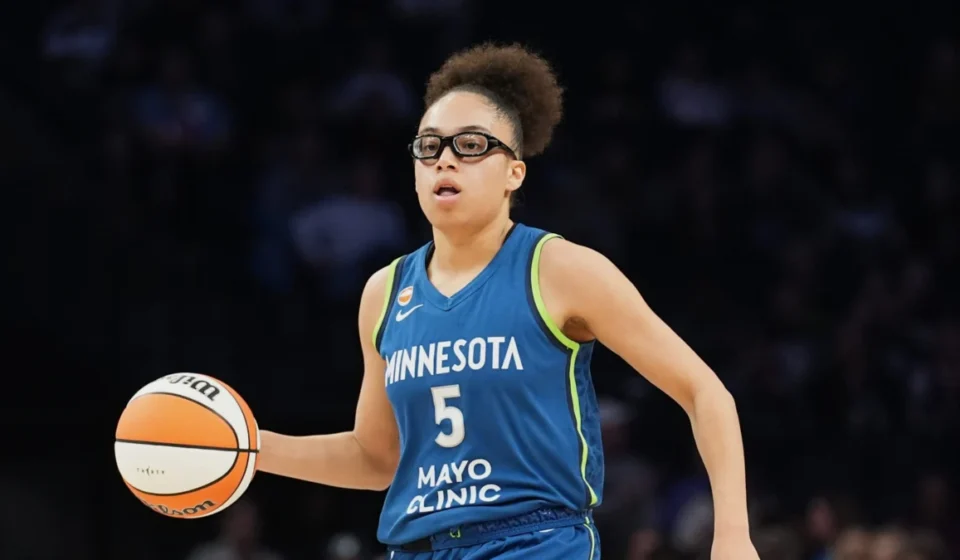

Seven games into her professional career, Olivia Miles walked into the Minnesota Lynx press conference room at the Target Center with the relaxed, unbothered air of someone returning to her own living room. For a rookie still adjusting to the relentless demands of the WNBA, the setting was a stark contrast to the high-stakes, high-pressure environment she faces on the hardwood.
As she stood before the microphones, still clad in her game-day shorts and a black tank top, she offered a candid, shivering critique of the environment: “It’s cold in here!”
The observation was as sharp as her court vision. The Lynx maintain their media space at a temperature reminiscent of a supermarket dairy aisle, a detail most would overlook. Yet, that is the essence of Miles: observant, unfiltered, and deeply present. Moments later, she settled onto the riser next to veteran forward Natasha Howard, playfully tugging at Howard’s ear with the irreverent charm of a younger sibling.
“What’s wrong with you?” Howard asked, feigning irritation.
The answer, as the league is quickly learning, is nothing at all. In fact, everything about Olivia Miles is exactly right.
A Meteoric Rise: The Chronology of an Impactful Debut
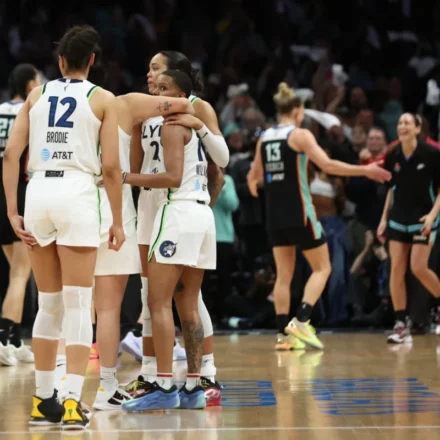
If the locker room antics suggest a rookie still finding her footing, the game film tells a different story—one of a seasoned floor general. Just five nights after her playful press conference, Miles delivered a masterclass in Phoenix, sparking a 111-77 demolition of the Mercury.
Her opening act was nothing short of historic. She blitzed the Phoenix defense for 11 points in the first quarter alone, hitting all four of her field-goal attempts and all three of her free throws. By the final buzzer, she had stuffed the stat sheet with 19 points, 10 assists, four rebounds, and three steals. According to team records, that performance vaulted her into an elite category: she became the only WNBA rookie other than Caitlin Clark to record a 19-point, 4-rebound, 3-steal game in the early stages of their debut season.
Her consistency has been just as remarkable. Miles scored in double figures in each of her first 10 games, eclipsing the club record previously shared by Naismith Hall of Famers Seimone Augustus and Tonya Edwards. Notably absent from that list is Maya Moore, the icon who defined the Lynx’s first championship era.
The crescendo of her early campaign arrived on a Thursday night against the Golden State Warriors, where Miles torched the nets for a season-high 28 points, including a league-record eight three-pointers in a single game—a remarkable turnaround for a player who had made only two of 18 attempts from deep prior to that evening.
Supporting Data: Why Miles is More Than Just a Highlight Reel
While the raw numbers are impressive, they fail to capture the visceral impact Miles has on the game’s rhythm. Her coach, Cheryl Reeve, noted that several of Miles’ passes have drawn audible gasps from the coaching staff and bench personnel.
One sequence, in particular, stands out: a perfectly threaded bounce pass between two defenders in the third quarter against Phoenix that found a cutting Teaira McCowan for an effortless layup. It was the kind of play that requires not just talent, but an innate, cerebral understanding of defensive geometry.
As of mid-June, Miles sits atop the leaderboard for all WNBA rookies in several critical categories:
- Points per game: 17.0
- Assists per game: 6.4
- Steals per game: 1.5
- Minutes per game: 30.4
These metrics, combined with her May "Rookie of the Month" honor, have firmly cemented her as the frontrunner in the Rookie of the Year conversation. Her ability to navigate the pick-and-roll—a skill refined during her time at Texas Christian University—has become the engine of the Lynx offense.
The Mentor’s Perspective: Official Responses
The admiration for Miles isn’t confined to her teammates; it resonates throughout the league. Lindsay Whalen, a Naismith Hall of Famer and the architect of the Lynx’s legendary point guard play, has been effusive in her praise.
“I think she’s a better passer than I was, especially a lot of those windows she’s able to find,” Whalen admitted. “Her ability to put pressure at the rim is something that can take people some time because the speed of the game is faster than college… She’s done a really good job of getting herself in those positions where she can finish or kick out.”
Courtney Williams, who has served as a vital partner in the backcourt, dubbed Miles “a little baby Chelsea Gray” after her 21-point, 8-assist pro debut—a moniker that highlights Miles’ poise and technical precision.
Even rival coaches have taken note. Sandy Brondello, who has guided both the Phoenix Mercury and New York Liberty to championships, sees a rare trajectory. “We knew she was always going to be a great player in this league,” Brondello said. “She’s like a generational point guard. We haven’t had many for a while.”
For her part, Coach Cheryl Reeve has resisted the urge to stifle Miles’ flair. When asked about a failed, flashy pass between the legs of Jordin Canada, Reeve was dismissive of any need for caution. “I want her to be herself, her confident, authentic self,” Reeve stated. “If there’s something we don’t like, then we’ll share it… But in general, I want her to go.”
Implications: Building a New Dynasty in Minnesota
The emergence of Miles couldn’t have come at a more critical juncture for the Minnesota Lynx. The franchise faced an unprecedented offseason of upheaval, with the new collective bargaining agreement triggering a mass exodus of talent. Key contributors like Alanna Smith, Jessica Shepard, Natisha Hiedeman, and DiJonai Carrington departed, and there was palpable anxiety surrounding the future of superstar Napheesa Collier.
Yet, in the vacuum created by these departures, Reeve successfully recalibrated. By pairing veterans like Natasha Howard and Nia Coffey with the youthful, electric energy of Miles, the Lynx have found themselves in possession of the league’s best record (8-2) and a staggering 13.0 net rating.
The synergy between Miles and Howard has been particularly transformative. Howard, a 13-year veteran, has noted that she has only experienced such immediate chemistry with a handful of point guards, including Sue Bird and Sabrina Ionescu.
“It’s unbelievable,” Howard said. “She sees things before they happen. She’s got in her head what she wants to do before the play even starts.”
Miles herself attributes this seamless transition to the team’s culture. “I came into the W like, kind of scared of that, stepping on toes,” she admitted. “But it was so easy. The culture, people just want to win. I’m very blessed.”
For critics who questioned the Lynx’s decision to draft Miles over other prospects, the early returns have been a humbling reminder of a fundamental basketball truth: nothing elevates a team’s ceiling quite like a generational point guard. As the season progresses, the league is finding that Miles is not just a rookie filling a roster spot—she is the architect of a new era in Minneapolis, and she is just getting started.
As Reeve succinctly put it: “You can call her a rookie if you want to. She’s just always ready for the moment.”