



















































Escaping to Middle-earth: Zephyr Theatre’s ‘The Hobbit’ Offers a Timely Mythic Retreat

In an era defined by rapid technological shifts, geopolitical instability, and a pervasive sense of social fragmentation, modern audiences are increasingly seeking solace in the enduring power of myth. The runaway success of recent epic cinematic ventures, such as Christopher Nolan’s The Odyssey, suggests a collective hunger for narratives that transcend the mundane. Tapping into this zeitgeist, the Zephyr Theatre has launched an enchanting, minimalist production of J.R.R. Tolkien’s The Hobbit. Set against the rustic backdrop of Aamodt’s Apple Farm in Stillwater, Minnesota, this production invites audiences to step out of the daily grind and into a world where the smallest individuals can indeed change the course of history.
A New Artistic Vision: Why This Show, Why Now?
For Reed Sigmund, the newly appointed artistic director of the Zephyr Theatre and a veteran performer known for his extensive work at the Children’s Theatre Company, the choice of The Hobbit was deliberate. In the show’s program notes, Sigmund reflects on the guiding question he posed to his creative team: "Why this show, why now?"
The answer lies in the character of Bilbo Baggins. Tolkien’s protagonist is the archetypal homebody—a creature of comfort, routine, and safety who is thrust into a struggle far beyond his humble doorstep. Bilbo’s journey from a reluctant observer to an active participant in a quest to reclaim a lost kingdom serves as a poignant mirror for contemporary society. Sigmund posits that Bilbo’s internal conflict—whether to stay on the sidelines or engage in a struggle that is not strictly his own—resonates deeply with the neighborly spirit and civic mobilization witnessed across Minnesota during the past winter’s "Operation Metro Surge."
The production reinforces this message through the dialogue, with one character poignantly noting: "A wrong that is silently seen will not fix itself." This thematic undercurrent transforms a beloved fantasy classic into a call for collective consciousness.
Chronology and Production Design: The Art of Minimalism
Unlike Peter Jackson’s exhaustive three-part cinematic adaptation (2012–2014), which arguably fell victim to the bloat of modern blockbuster filmmaking, Greg Banks’ adaptation of The Hobbit prioritizes momentum and clarity. The Zephyr Theatre’s production moves with a brisk, intentional pace, hitting the narrative’s pivotal beats without unnecessary ornamentation.
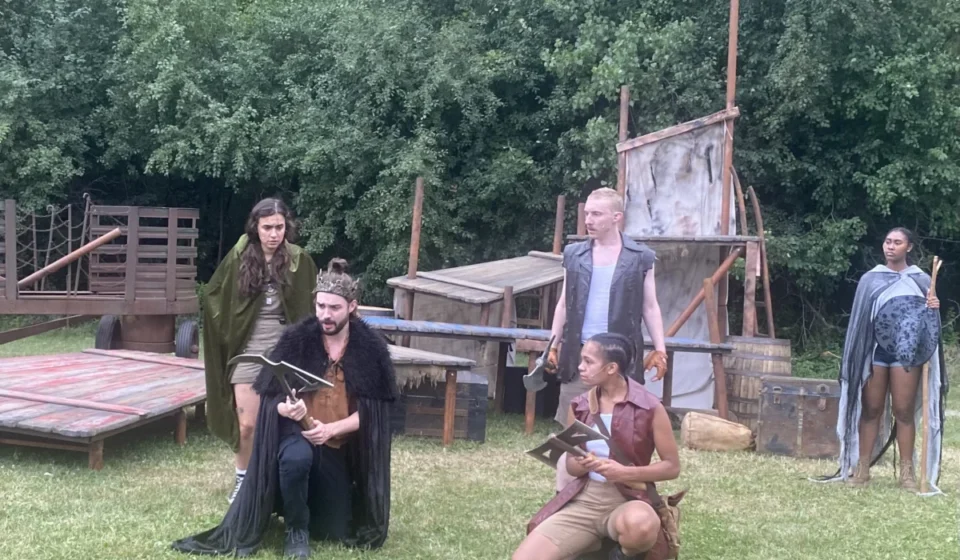
Sigmund’s directorial style mirrors Banks’ script: it is droll, unpretentious, and deeply physical. The production eschews big-budget CGI and complex sets in favor of creative, ensemble-based storytelling. For instance, the illusion of galloping horses is conjured through the actors’ physical movements and percussive sound effects rather than elaborate machinery.
The ensemble of five performers operates with a high degree of fluidity, frequently shifting between multiple roles. This "economical" approach extends to the costuming, which utilizes singular, emblematic pieces to denote character shifts, and the prop design, where simple cylinders serve as wine barrels in the iconic escape sequence. The goblin masks, while simple, provide a hauntingly effective aesthetic that proves theater need not be expensive to be immersive.
Casting and Gender Dynamics: A Fresh Perspective
Perhaps the most striking departure from Tolkien’s original text is the gender-fluid casting. In this iteration, the roles of Bilbo Baggins and the wizard Gandalf are portrayed by Grace Hillmyer and Antonisia Collins, respectively, while the dwarf Balin is played by Anya Naylor.
This decision serves a dual purpose: it opens up historically male-dominated fantasy roles to women and injects a fresh tonal quality into the narrative. Collins provides a grounded, savvy sense of calm to Gandalf, while Hillmyer imbues Bilbo with a palpable, empathetic vulnerability. During a moment of crisis, her delivery of the line, "I’m here because right now it’s the right time to do what’s right," feels earnest and urgent.
This casting choice has also sparked broader conversations regarding the role of fantasy in modern culture. As audiences become increasingly conscious of the political stances of the creators they support, many are seeking alternatives to franchises entangled in controversy. For those disillusioned by authors like J.K. Rowling, who has publicly committed future earnings to anti-trans advocacy, the Zephyr Theatre’s inclusive, welcoming production offers a safe and morally resonant alternative to the fantasy genre.

Performance Analysis: The Ensemble’s Heavy Lifting
The success of the production rests on the shoulders of its five-person cast. Jeffrey Nolan, in particular, demonstrates remarkable versatility. As the dwarf Kili, he is gruff and suspicious; as the villainous Gollum, he channels the manic intensity of Andy Serkis; and as the dragon Smaug, he strikes a balance between menacing and impishly silly. His ability to navigate these rapid-fire costume and character changes is a testament to the high-caliber talent currently gracing the outdoor stage.
However, the production is not without its minor imperfections. The musical choices—featuring folk classics from artists such as Peter, Paul and Mary, Simon and Garfunkel, and John Denver—often feel disjointed. While songs like "Puff the Magic Dragon" are thematically linked to the narrative, the inclusion of tracks like "Country Roads" feels incongruous with the fantasy setting. While performer Sophia Schott is a talented vocalist, the curation and timing of the soundtrack currently act as a distraction rather than a support to the story’s "vibe."
The Setting: An Immersive Escape
The choice of venue—Aamodt’s Apple Farm in Stillwater—is a masterstroke of atmospheric production. The stage is nestled in a clearing overlooking a wooded area, providing a natural, enchanting backdrop that requires very little set design to be convincing.
Before the show, visitors are encouraged to lean into the full experience of the farm. From apple picking to sampling local refreshments at Saint Croix Vineyards and Thor’s Hard Cider, the venue offers a community-centered atmosphere that extends well beyond the performance. The availability of bakery items, apple brats, and local delicacies makes for a perfect summer outing.
Implications for the Local Theater Scene: Dinner and a Show
The Zephyr Theatre’s The Hobbit is part of a larger trend in Minnesota of pairing high-quality theater with sophisticated dining experiences. This summer, the Guthrie Theater in Minneapolis has also leaned into this model with the opening of Indígena by Owamni, a new restaurant helmed by Sean Sherman.
Following a performance of Noël Coward’s Private Lives—a biting, dark farce—patrons can now head to the theater’s restaurant to decompress. The juxtaposition of the Guthrie’s polished, classic repertoire with the indigenous-inspired, modern flavors of Indígena highlights a maturation in the local arts scene. Discussing the intricacies of a production—even one with as many problematic romantic tropes as Private Lives—while enjoying maple and sumac glazed venison skewers or smoked whitefish tostadas, marks a significant shift in how audiences engage with theater in the Twin Cities.
Conclusion and Ticketing Information
The Zephyr Theatre’s production of The Hobbit is a reminder of the power of simplicity and the necessity of community-focused art. By grounding a classic myth in a local, accessible setting and inviting a diverse range of voices to inhabit the roles, the production has created something that is both nostalgic and forward-looking.
Upcoming Performances:
- Thursday, July 30, at 7 p.m.
- Friday, July 31, at 7 p.m.
- Saturday, August 1, at 2 p.m. and 7 p.m.
- Sunday, August 2, at 2 p.m.
Location: Aamodt’s Apple Farm & Saint Croix Vineyard, 6428 Manning Ave N., Stillwater.
Pricing: $42 for a chair seat; $37 to bring your own chair (adults); $21 to bring your own chair (ages 10 and under).
For more information, please visit Stillwater Zephyr Theatre. Whether you are a die-hard Tolkien fan or simply looking for a quiet, mythic escape from the heat of a Minnesota summer, the Zephyr’s latest offering is a journey well worth taking.