








































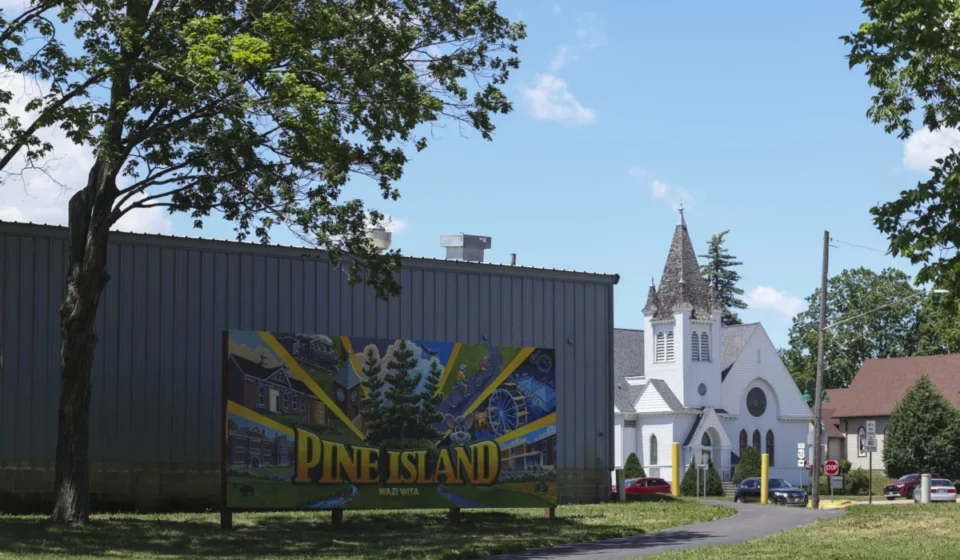

PINE ISLAND, Minn. – Driving down a quiet dirt road that hugs a vast expanse of farmland, Aubree Derksen articulates a sentiment shared by a growing number of Minnesotans: a feeling of being a modern-day David confronting a technological Goliath. Her Goliath is Google, the omnipresent tech titan, which, in collaboration with a developer, plans to transform this serene rural landscape into a hyperscale data center. From her nearby home in Pine Island, prominently adorned with anti-data center signage, Derksen has become a vocal leader in the local opposition, her determination echoing through the tranquil countryside.
Derksen is not alone. She has garnered allies not only within Pine Island but also across the state, forming a robust grassroots coalition. This diverse group of Minnesotans is actively working to halt similar projects in various cities, including Farmington, Hermantown, and Monticello, among others. Their unified message is clear: local governments, often swayed by the allure of economic development, are failing to adequately address resident concerns regarding the significant health, environmental, and resource-management risks associated with these colossal digital infrastructures.
Despite their fervent protests and organized efforts, many proposed developments have swiftly navigated local regulatory processes over the past two years. The only instances of successful pauses have come through court orders, as seen in Pine Island and Faribault, offering temporary reprieves. At a higher legislative level, a host of bills introduced last session, aimed at reining in data center proposals through moratoriums and greater transparency, ultimately failed to pass. "That was incredibly disappointing," Derksen stated, reflecting on the legislative setbacks.
However, the upcoming campaign season has ignited a new sense of purpose. With city, county, and state offices on the ballot across Minnesota this fall, Derksen and her allies view data centers as a pivotal election issue, capable of reshaping political landscapes. "This is the new single-issue voter," she declared. "It’s not going to be abortion or LGBTQ or immigration issues. I think it’s going to be data centers, and I think that’s something both parties are going to have to reckon with."

The Unfolding Battle: Main Facts
The core of the conflict revolves around the rapid expansion of hyperscale data centers across Minnesota, driven by the increasing demand for cloud computing, artificial intelligence, and digital services. Tech giants like Google and Meta, alongside developers such as Ryan Companies, are eyeing Minnesota for its relatively affordable land, stable power grid, and access to water resources. However, these benefits for corporations translate into significant concerns for local communities.
Residents, organized into groups like the Coalition for Responsible Data Center Development, are raising alarms over several key issues:
- Environmental Impact: Massive water consumption for cooling, placing strain on local aquifers and potentially impacting agricultural and natural ecosystems.
- Energy Demand: Enormous electricity usage, taxing existing grids, potentially increasing reliance on fossil fuels, and contributing to carbon emissions, even with attempts at green energy sourcing.
- Quality of Life: Noise pollution from constant cooling systems, light pollution from extensive security lighting, disrupting rural tranquility and dark skies.
- Economic Promises: Skepticism regarding the long-term economic benefits, with many jobs being temporary construction roles and property tax revenues potentially dwindling over time, leaving behind "empty industrial buildings."
- Transparency: Concerns over Non-Disclosure Agreements (NDAs) signed by local officials, which obscure project details from public scrutiny and erode trust.
The grassroots movement, initially disparate, has coalesced into a formidable force, leveraging local elections and state party conventions to push their agenda. Their objective is to elect officials at all levels who are committed to imposing moratoriums, implementing stricter regulations, and prioritizing community and environmental well-being over unchecked industrial development.
A Chronology of Conflict and Mobilization
The seeds of the current political reckoning were sown months ago, as residents across Minnesota began to grasp the scale and implications of the proposed data center projects.

The first whispers of large-scale data center developments often emerged under code names, such as Google’s "Project Skyway" in Pine Island and "Project Loon" in Hermantown. These clandestine beginnings, frequently shrouded by Non-Disclosure Agreements between developers and local government officials, immediately bred distrust among residents. As details slowly surfaced, communities started to organize, initially at the local level through town hall meetings and online forums.
Over the past two years, despite mounting vocal protests from residents, many of these projects "hummed through local regulatory processes." Local planning commissions and city councils, often swayed by promises of job creation and increased tax revenue, approved zoning changes and permits, seemingly impervious to public outcry. This rapid progression often left residents feeling unheard and marginalized.
However, legal challenges provided crucial, albeit temporary, brakes. Court orders forced pauses in proposed developments in Pine Island and Faribault, offering a glimmer of hope and validating some of the residents’ procedural concerns. These legal victories demonstrated that the process was not entirely unchallengeable.
Seeking more systemic change, activists turned their attention to the state Legislature during the last session. A series of bills were introduced, aiming to impose statewide moratoriums on new data center construction or, at minimum, to mandate greater transparency and stricter environmental reviews. To the dismay of the burgeoning movement, these legislative efforts ultimately failed to advance, leaving activists "incredibly disappointed" and highlighting the entrenched interests supporting such developments.

Undeterred, the movement recognized the upcoming election cycle as a new battleground. The intensity of this issue became palpable at the DFL (Democratic-Farmer-Labor) and GOP (Republican) state conventions held last month. Aubree Derksen, a former Minneapolis resident who moved to Pine Island for its rural charm, became a first-time delegate, driven by her opposition to Project Skyway. Similarly, Cathy Johnson, a retired teacher turned activist against a project in Farmington, found herself deeply immersed in political organizing. "I was really enjoying my retirement," Johnson remarked, "It just felt like these are such egregious projects that I could not just sit by. I needed to be involved."
At the DFL convention, two data center resolutions garnered significant support on platform ballots. A resolution advocating for a moratorium received 64% of the votes, while a more tempered resolution focusing on tighter regulations, considered more palatable to labor unions, secured 76%. This demonstrated a clear shift in party sentiment, even among factions with differing priorities.
The Republican convention, while perhaps less overtly focused on data centers than its DFL counterpart, also reflected the growing concern. Platform committee members adopted a resolution calling for a "data center pause," indicating a bipartisan recognition of the issue’s gravity.
These convention outcomes underscore the shift in political strategy: from legislative advocacy to direct electoral engagement. The resignation of Pine Island Mayor David Friese last week, citing work changes, further opens up local political opportunities. Residents are actively identifying and supporting candidates for the three city council seats and the mayoral race this fall, aiming to elect officials who will champion their cause.

Supporting Data and Deeper Concerns
The grassroots opposition to data centers is rooted in concrete concerns, supported by growing evidence and expert analysis regarding the environmental, resource, and social impacts of these facilities.
Water Consumption: Hyperscale data centers are notoriously thirsty. They require vast quantities of water for their cooling systems, often drawing millions of gallons daily from local municipal supplies or directly from natural bodies of water. This heavy demand can strain local aquifers, deplete natural resources, and compete with agricultural needs and residential consumption, especially in regions already facing water scarcity or drought conditions. Critics argue that diverting such large volumes of water for corporate data storage is an unsustainable practice, threatening the long-term ecological balance and water security of communities.
Energy Footprint: Beyond water, data centers are immense energy consumers. A single hyperscale facility can require as much electricity as a small city, putting significant strain on existing power grids. While many tech companies pledge to power their data centers with renewable energy, the sheer scale of demand often necessitates reliance on existing fossil fuel-based grids, at least partially. This can lead to increased carbon emissions, even if indirectly, and can place a heavy burden on utility infrastructure, potentially leading to higher energy costs for residents. The constant need for uninterrupted power also raises questions about energy resilience and grid stability.
Noise and Light Pollution: For residents like Aubree Derksen, who moved to Pine Island for its quiet, rural atmosphere, the threat of noise and light pollution is deeply personal. Data centers operate 24/7, with powerful cooling fans and generators creating a persistent, low-frequency hum that can be highly disruptive to residential areas. The extensive security lighting required for these facilities can also obliterate dark skies, impacting stargazing and the natural nocturnal environment. Derksen’s concern about "Project Skyway" being less than a mile from her home highlights the immediate degradation of her quality of life: "If this were to get built, with the noise, with the light, are we still going to be able to hear the birds? We can’t afford to move, so we don’t have an escape plan."

Skepticism on Economic Benefits: Mayor Tom Berg of Lonsdale, a city that recently imposed a moratorium on new data centers, articulates a common skepticism regarding the economic promises made by developers. While initial construction phases do create temporary jobs, the long-term operational workforce for data centers is typically small and highly specialized. Berg warns against "praying for a boom," suggesting that the long-term property tax revenue, while initially attractive, might not be sustainable. He fears cities could be left "overextended with an empty industrial building" if the economic landscape shifts or if the projected revenues fail to materialize. This raises questions about fiscal responsibility and prudent urban planning.
Erosion of Public Trust through NDAs: A significant point of contention has been the widespread use of Non-Disclosure Agreements (NDAs) by developers to keep projects secret during initial planning stages. Mayor Berg testified at the Capitol against such practices, arguing that NDAs erode public trust in government institutions by shielding critical information from residents. This lack of transparency prevents communities from engaging in informed discussions and raises suspicions about what developers and officials might be trying to hide.
Bipartisan Concern: An Ipsos poll underscored the bipartisan nature of these concerns. While Democrats expressed greater concern about environmental impacts, a significant number of Republicans also shared similar sentiments. The poll concluded that "partisan rifts on data centers come from unsurprising areas. Republicans have a stronger inclination for a more free-market approach, while Democrats are more cautious about environmental impacts. And while Republicans are slightly more optimistic about data centers, overall support for their construction remains low." This polling data confirms that data centers are not a narrowly partisan issue but rather a broad community concern, making them a potent force in elections.
Official Responses: From Indifference to Action
The response from official channels has been varied, reflecting the complex interplay of economic development pressures, environmental concerns, and local autonomy.

Initially, many local governments across Minnesota appeared "charmed by the promises of economic development." The allure of substantial property tax revenues and job creation often led city councils and planning boards to fast-track approvals for data center projects, sometimes with minimal public engagement or thorough environmental impact assessments. This top-down approach, often facilitated by NDAs, left residents feeling sidelined and unheard.
At the state legislative level, the response has been largely one of inaction. Despite the efforts of activists and supportive lawmakers, bills seeking moratoriums or increased transparency failed to pass in the last session. This legislative inertia highlighted the powerful lobbying efforts by tech companies and utility providers, as well as the divided opinions even within the DFL party, where pro-business moderates and labor groups sometimes clash with environmental advocates. Sarah Mooradian, government relations and policy director at CURE, a nonprofit tracking data center issues, noted the DFL platform votes were "a pretty good indicator of what’s happening statewide," confirming the bipartisan concern despite legislative gridlock.
However, some local governments have demonstrated a willingness to pause and reconsider. Rosemount, a southeast Twin Cities suburb, provides a notable example. While Meta is actively constructing a data center there, the city subsequently imposed a moratorium on any new projects beyond the current one. This proactive step signals a recognition of the need to manage growth and assess long-term impacts.
Lonsdale, a city approximately 40 miles south of Minneapolis, followed suit, imposing a one-year moratorium in May. Mayor Tom Berg explained that the city observed other communities rushing into agreements without adequate regulations, and Lonsdale chose a different path. "It was easy for us to take that pause and enact it now, and then start really pushing forward with regulations with community feedback," he said. Mayor Berg has also been an outspoken advocate at the Capitol, testifying in favor of a bill banning local officials from signing NDAs, emphasizing their detrimental effect on public trust.

The recent state party conventions also represent a shift in official political discourse. The strong support for moratoriums and stricter regulations within both DFL and GOP platforms signals that politicians are increasingly recognizing the political potency of the data center issue. This indicates that while legislative action has been slow, the political landscape is changing, making candidates more accountable to resident concerns.
Implications for Minnesota’s Future
The intensifying debate over data centers carries profound implications for Minnesota’s communities, its political landscape, and its environmental future.
For residents like Aubree Derksen and Rodney Lanners, the stakes are intensely personal. Derksen, who moved to Pine Island six years ago for its small-town charm and proximity to nature, fears the loss of her community’s character. She cherishes the ability to monitor native plants, birds, and pollinators in her backyard, to witness the Northern Lights from her patio, and to observe a bald eagle’s nest near a local cemetery. The proposed "Project Skyway" threatens this idyll with its potential for constant noise and light pollution, raising the poignant question: "Are we still going to be able to hear the birds?" With no "escape plan," her fight is for the preservation of her home and way of life.
Rodney Lanners, a 74-year-old Pine Island resident of 53 years, echoes this sentiment. From his backyard, he enjoys watching raptors soar and songbirds visit his feeders. "I’m a little bit in heaven here," he says of his home. The prospect of a data center altering this cherished environment galvanizes him, despite his preference for tending to his projects over attending public meetings. Both Derksen and Lanners represent a broader segment of the population for whom data centers symbolize a fundamental threat to their community’s identity and the natural environment they value.

The power imbalance in this struggle is stark. Grassroots activists, operating on limited resources, are pitted against global tech giants like Google and Meta, along with powerful developers and energy companies. The anecdote of Google, Ryan Companies, and Xcel Energy being "platinum sponsors" at Pine Island’s annual Cheese Festival subtly illustrates the financial might arrayed against local opposition. This disparity in resources makes electoral engagement even more critical, as it offers a democratic avenue to counterbalance corporate influence.
The upcoming elections, from city councils to state legislative races, are now seen as crucial battlegrounds. In Pine Island, the three City Council seats and the mayoral race present a direct opportunity for residents to elect officials aligned with their views. Similar efforts are underway in Hermantown, Farmington, and other affected communities. Activists like Cathy Johnson are actively supporting candidates who promise a more critical approach to data center development, such as Mark Legvold, the DFL challenger to Republican Sen. Bill Lieske in a key battleground district. Rebecca Gilbertson’s group in Hermantown is also "doing everything we can to make it an election issue."
This movement signifies a broader trend: a growing public awareness and skepticism regarding the unbridled expansion of industrial infrastructure, particularly when it impacts quality of life and environmental sustainability. It’s a powerful testament to how seemingly local issues can coalesce into significant statewide political forces, compelling candidates and parties to address concerns that might otherwise be overlooked. The outcome of these local and state elections will not only determine the fate of specific data center projects but also set precedents for how Minnesota balances economic development with environmental stewardship and community well-being in an increasingly digital world. For many Minnesotans, the fight against data centers is not just about a building; it’s about defining the future character of their home.