





















































Microsoft Teams Bolsters Security: New AI-Driven Phishing Detection Set for November Launch

In an era where remote and hybrid work environments have become the standard for global enterprise, Microsoft Teams has cemented its position as a primary hub for digital collaboration. However, this ubiquity has also transformed the platform into a lucrative hunting ground for cybercriminals. To combat the rising tide of sophisticated social engineering, Microsoft has announced a significant upgrade to its security infrastructure: an AI-powered, context-aware phishing detection tool designed to analyze the behavioral nuances of conversations within Teams.
The initiative, first reported by Bleeping Computer, marks a shift in how Microsoft handles platform security. By moving beyond traditional signature-based detection—which focuses primarily on malicious links or known malware payloads—the new tool employs advanced heuristics to identify suspicious communication patterns. The feature is slated for an automated global rollout beginning in November 2026.
Main Facts: A New Paradigm for Platform Defense
The core of Microsoft’s new strategy lies in "context-aware" intelligence. Traditional security filters are often static, scanning for known bad actors or blacklisted domains. The new AI-driven mechanism, conversely, acts as a behavioral analyst. It monitors the cadence, intent, and legitimacy of interactions, specifically targeting the vulnerabilities inherent in "new contact" scenarios.
How the Technology Functions
According to internal documentation, the AI engine evaluates the behavior of the messenger. If an external user initiates a conversation that mimics the tone or urgency of an internal help desk or a C-suite executive, the system will flag the interaction. This is particularly vital for mitigating "business email compromise" (BEC) style attacks, which have migrated from email to instant messaging platforms.
Scope of the Rollout
- Target: All Microsoft Teams enterprise users.
- Key Focus: Conversations originating from outside an organization’s verified tenant.
- Automation: The feature is "opt-out" by design, meaning IT administrators do not need to configure or toggle the system; it will be enabled automatically.
- Timeline: Deployment begins in early November 2026, with full general availability projected for the first half of December 2026.
Chronology: The Evolution of Teams Security Threats
The development of this tool is not a reactive whim but a calculated response to a multi-year trend of exploitation targeting Teams users.
The Rise of the "Fake Help Desk"
Throughout 2024 and 2025, security researchers documented an alarming uptick in attackers successfully impersonating enterprise IT support staff. By creating external Teams accounts that mirror legitimate internal support naming conventions, attackers have been able to trick employees into granting remote access to corporate workstations.
The 2025 Security Audit
Following a string of high-profile enterprise intrusions, Microsoft launched an internal audit of the Teams architecture. The findings highlighted a "trust gap": employees were conditioned to trust the internal Teams environment more than external email. Attackers exploited this psychological shortcut, using the platform’s trusted status to bypass traditional email-based spam filters.
Development and Validation (Q1–Q3 2026)
Microsoft spent the better part of 2026 testing the AI models. During this phase, the system ran in a "shadow mode," observing message traffic without alerting users to ensure that false-positive rates remained within acceptable enterprise thresholds.
Supporting Data: Why Behavioral Analysis is Necessary
To understand the necessity of this tool, one must look at the data surrounding modern social engineering. According to various cybersecurity threat intelligence reports, social engineering attacks have seen a 45% increase in frequency on collaboration platforms compared to the previous two-year period.
The Vulnerability of External Federations
Teams allows organizations to federate, enabling external collaboration. While this drives productivity, it creates a massive attack surface.
- 82% of observed Teams-based attacks in 2025 originated from external accounts masquerading as internal entities.
- 60% of successful intrusions occurred within the first 30 minutes of the initial contact, highlighting the effectiveness of urgency-based phishing.
Privacy and AI Ethics
A common concern for enterprise IT departments is the privacy of internal communications. In a Microsoft 365 Message Center post, the company addressed these concerns directly. Microsoft has clarified that:
- No message retention: Conversations flagged as suspicious are analyzed in real-time.
- No training loops: Messages analyzed by the tool are not used to train Microsoft’s larger Large Language Models (LLMs).
- Strict Purpose Limitation: The data processing is exclusively for security purposes. It is explicitly prohibited from being used for user surveillance, productivity monitoring, or advertising.
Official Responses and Privacy Assurances
Microsoft’s commitment to privacy has been a central pillar of their messaging regarding this update. The company is acutely aware that enterprise clients are sensitive to "Big Brother" concerns.
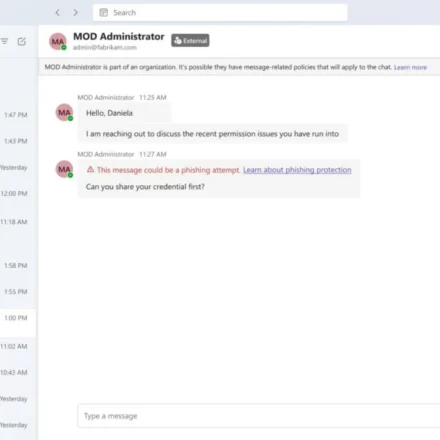
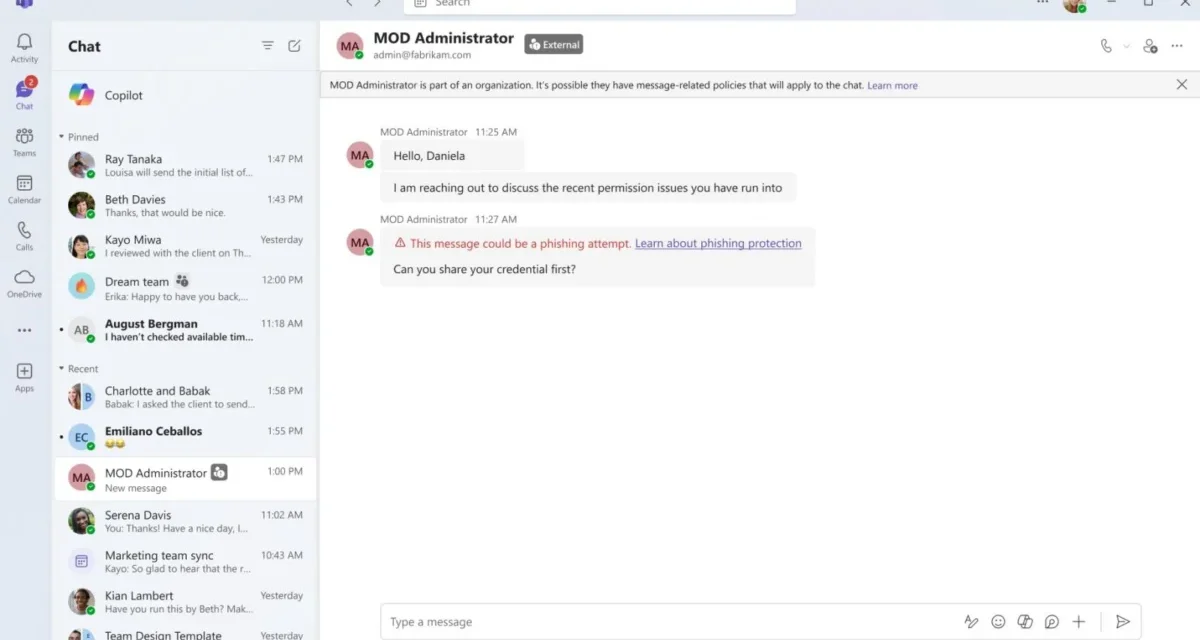
"During initial quality validation, detection may run in the background without showing warnings to users," the company noted in its official communication. "After validation, users may see a warning when potential phishing is detected."
This staggered approach is designed to ensure that when the tool finally goes "live" for the end-user, the warning system is calibrated to minimize disruption. IT teams are being encouraged to review their internal security policies to ensure that employees know how to respond to these new warnings—specifically, how to report the flagged contact to the internal security operations center (SOC).
Implications: The Future of Enterprise Collaboration Security
The deployment of this feature will have profound implications for both cybersecurity professionals and the average knowledge worker.
For IT Departments and SOCs
For the security operations center, this is a force multiplier. Previously, SOC teams had to rely on user reports of phishing to initiate investigations. With this new tool, the platform itself provides telemetry. The AI will likely generate metadata that IT teams can use to block malicious domains or rogue external tenants across the entire enterprise, creating a proactive, rather than reactive, security posture.
For the End-User
For the average employee, the warning banner will become the new "red flag." Similar to how modern browsers warn users about insecure websites, the Teams interface will now offer a visual cue regarding the trustworthiness of a chat. This shift puts the onus of verification on the system rather than the user’s intuition, which is a significant win for human-centric security.
The Broader Market Impact
Microsoft’s move sets a new industry standard. Competitors such as Slack (Salesforce) and Zoom are under increasing pressure to implement similar "context-aware" detection layers. As AI becomes a standard component of communication platforms, the baseline for what constitutes "secure software" is rising.
Challenges and Limitations
Despite the promise of AI, no system is infallible. Adversaries are already exploring ways to "jailbreak" or confuse AI detection models by using obfuscated text or image-based social engineering. Microsoft’s challenge will be to ensure that as attackers pivot their tactics, the underlying AI models are updated with enough velocity to maintain the platform’s integrity.
Conclusion
As Microsoft Teams continues to evolve, the integration of AI-driven phishing detection represents a critical maturation of the platform’s security model. By focusing on the behavioral aspects of human interaction, Microsoft is addressing the most dangerous vulnerability in any organization: the user. While no single feature can eliminate the risk of social engineering, this automated, intelligence-led approach offers a significant layer of defense in an increasingly dangerous digital landscape. As the November rollout approaches, enterprises are encouraged to prepare their staff for the new visual warnings, ensuring that the technology is treated not as a replacement for vigilance, but as a powerful partner in the ongoing effort to secure the digital workplace.