























































The Paraquat Papers: Inside the Decades-Long Corporate Campaign to Keep a Controversial Pesticide Afloat

For over forty years, the global consensus on the toxic herbicide paraquat has been shifting toward a definitive conclusion: it is a public health hazard that has no place in modern agriculture. Since Sweden pioneered the first national ban on the chemical in 1983, over 70 countries—including the entire European Union and, notably, China, the primary home of paraquat manufacturer Syngenta—have prohibited its use.
Yet, in the United States, the Environmental Protection Agency (EPA) has consistently greenlit the chemical, allowing its application on millions of acres of farmland. Now, a massive cache of internal corporate documents, totaling approximately 3,700 pages and revealed through recent civil litigation, offers a disturbing look at how this persistence was maintained. The files suggest that while the rest of the world was moving toward bans, Syngenta engaged in a sophisticated, multi-decade campaign to discredit scientific warnings, suppress internal safety data, and maintain its grip on the lucrative U.S. market.
The Chronology of a "Blockbuster" Defense
The history of paraquat is not merely a story of a chemical; it is a case study in corporate regulatory capture. Since its introduction in the 1960s, paraquat has been a cornerstone of industrial farming, used primarily for weed control and crop desiccation. However, as the 21st century dawned, the emergence of credible research linking paraquat exposure to Parkinson’s disease—an incurable, progressive neurodegenerative disorder—threatened the product’s viability.

- 1983: Sweden enacts the first national ban on paraquat, citing significant health risks.
- 2000–2018: Despite growing global opposition, paraquat usage in the U.S. nearly triples, as Syngenta intensifies its domestic market strategy.
- 2007: The European Union bans paraquat following extensive evidence of neurotoxicity.
- 2012–2016: China, recognizing the extreme toxicity risks after conducting independent government studies, implements a full ban on the chemical.
- 2021: Facing mounting litigation, Syngenta reaches a $187 million settlement in U.S. courts, though it admits no liability.
- 2026: Syngenta announces it will halt global production of paraquat, citing "market factors" rather than health concerns.
Suppressing the Science: The "Secret" Data
The internal documents submitted to a Pennsylvania state court—where hundreds of lawsuits from Parkinson’s patients are currently being litigated—reveal that Syngenta possessed significant data that it failed to disclose to the EPA. Federal law, specifically the Federal Insecticide, Fungicide, and Rodenticide Act (FIFRA), requires manufacturers to report any "unreasonable adverse effects" their products may cause.
The newly surfaced files show that the company’s internal understanding of paraquat’s risks often contradicted its public-facing assurances. Key omissions include:
1. Surfactant Toxicity and Absorption
For decades, Syngenta labels have recommended that farmers mix paraquat with surfactants to improve efficacy. However, internal company research dating back to the 1970s acknowledged that mixing these agents significantly increased the chemical’s toxicity, particularly its ability to permeate the skin and enter the bloodstream. A 1975 internal letter explicitly noted that registering a product pre-mixed with surfactants was "very undesirable due to increased toxicity." Yet, the company continued to advocate for surfactant use while failing to disclose the full scope of their own animal studies demonstrating the dangers of this combination.

2. The "Brush Aside" Strategy
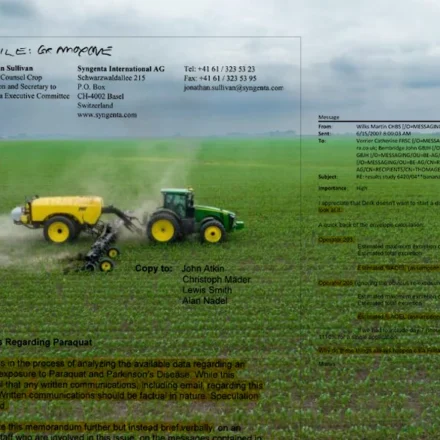
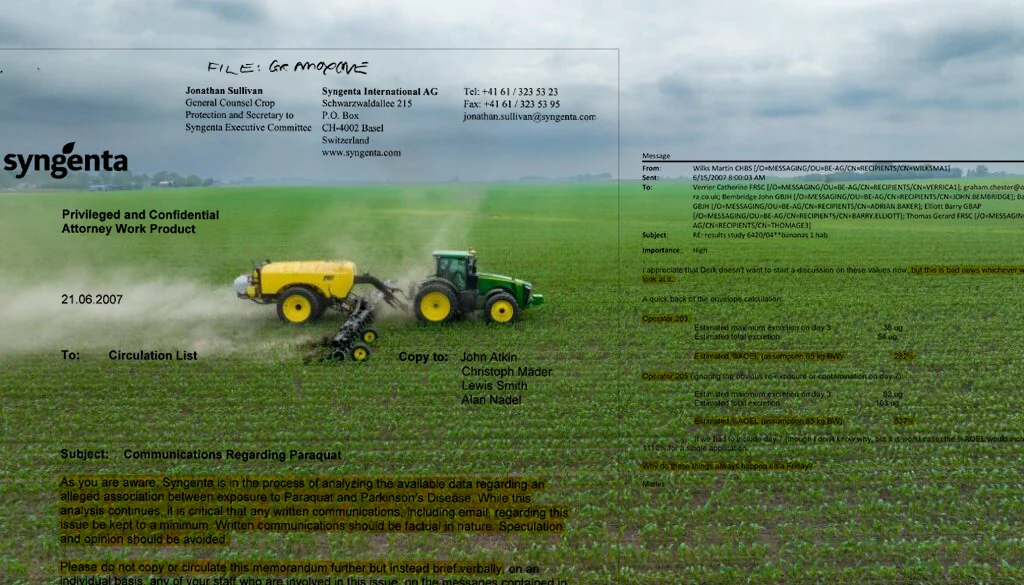
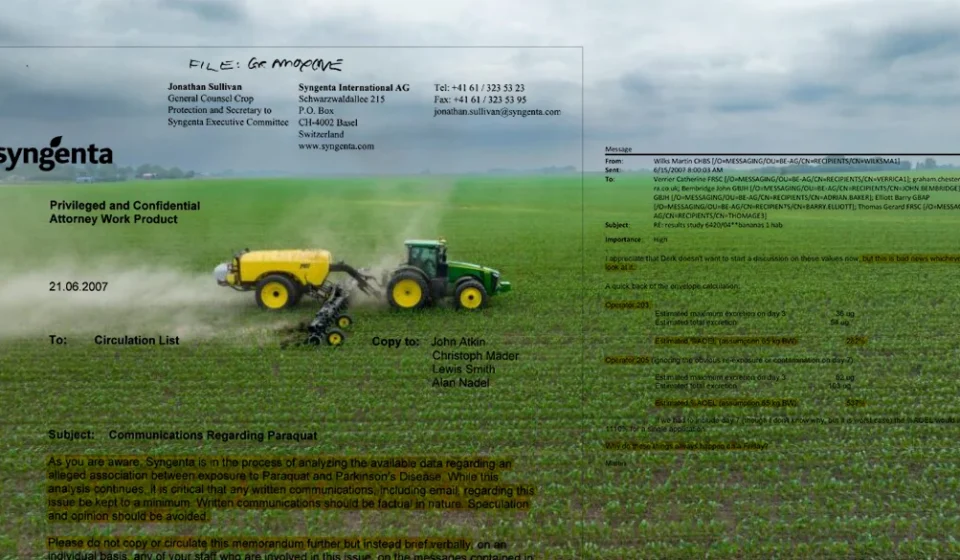
Perhaps most damning is the company’s coordinated effort to undermine outside science. In a 2001 strategy document, executives stated, "Our efforts will be to steer the focus of serious research away from paraquat and on to other agents." By 2008, internal emails explicitly discussed the goal of "brushing aside" ten years of research by independent scientists and replacing it with company-sponsored data that was "dead solid airtight."
3. Ghostwritten Research and Managed Outcomes
The records detail how Syngenta utilized contract research organizations like Exponent to produce "independent" studies. In one instance, scientists discussed revising and improving a manuscript to be published under an outside researcher’s name, specifically noting that communication should occur "verbally" to avoid leaving a paper trail that would suggest corporate influence. One senior scientist confirmed a $160,000 contract for one such study, which was later cited to discount the findings of government-funded research that had identified a link between paraquat and Parkinson’s.
The Regulatory Failure: The EPA’s Role
The EPA has long maintained that there is "no clear link" between paraquat and Parkinson’s disease, basing its assessments on an "extensive database of information." However, critics argue that this reliance is the system’s greatest vulnerability. By depending almost entirely on data provided by the companies they regulate, the EPA created an environment where the "full universe of data" was never actually evaluated.

Dr. Ted Schettler, science director for the Science and Environmental Health Network, argues that the EPA’s failure to conduct independent testing—unlike the Chinese government—has had catastrophic public health consequences. "This story illustrates the public health risks of allowing the US EPA to be the sole arbiter of pesticide safety," Schettler said. "Untold numbers of people could have been prevented from developing Parkinson’s disease if the agency had done its job of protecting public health."
Furthermore, the recent Supreme Court ruling declaring the EPA as the preemptive authority for pesticide labeling has added a new layer of concern. If companies can effectively influence the EPA’s regulatory stance through the strategic withholding of data, they effectively shield themselves from legal accountability across the entire country.
Official Responses and Corporate Defenses
Syngenta continues to maintain that its actions were appropriate and compliant with all regulatory requirements. In a statement, a spokesperson for the company asserted that Syngenta has never "knowingly failed to provide regulators with relevant and required information" and that the documents cited in litigation were not relevant to U.S. regulatory oversight. The company maintains that its decision to stop production was based purely on market shifts, not health liability, and that studies showing a link to Parkinson’s are inconclusive.

The EPA, for its part, stated that it "cannot speculate" on how the omitted information would have changed its assessments. Agency officials noted that the review of paraquat is "ongoing" and reiterated that companies are legally obligated to submit all data regarding adverse effects. "If information exists that has not been submitted to EPA, EPA wants it," the agency said in a statement, emphasizing that failure to comply is a "direct violation of federal law."
Implications for Public Health and Future Oversight
The implications of the "Paraquat Papers" extend far beyond a single herbicide. They raise fundamental questions about the integrity of the U.S. regulatory system for all agricultural chemicals.
When a multi-billion dollar corporation can essentially "manage" the science that governs its own products, the precautionary principle—the idea that if an action has a suspected risk of causing harm to the public, the burden of proof that it is not harmful falls on those taking the action—is effectively abandoned.

Tracey Woodruff, a professor of epidemiology at the Stanford University School of Medicine, summarized the ethical crisis succinctly: "When the pesticide companies know from their own studies that their pesticides are harmful and don’t tell the public or regulators, then they are knowingly contributing to people getting sick and dying."
As litigation continues and more internal documents come to light, the paraquat saga will likely be remembered as a pivotal moment in the movement for stricter chemical oversight. It serves as a stark reminder that in the absence of independent, rigorous, and transparent scientific review, corporate profit motives can, and often do, eclipse the fundamental right of the public to a safe environment. Whether the EPA will reform its reliance on industry-funded data or remain a passive recipient of corporate-curated science remains the central, unresolved question of this ongoing crisis.