

























































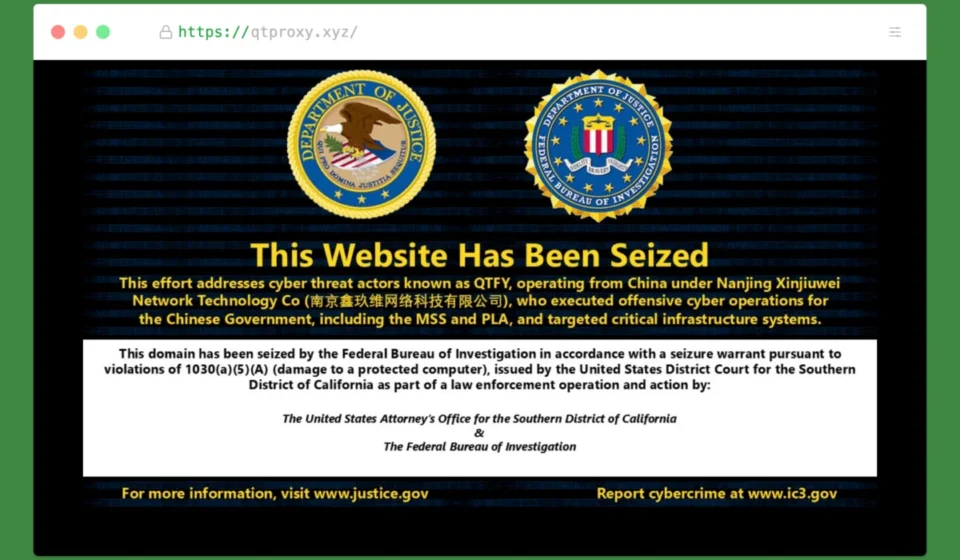
Cyber Siege: FBI Dismantles Massive China-Linked Botnet Targeting U.S. Critical Infrastructure

In a landmark maneuver to counter the escalating threat of state-sponsored cyber warfare, the U.S. Department of Justice and the Federal Bureau of Investigation (FBI) have successfully seized control of a vast network of internet domains. This infrastructure served as the backbone for "QTFY," a sophisticated, China-backed botnet responsible for years of surreptitious cyberattacks against high-value American targets.
The operation, which rendered the botnet’s command-and-control (C2) servers inoperable, represents a significant blow to the operational capacity of Chinese state-linked hackers. By severing the communication links hardcoded into the botnet’s architecture, U.S. authorities have effectively neutralized a digital weapon that had been weaponized against hospitals, defense contractors, and core federal agencies.
The Anatomy of the QTFY Botnet
At the center of this investigation is a Chinese private entity known as Nanjing Xinjiuwei Network Tech. According to federal prosecutors, this firm served as the architect and operator of the QTFY botnet—a sprawling collection of thousands of compromised internet-connected devices (IoT) spread across the globe.
The primary function of the QTFY network was obfuscation. By routing malicious traffic through these thousands of hijacked devices, the operators were able to mask their true origin, making it exceptionally difficult for domestic cybersecurity teams to distinguish between legitimate traffic and state-sponsored espionage. This "proxy" model is a hallmark of modern advanced persistent threats (APTs), designed specifically to ensure that the fingerprints of state intelligence agencies remain hidden beneath layers of commercial and residential device traffic.
The Justice Department’s filings detail a disturbing "hacking-as-a-service" model. Nanjing Xinjiuwei did not merely use the botnet for its own ends; it marketed the network to other malicious actors, including operatives directly affiliated with China’s Ministry of State Security. This symbiosis between private-sector contractors and government intelligence illustrates the "state-enablement model" that has become a defining feature of China’s cyber strategy over the last decade.
Chronology of Compromise: A Multi-Year Campaign
The reach of the QTFY botnet was extensive, impacting the most sensitive sectors of the United States economy and governance. The campaign, which authorities believe dates back to at least 2018, was characterized by persistence and patient data exfiltration.
2018–2025: Establishing the Footprint
For seven years, the botnet operated in the shadows. The list of victims reads like a blueprint of American strategic interests. Federal agencies impacted by the campaign include the Department of Energy, the Department of Justice, and the Department of Health and Human Services. Even the Federal Reserve and NASA fell victim to the intrusion, highlighting the broad scope of the Chinese intelligence-gathering effort.
2026: The Height of Intrusion
The severity of the threat reached a breaking point in 2026. According to court affidavits filed earlier this week, the penetration extended into the highest levels of the U.S. legislative branch. The U.S. Senate was compromised as recently as 2026, a development that forced a rapid escalation in the FBI’s remediation efforts. The realization that the botnet was being used to target the seat of American democracy provided the final impetus for the judicial authorization required to seize the domains.
Supporting Data: Infrastructure and Intelligence
The success of this operation was not solely the result of FBI investigations; it relied on the collaborative efforts of private-sector telecommunications giants. Network security firm Lumen Technologies played a pivotal role in uncovering the scope of the threat.
In a comprehensive technical report, Lumen researchers described observing the hackers systematically profiling and targeting government agencies, the defense sector, and the aerospace industry. By tracking the infrastructure used by Nanjing Xinjiuwei, Lumen was able to map the "infrastructure quartermaster" model, wherein hackers carefully curate and maintain a rotating list of nodes to bypass traditional signature-based detection systems.
The FBI’s seizure of the domains was a surgical strike. Because the domains were hardcoded into the malware that infected the thousands of IoT devices, the seizure effectively "bricked" the botnet. Without these domains to check in with for instructions, the compromised devices were effectively isolated, rendering the entire command-and-control architecture dead on arrival.

Official Responses and Legal Justification
The Justice Department’s public statement on Wednesday was blunt regarding the necessity of the intervention. "The seizure of these domains denies the operators access to the platforms used to coordinate these attacks," the department noted.
By framing the action as a necessary defense of critical infrastructure, the DOJ is signaling a shift toward more aggressive, proactive cyber-defense. Rather than merely reacting to individual breaches, the government is increasingly targeting the underlying infrastructure that allows APT groups to operate with impunity.
The affidavit filed in court further elaborates on the legal basis for the seizure, citing the "unauthorized access to protected computers" and the "damage to computers of financial institutions and government entities." By establishing that the botnet was used for illegal intrusions under the Computer Fraud and Abuse Act (CFAA), the government secured the legal standing to seize the domains, even those registered outside of U.S. jurisdiction.
Implications for Global Cyber Security
The dismantling of the QTFY botnet is a tactical victory, but it raises broader questions about the future of the internet and the nature of cyber-sovereignty.
1. The Rise of State-Contracted Hacking
The role of Nanjing Xinjiuwei Network Tech proves that the line between private Chinese tech firms and state intelligence is increasingly porous. The U.S. government must now contend with a "proxy" landscape where it is difficult to distinguish a private-sector software vendor from a state-aligned intelligence operative. This requires a shift in how U.S. companies vet their own supply chains.
2. The Vulnerability of the IoT Ecosystem
The QTFY botnet relied on thousands of mundane, internet-connected devices—ranging from home routers to security cameras. This highlights a systemic failure in the security of the "Internet of Things." As long as these devices are sold with weak security protocols and are difficult to patch, they will remain the preferred tools for state-sponsored botnet operators. The incident serves as a wake-up call for both manufacturers and consumers to prioritize cybersecurity at the hardware level.
3. The Future of Deterrence
Can the seizure of domains actually deter a nation-state? While it disrupts current operations, the cost of re-registering new domains or building a new botnet is relatively low compared to the strategic value of the data stolen. Critics argue that until there are severe diplomatic or economic consequences for the nations that harbor these hacking groups, the "whack-a-mole" strategy of domain seizure will be a temporary fix rather than a permanent solution.
4. Protecting Democracy
The inclusion of the U.S. Senate as a target is particularly alarming. It suggests that the objective of these operations is not merely commercial espionage or the theft of trade secrets, but the potential destabilization of political processes. The ability of the FBI to identify and mitigate this threat before it could be used to disrupt legislative activities is a testament to current threat-hunting capabilities, but it also underscores the extreme stakes of the modern cyber-conflict.
Conclusion
The neutralization of the QTFY botnet is a rare glimpse into the complex, high-stakes battle being waged beneath the surface of the internet. While the FBI has succeeded in turning off the lights on this specific operation, the infrastructure of global cyber-espionage is vast and resilient.
For now, the seizure stands as a clear message from the Department of Justice: the U.S. will no longer stand by while state-backed actors use hijacked infrastructure to compromise the integrity of its hospitals, defense contractors, and federal institutions. However, as the digital battlefield continues to evolve, the challenge of securing the nation’s technological ecosystem from foreign interference remains one of the most daunting security priorities of the decade. The fight to protect the integrity of the digital commons has only just begun.