


























































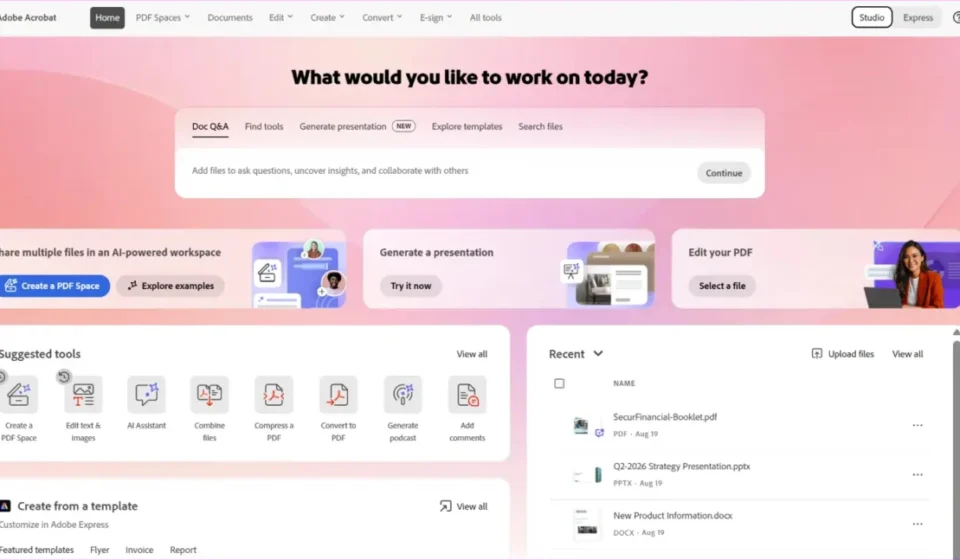

In a significant strategic pivot that signals the end of the "static document" era, Adobe is aggressively repositioning its iconic Acrobat platform. Once defined primarily by its role in viewing and editing PDFs, Acrobat is undergoing a metamorphosis into an AI-powered document intelligence and creativity hub. This shift, underscored by a suite of new generative AI capabilities, aims to transform how businesses interact with their vast, often dormant repositories of institutional knowledge.
The latest updates to the Adobe Document Cloud ecosystem introduce tools designed not just to read files, but to interpret, summarize, and extract actionable data from them. By integrating advanced generative AI into the workflows of finance, procurement, and legal departments, Adobe is attempting to bridge the gap between unstructured document storage and structured enterprise data management.
The New AI Toolkit: Visuals, Audio, and Automation
Adobe’s latest release focuses on three primary pillars of productivity: visual transformation, multi-modal synthesis, and deep data extraction.
1. Generative Visuals and Slides
Acrobat’s AI Assistant can now synthesize dense, text-heavy PDFs into interactive, visual formats. Users can prompt the AI to analyze a report and generate corresponding presentation slides, charts, and infographics. The tool interprets user intent, allowing for the creation of navigation-friendly, professional-grade visual documents that turn static data into compelling narratives.
2. Audio Summarization
In a move that mirrors the functionality of Google’s NotebookLLM and Microsoft’s Copilot Notebook, Adobe has introduced audio generation features. Users can now convert lengthy documents or web-based research into podcast-style audio summaries. This feature caters to the modern "on-the-go" professional, providing an alternative, auditory way to digest complex information.
3. Professional "Stylization"
Beyond content generation, Adobe is addressing the aesthetic quality of corporate output. The new "Stylize" feature uses AI templates to automatically enhance plain-looking documents—such as invoices, whitepapers, or resumes—transforming them into polished, professional deliverables without requiring advanced design skills.
Chronology: The Path to AI-Integrated Documentation
The evolution of Adobe Acrobat from a file format utility to an AI platform did not happen overnight. The transition reflects a broader industry trend toward "intelligent documents."
- Early 2024: Adobe formally introduces the "AI Assistant" for Acrobat, marking the initial move toward conversational search within PDFs.
- Mid-2024: Integration with collaborative platforms like Microsoft Teams and Slack begins to take shape, allowing users to query documents without leaving their primary workspace.
- Late 2024/Early 2025: Adobe expands its AI footprint to include cross-platform knowledge management, connecting SharePoint and Google Drive to the Acrobat ecosystem.
- Current Quarter: The rollout of the "Analyzer" and "Knowledge Base" tools officially marks the move from simple document search to enterprise-grade data extraction.
Supporting Data and Technical Architecture
The new capabilities are segmented into specific tiers of the Adobe ecosystem, primarily targeting the enterprise sector:
- Acrobat Knowledge Base: This feature allows for the indexing of vast document collections. By integrating with SharePoint and Google Drive, it allows employees to ask questions about policies, product roadmaps, or pricing, with the AI providing "cited answers" that link back to the source material.
- The Analyzer Tool: Designed for high-volume tasks, Analyzer is the most technically sophisticated addition. It is built to parse thousands of files—such as contracts or invoices—to identify specific variables like renewal dates, liability clauses, or revenue figures.
The Credit-Based Economy
A significant aspect of these new tools is the "shared credit" model. Usage is not unlimited; instead, Adobe has implemented a system that assigns different "costs" to different actions. For example, simple document uploads consume fewer credits than complex queries across Slack or Teams. While Adobe has not disclosed the exact cost of "top-up" credits, the model forces organizations to carefully manage their internal AI usage.
Official Responses and Strategic Vision
Abhigyan Modi, Senior Vice President for Adobe Document Cloud, emphasized that the goal is to liberate data that has historically been trapped in siloed files.
"Knowledge Base transforms curated document collections—policies, playbooks, product information, pricing guidance, research—into cited answers available from Slack, Microsoft Teams, Acrobat, and other places employees already work," Modi stated in an official company blog post.
By making this information accessible in the flow of work, Adobe aims to reduce the "context switching" that plagues modern corporate environments, where employees spend hours searching for information across fragmented digital storage systems.

Industry Implications: A Shift in Budgetary Priorities
The introduction of these tools has drawn sharp analysis from industry experts. Mike Leone, Vice President and Principal Analyst at Moor Insights & Strategy, offers a nuanced take on the distinction between "search" and "extraction."
"Knowledge Base is a search product, and search products get judged feature against feature," Leone noted. "Analyzer is closer to a data product, because that extraction work is what companies currently pay people and pipelines to do."
The "Data Gravity" Problem
Leone highlights a critical question for enterprise adoption: Where does the data go? If the insights extracted by Adobe’s Analyzer remain trapped within the Acrobat ecosystem, their utility is limited. If, however, Adobe allows this data to be exported to centralized data warehouses or ERP systems, it could represent a major shift in how companies allocate their IT budgets.
"If it can leave Acrobat and land where the rest of the company’s data lives, this starts competing for a real data budget," Leone explained. "If it stays inside the app, it’s a very good Acrobat feature."
Challenges and Enterprise Risks
While the promise of AI-driven efficiency is high, the deployment of these tools brings significant management challenges for enterprise IT leaders.
1. The Headcount Fallacy
A recurring issue with usage-based enterprise software is that headcount is a poor predictor of actual consumption. In an organization, a small legal or procurement team might perform high-intensity document analysis that dwarfs the usage of a thousand general employees.
"One person pointing it at 10,000 contracts will burn more credits than a hundred people asking the occasional question," Leone observed. Pooling credits is an essential strategy, but it requires diligent monitoring to prevent a few "power users" from depleting the organization’s quota, leaving other departments without access to the tool.
2. The Rationing Risk
Adobe’s credit system creates a psychological barrier to adoption. If employees do not understand the cost of a query, they may begin to "ration" their usage, fearing they might exceed their department’s allowance. This fear of overconsumption can lead to underutilization—a scenario where a company pays for a high-end enterprise tool that employees are too hesitant to use.
"The last thing any organization wants is to pay for a knowledge tool that people won’t use or can’t use," says Leone.
The Future of the Document Lifecycle
Adobe’s aggressive expansion into AI signals that the PDF is no longer just a digital substitute for paper; it is now a digital container for dynamic, queryable information. By automating the extraction of data from thousands of files, Adobe is positioning itself to be a central layer in the enterprise data stack.
However, the success of this strategy will depend on three factors:
- Integration: How seamlessly can this data flow into the rest of the enterprise tech stack?
- Transparency: Can Adobe demystify its credit-based pricing model to ensure widespread, confident adoption?
- Accuracy: As organizations rely on these tools for compliance and financial extraction, the margin for error remains razor-thin.
As Adobe continues to iterate, the line between "document management" and "data science" will continue to blur. For the enterprise, the transition promises a future where documents work for the business, rather than the business working for the documents. Whether Adobe can successfully navigate the complexities of enterprise pricing and technical integration will determine if it remains a staple of the office suite or evolves into a critical engine of corporate intelligence.